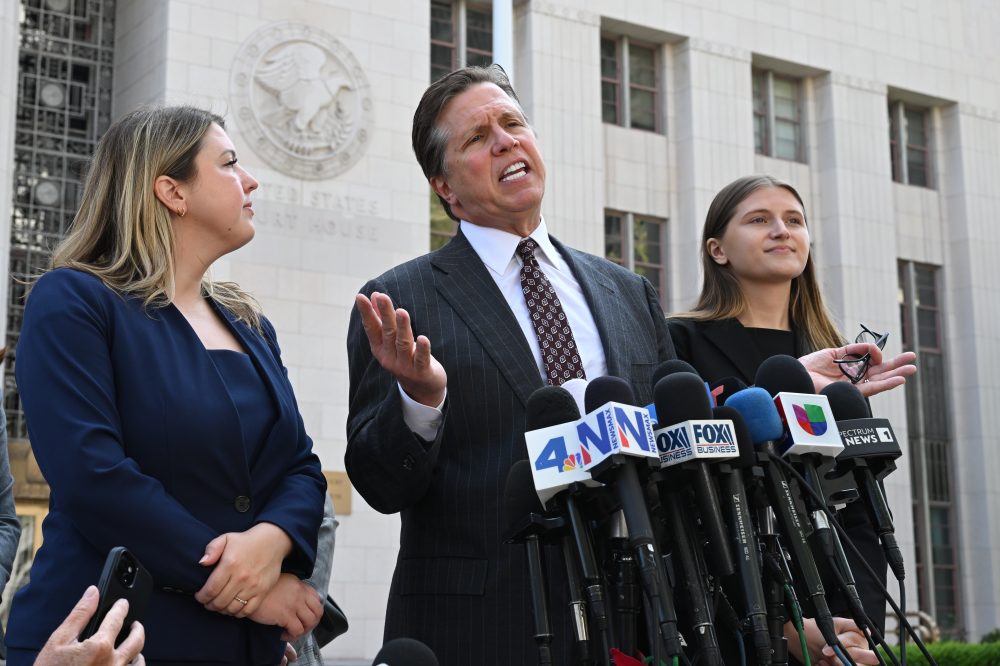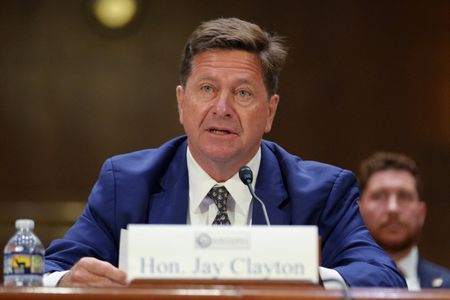

WASHINGTON — President Trump’s nominee to serve as the country’s top intelligence official, Jay Clayton, refused Wednesday to plainly acknowledge that Trump lost the 2020 presidential election to Democrat Joe Biden, even as Democratic senators pushed him repeatedly on the question during his Senate confirmation hearing.
Democratic Senator Mark Kelly of Arizona challenged Clayton directly, pointing out that Trump was not present at the hearing. “Trump isn’t in the room today,” Kelly told Clayton. “If you can’t disagree with him when he’s not in the room, are you going to be able to disagree with him when you’re sitting across from him?”
Clayton’s only concession was that Biden had been “certified” as president, while insisting, “I am not an election denier.”
When Kelly pressed him further — asking whether the winner of an election is the person certified by Congress who received the most electoral votes — Clayton responded: “I think that’s your characterization. I’m really, I’m not going to continue.”
The exchange escalated into shouting at points during the Senate Intelligence Committee hearing, where Clayton is being considered to serve as director of national intelligence, the president’s chief intelligence adviser and overseer of the 18-agency U.S. intelligence community.
The hearing comes as the Trump administration, fueled by the president’s claims that U.S. elections are “rigged” and his ongoing refusal to accept his 2020 loss, has been pushing for greater federal control over elections. Legal experts have warned such efforts would strip power from states in a way that conflicts with the U.S. Constitution.
On Thursday night, Trump is scheduled to deliver a national address focused on newly declassified intelligence related to U.S. elections and what the White House describes as vulnerabilities in voting machines.
Senators also grilled Clayton about subpoenas he issued Friday in his current role as the U.S. Attorney for Manhattan. Those subpoenas ordered journalists from the New York Times to testify before a federal grand jury following the newspaper’s reporting on security concerns related to Trump’s new Qatari-donated Air Force One.
The Times characterized the move as “an extraordinary escalation” in the administration’s efforts to pressure journalists — a description echoed by several senators. The Justice Department, however, maintained the subpoenas were aimed at officials leaking sensitive information, not at the journalists themselves.
Clayton defended the subpoenas, saying they were “in connection with an ongoing national security investigation” and were issued through a “consultative process” involving career prosecutors in his office. “I’m absolutely committed to and respect our First Amendment and the role of the press,” he said, while declining to go into further detail about the case.
Senator Mark Warner of Virginia, the committee’s top Democrat, urged Clayton to avoid what Warner described as “repeated attempts” to politicize intelligence — a pattern he attributed to Clayton’s predecessors in the acting DNI role.
Warner also raised concerns about how the current acting DNI, Bill Pulte — who has held the position for only three weeks and lacks national security and intelligence experience — would handle the declassification of sensitive election-related intelligence for Thursday’s presidential address. “I just don’t understand how Mr. Pulte … can end up figuring out what is appropriate or not appropriate (to declassify) since he’s been in the job for only three weeks,” Warner said.
Pulte, a close Trump ally who also serves as Federal Housing Finance Agency director, took over the acting DNI role after Tulsi Gabbard departed the position in June. Since taking over, Pulte has announced multiple rounds of staff cuts, as some Republicans have called for the Office of the Director of National Intelligence to be eliminated entirely.
Clayton pushed back on that idea, saying there is a need for a “focal point for coordination across the other 17 intelligence agencies,” though he acknowledged the office should “probably pull back” from operational involvement and functions already handled by other agencies.
Clayton said he was not involved in preparations for Trump’s Thursday night speech.
While Clayton does not have deep traditional intelligence agency experience, he pointed to national security work during his time leading the Securities and Exchange Commission and his current role as Manhattan U.S. Attorney, where he has been overseeing the prosecution of deposed Venezuelan President Nicolas Maduro.
Wednesday’s hearing was Clayton’s second before the intelligence panel. Trump last month abruptly ordered the postponement of his first hearing in an effort to pressure Congress into passing a package of election restrictions known as the SAVE America Act. That legislation remains stalled, lacking enough Senate votes to advance. Voting rights organizations argue the measure would strip voting access from millions of Americans who lack ready access to passports and birth certificates.
Senator Tom Cotton of Arkansas, the committee’s Republican chairman, said he plans to hold a vote on Clayton’s nomination early next week and then send it to the full Senate for consideration.