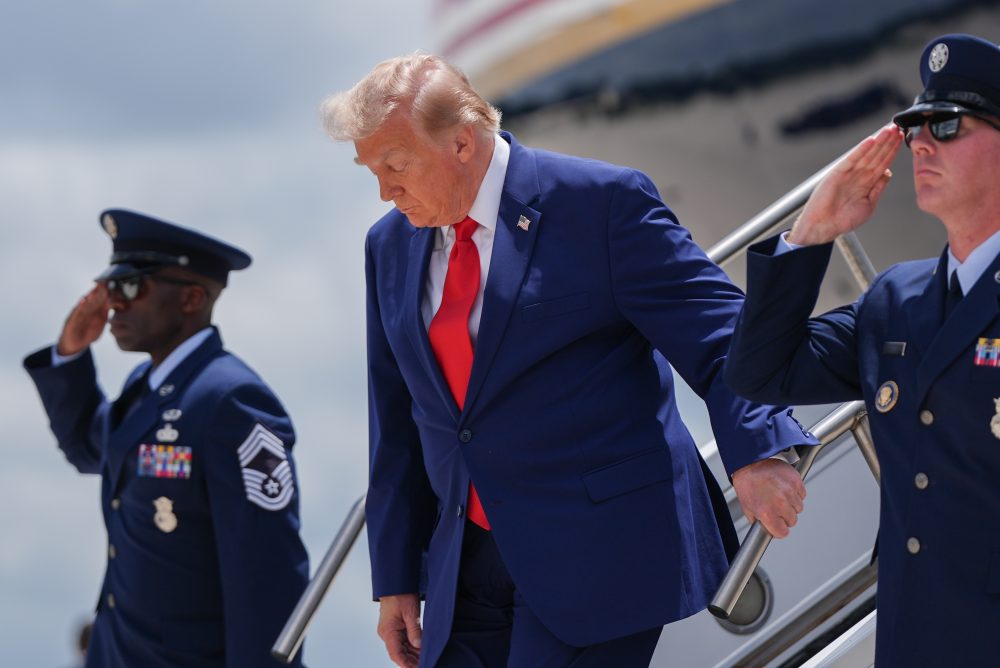

President Trump announced Thursday that a civilian nuclear agreement being finalized with Saudi Arabia comes with a key condition — the kingdom must normalize its relationship with Israel through the Abraham Accords. In a social media post, Trump stated the deal would not permit uranium enrichment. However, experts in nuclear nonproliferation have voiced concern that the agreement lacks sufficient safeguards to stop uranium from being enriched to levels used in weapons.
Trump wrote that the agreement “will be approved, but is totally subject to Saudi Arabia joining the very respected and successful Abraham Accords.” He also noted that “The United States is not opposed to Civil (Non-Enriched) Nuclear Facilities.” The 2020 Abraham Accords expanded the number of Arab nations maintaining formal diplomatic ties with Israel, and Trump has made growing that list a priority.
Meanwhile, two shootings involving Immigration and Customs Enforcement officers — one in Maine and one in Houston — have sparked sharp criticism over a perceived lack of accountability within the agency. The incidents occurred within a single week of each other. At least 10 people have died in confrontations with immigration agents since Trump restarted his immigration enforcement crackdown after returning to office. In the Maine case, relatives of the ICE officer who fired the weapon say he had a documented history of violent behavior and should never have been issued a badge or firearm.
Democratic members of the House Homeland Security Committee revealed after a closed-door briefing with ICE officials Wednesday that only one ICE officer has been referred for disciplinary action over a use-of-force incident since the start of the Trump administration. The briefing covered topics including body cameras, vehicle stops, and officer training.
On another front, a prominent Republican lawmaker says he believes former special counsel Jack Smith may have lied to Congress during testimony about his investigation of Trump and the Justice Department. Rep. Jim Jordan of Ohio, who chairs the House Judiciary Committee, sent a referral to the Justice Department on Wednesday alleging Smith made false statements during closed-door testimony. The testimony centered on whether Smith had obtained phone toll records belonging to Republican lawmakers as part of the probe into Trump’s efforts to challenge his 2020 election defeat. Attorneys for Smith deny the allegations, saying he testified truthfully.
The referral focuses on a December 2025 exchange in which Smith was questioned about subpoenas prosecutors issued for the toll records of certain Republican lawmakers. Toll records capture the time, date, duration, and phone numbers involved in calls — but not the actual content of conversations.
President Trump also issued a stern warning to Yemen’s Houthi rebels Thursday, saying he is “very disappointed” in the group and threatening “major military punishment” if their attacks on ships do not stop. In a social media post, Trump warned that “if they do this again, the U.S. will hold Iran responsible” and said both Iran and the Houthis would face serious consequences. Trump said the Houthis had previously been behaving “very responsibly” following earlier U.S. military strikes, but added: “Unfortunately, now they are starting up again, shooting at two Saudi Arabian ships last night.”
On the Iran front, Secretary of State Marco Rubio, speaking to reporters while traveling in the Philippines, said the price for Iran’s actions “will continue to get higher every single night until they come to their senses.” He said Iran is “begging” for a deal but that Trump “doesn’t see a lot of utility in responding to their overtures at this point, because, frankly, Iran is clearly not ready to make a deal, at least not one they’re willing to live by.” Trump had previously warned that the U.S. would destroy an Iranian bridge or power plant each time Iran fires on a ship in the Strait of Hormuz. Iran’s foreign minister responded by invoking an “eye for an eye” doctrine. Rubio countered: “The president’s policy is a head for an eye. They will pay a very heavy price for the things they’re doing.”
Rubio also addressed the situation in Venezuela, saying there is a place for exiled opposition leader María Corina Machado in a future Venezuelan government if the people choose that path. He noted that significant work remains to establish conditions for a legitimate election following the U.S. action that removed leader Nicolás Maduro in January. “There’s a lot of change to happen,” Rubio said, adding that the process “requires patience, persistence.” He said the U.S. is “there to facilitate it, not to dictate it.”
Regarding Ukraine, Rubio acknowledged there is no fast route to ending the conflict, calling past diplomatic efforts “unsuccessful or at least unfruitful.” After meeting with his Russian counterpart in Manila, Rubio said Trump remains committed to finding a resolution “if conditions and factors have changed to make that possible.” He added: “That’s been the challenge — an end that both sides can accept. And we’ve tried and we’ll continue to try to see if we can find a middle ground that brings this about.”
On the budget front, the House passed a Republican-only $95 billion spending proposal Wednesday in a narrow 216-214 vote, with two Republicans and one independent siding with Democrats in opposition. The plan is aimed at funding the Iran war and other White House priorities. Conservative Republicans expressed reservations because the proposal includes no offsetting budget cuts. Democrats argued the funds should instead be directed toward reducing costs for American families. Congress remains at an impasse over the U.S. military campaign against Iran, having neither authorized the use of force nor found a way to halt the strikes.