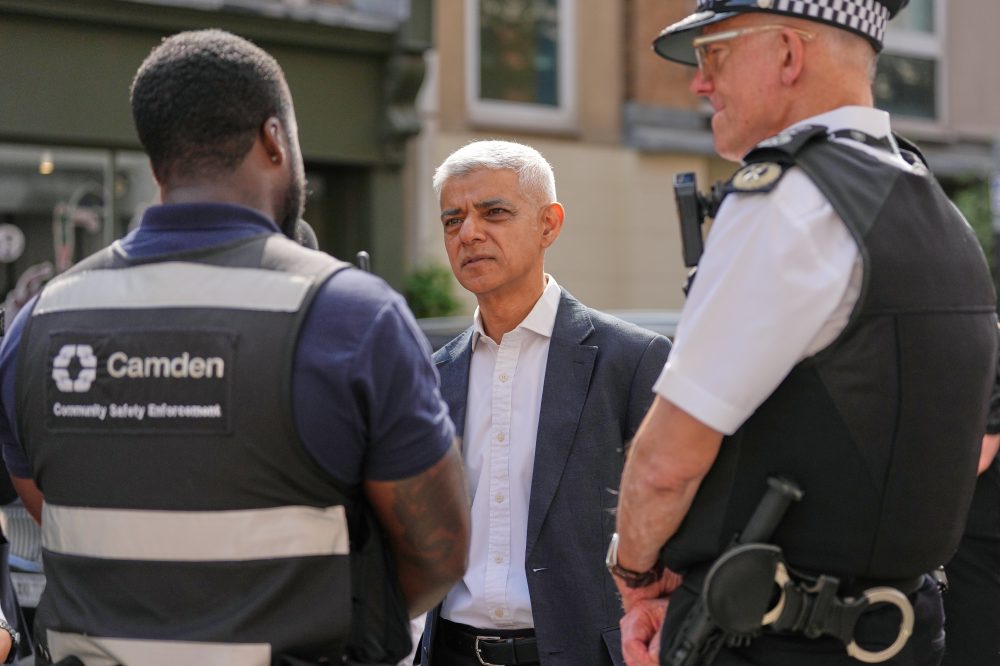

LONDON (AP) — London’s top elected official and the city’s police chief stepped forward Thursday to counter a growing wave of online claims that Britain’s capital has become unsafe, pointing to newly released data showing a notable decline in street crime.
The Metropolitan Police reported that what it classifies as “neighborhood crime” — a category covering phone theft, pickpocketing, home burglaries, and vehicle-related offenses — dropped 14% in the year ending in June. In Westminster, the borough that includes Parliament, Soho, and Leicester Square, those crimes fell by more than a third. Neighboring Camden, another area popular with visitors, saw a 25% reduction.
Despite those numbers, Mayor Sadiq Khan noted that over the past two years, social media has seen a 200% surge in posts claiming London is in “decline” or is dangerous. Those narratives have spread widely online and have been amplified by right-leaning political figures, frequently alongside anti-immigrant and anti-Muslim rhetoric.
Khan attributes the phenomenon to an online “outrage economy” that profits from spreading negativity. As London’s first Muslim mayor — a position he has held since 2016 — he has personally been a target of that hostility, including insults from X owner Elon Musk and U.S. President Donald Trump, who has referred to him as a “stone-cold loser” and a “terrible, terrible mayor.”
“We know there are bot farms making money from negative stories about London,” Khan told The Associated Press. “We know that there are state actors in Russia and China and MAGA-backed influencers in the USA who want to do London down. Why? Because we’re liberal, we’re progressive, we are multicultural and we’re incredibly successful.”
He also called for government action if social media platforms fail to address the problem. “If the social media companies don’t sort themselves out, I think there’s got to be regulation,” he said.
Violent crime has been trending downward in London, mirroring patterns seen in other major cities across Europe and North America. Police recorded 97 homicides in the city so far in 2025 — the lowest figure since 2014 and a lower rate per capita than Paris, Berlin, or New York.
Still, Khan acknowledged the full picture is more complicated. He expressed concern over rising hate crimes directed at Muslim and Jewish communities, a trend he linked in part to ongoing conflicts in the Middle East.
“We’ve got to make sure we give these communities the confidence to report these crimes,” he said. “We’ve also got to be sure we support them to make their places of worship safer, so nobody’s scared to practice their faith.”
Everyday offenses continue to frustrate many residents. Phone snatching, shoplifting, and subway fare evasion remain common complaints among Londoners, many of whom have personal experience with such crimes.
Police said Thursday’s statistics reflect the impact of a multi-pronged strategy combining high-visibility patrols in crime-prone areas, intelligence-driven operations targeting repeat offenders, and the use of technology.
Metropolitan Police chief Mark Rowley specifically highlighted the department’s use of facial recognition technology, calling the approach “innovative and creative” — though he acknowledged it remains controversial.
“There’s classic police work, officers on the streets, supported by the best of 21st century technology that’s making a difference,” Rowley said.
Rowley took over as Metropolitan Police commissioner in 2022, inheriting a department working to rebuild public trust after a string of scandals and a scathing independent review that found the force plagued by sexism, homophobia, and institutional racism. The department has also faced accusations from the political right of practicing “two-tier” policing that allegedly disadvantages white people.
Rowley pushed back on those characterizations, saying “the entire community can have faith in the Met.”
“We’re routinely invited to join either side of the culture wars. We’re politely declining those invites,” he said. “We operate under the law without fear or favor. We’re here to protect every citizen and we do that with equal vigor.”
Among those visiting the city, reactions to the safety question were mixed. Julianne Sweeten, a 21-year-old university student from Chesapeake, Virginia who is studying abroad in London, said the city “feels a lot safer than the U.S.” She noted there is “very little threat of gun violence” and said her earlier concerns about phone theft have not materialized.
Longtime Londoner Vicky Hawkins, 78, an artist who has spent her entire life in the city, said crime feels “about the same” as it always has. “I know people feel more unsafe, I think, these days. But I don’t,” she said. “But I know not to push my luck.”