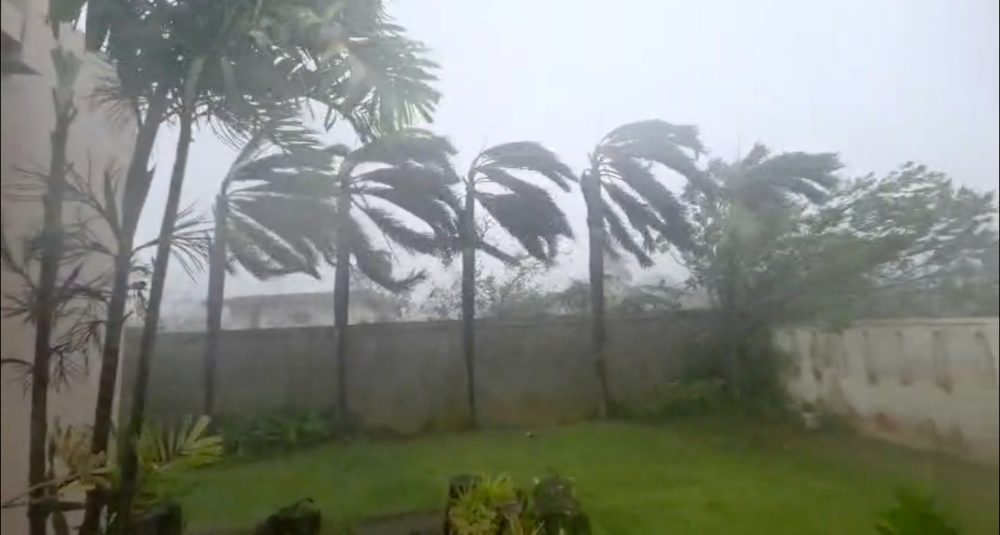

Residents of remote U.S. Pacific territories are battening down as Super Typhoon Sinlaku unleashes devastating winds and torrential rains, causing structures to crumble and debris to become deadly projectiles.
“It’s hitting us hard,” said Mayor Ramon “RB” Jose Blas Camacho of Saipan during the nighttime assault. “It’s so difficult for us to respond with this heavy rain, heavy wind to rescue people. Objects are just flying left and right.”
Camacho reported that rescue operations have saved some residents, while trees are being hurled through the air and wooden and metal structures are collapsing. Even his office is under threat as the glass door flexes under the storm’s power.
“It’s already bending. That’s how powerful this is,” he explained.
The monster storm is crawling toward Saipan, the main island in the Northern Mariana chain, at just 3 mph. Weather officials warn conditions will deteriorate further through the night.
According to the Navy’s Joint Typhoon Warning Center in Guam, Sinlaku has intensified to 150 mph winds. Forecasters say the storm will make landfall “imminently” near Tinian, located roughly 6 miles from Saipan, or the uninhabited Aguijan island.
The typhoon’s sluggish pace has officials particularly worried.
“That’s the scary part,” Camacho noted, adding “it’s better to speed up so it can just exit.”
To the south, Guam – a U.S. territory housing multiple American military bases and approximately 170,000 people – is experiencing “torrential rainfall” and “ongoing flash flooding,” weather officials reported. “We ask that everyone remain indoors and away from windows.”
National Weather Service meteorologist Landon Aydlett in Guam characterized the typhoon as moving at “a very slow gradual crawl” Tuesday evening.
“The slow motion means destructive winds in excess of 150 miles an hour will be prolonged once they arrive” at Tinian and Saipan, Aydlett warned.
“This is an extremely dangerous and life-threatening situation,” he emphasized.
Dangerous flash flooding is forecast to persist across both islands through Wednesday. Approximately 50,000 people inhabit three islands in the region, with Saipan hosting the largest population and serving as the capital, famous for its relaxed resorts, diving opportunities, and golf courses.
Despite predictions that Sinlaku will weaken somewhat in coming days, it’s expected to pass through the islands as a Category 4 or 5 typhoon.
Saipan holds historical significance as the location of one of the Pacific Theater’s most devastating World War II battles, claiming over 50,000 Japanese and American military personnel and civilian lives.
On Guam, where Typhoon Mawar caused extended power outages in 2023, U.S. military commanders have instructed personnel to prepare for the storm and remain sheltered. Military installations occupy roughly one-third of this strategically important Pacific hub.
Prior to targeting Guam and the Northern Marianas, the storm caused substantial destruction across Chuuk’s outer islands and atolls in the Federated States of Micronesia, meteorologist Landon Aydlett confirmed.
Glen Hunter, a Saipan native experienced with typhoons, described the situation after awakening to powerful gusts and fallen trees.
“We sit in what they call ‘Typhoon Alley,’” he said early Tuesday.
Hunter explained that most islanders live in solid concrete homes, while those in weaker wooden structures with metal roofing typically stay with relatives or in government shelters during storms.
Tourism-reliant Saipan was still rebuilding from 2018’s Super Typhoon Yutu when the COVID-19 pandemic struck in 2020, Hunter remembered. The local economy remains struggling, he noted.
President Donald Trump authorized emergency disaster declarations for Guam and the Northern Mariana Islands on Saturday, enabling additional emergency assistance.
The Federal Emergency Management Agency announced it’s organizing multi-agency support, deploying almost 100 FEMA personnel along with staff from the Environmental Protection Agency, Department of Transportation, and U.S. Army Corps of Engineers.
Super typhoons represent the most powerful tropical cyclones that develop in the northwestern Pacific Ocean, Earth’s breeding ground for the most severe storms.
Tracked by Guam’s Joint Typhoon Warning Center, super typhoons match Category 4 or 5 Atlantic hurricanes in intensity, featuring winds of at least 150 mph. More than 300 super typhoons have been documented since the warning center began using this classification nearly 80 years ago.