
LIMA, Peru — Peru is heading toward a June presidential runoff election after Sunday’s chaotic voting failed to produce a clear winner among 35 candidates, with ballot counting still underway following significant logistical problems.
Election officials have been tallying votes for three consecutive days after widespread ballot delivery failures forced them to extend the voting period through Monday.
Current results from Peru’s National Office of Electoral Processes show two conservative candidates at the front of what represents the largest presidential field in the South American nation’s history, with 72% of votes counted as of Tuesday.
Leading the race is Keiko Fujimori, whose father is a former president now in disgrace, capturing 16.92% of the vote. Following her is Rafael López Aliaga, an ultra-conservative who previously served as Lima’s mayor, with 12.95% support.
Since no candidate achieved the required 50% threshold for an outright win, the top two vote-getters will compete in a runoff scheduled for June 7. Whoever emerges victorious will become Peru’s ninth president within a decade.
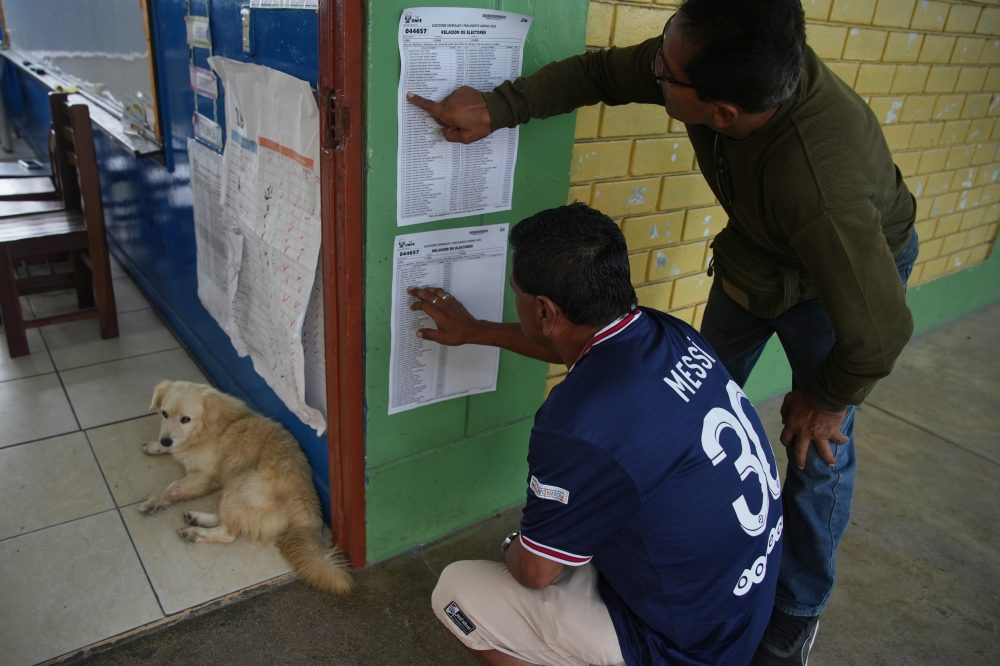
The voting process was severely disrupted by organizational failures that prevented thousands of citizens both domestically and internationally from casting their ballots. These problems led officials to permit over 52,000 Lima residents to vote on Monday. The voting extension, declared after Sunday evening’s count had already begun, also applied to Peruvian voters registered in Orlando, Florida, and Paterson, New Jersey.
“I’m fed up,” said Iris Valle, 56, while waiting in line Monday at a Lima public school polling site. She expressed concern about potential pay cuts from her employer due to arriving late to work while fulfilling her voting duty.
Peruvian law requires all citizens between 18 and 70 years old to vote, with penalties reaching $32 for those who fail to participate.
The election occurred during a period of escalating violent crime and corruption that has created widespread voter dissatisfaction, with many citizens viewing the candidates as dishonest and ill-equipped for presidential duties.
Despite the crime wave and political turmoil caused by a constant rotation of presidents — including three since October alone — Peru’s economy has shown resilience. The nation, benefiting from its position as a major global copper producer, achieved growth exceeding 3% in both 2024 and 2025, though this falls short of the 5%-6% annual expansion seen during the 2000s.
Will Freeman, a Latin American Studies fellow at the Council on Foreign Relations, noted that the central bank’s independence has been crucial to maintaining economic stability.
“Although Peru has had all these presidents, it has had only one central bank president since the mid-2000s, Julio Velarde,” Freeman explained. “He’s been a real source of stability and given investors some confidence that there is an institutional core that remains from one presidency to the next in Peru.”
However, Freeman cautioned against overconfidence, noting that current growth rates lag behind the robust performance of the 2000s and recent Congressional actions suggest “a more conservative economic populism.”
Fujimori, making her fourth presidential attempt, has pledged aggressive anti-crime measures while simultaneously supporting legislation that experts argue hampers criminal prosecutions. Her party has backed recent laws eliminating preliminary detention in certain situations and increasing thresholds for confiscating criminal assets.
Her proposed reforms include anonymous judges for criminal proceedings and requiring prisoners to work for their meals.
López Aliaga’s platform includes constructing prisons in Peru’s Amazon territory, permitting judges to hide their identities, and deporting foreign nationals residing illegally in the country.
Voters also selected members of a two-chamber Congress for the first time in over three decades, following recent legislative changes that grant substantial authority to the newly created upper chamber.