
MONTORO, Spain — A Catholic brotherhood’s decision to ban women from participating in their Holy Week procession has sparked national outrage in Spain, where Easter celebrations represent some of the world’s most passionate religious traditions.
The controversial exclusion stands out as an anomaly among Catholic processions currently taking place throughout the country. These celebrations range from marathon events drawing tens of thousands of worshippers and visitors in major cities like Seville to smaller community gatherings that emphasize family connections and local customs.
Public anger erupted over the situation in Sagunto, where the Puríssima Sang de Nostre Senyor Jesucrist brotherhood’s majority membership voted to bar women, claiming their choice honored “respect for tradition.” The decision prompted both government criticism and street demonstrations.
Spain’s Holy Week processions represent elaborate ceremonies requiring months of preparation, reaching their climax during the early morning hours of Good Friday, considered one of Christianity’s most sacred days.
Religious brotherhoods coordinate groups that spend hours transporting massive floats featuring religious statues, sometimes as many as six depicting Gospel scenes of Jesus’ suffering and crucifixion, including Judas’ betrayal kiss at the Mount of Olives.
Female participants often serve as “portadoras,” bearing these floats upon their shoulders.
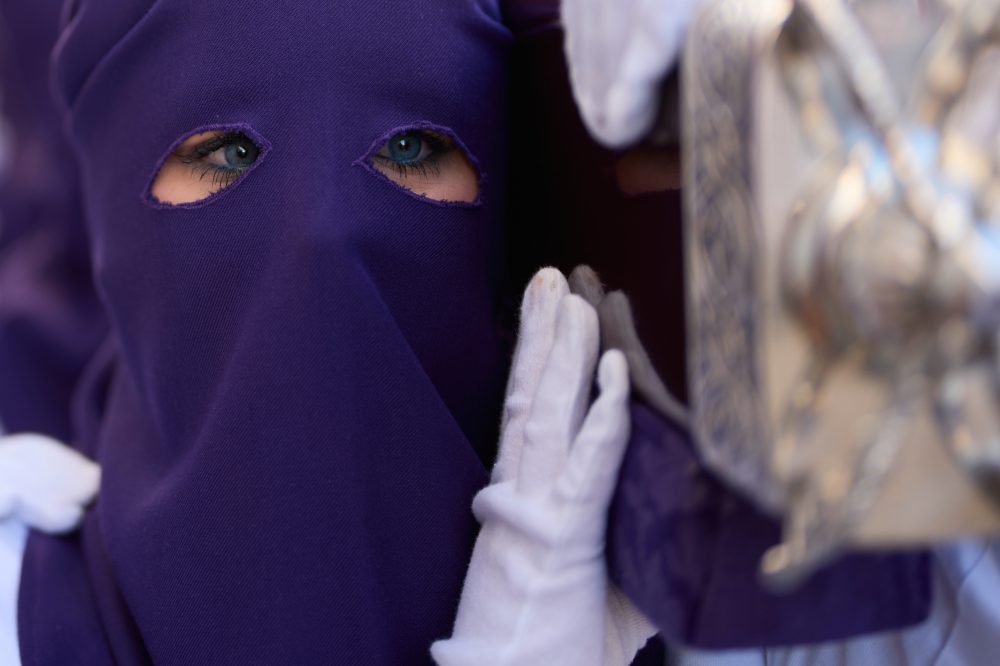
In Baena, a hillside community of white-painted houses nestled among Andalusia’s olive orchards, women with mascara-enhanced eyelashes were visible beneath purple hoods as they carried a flower-adorned float bearing a statue of Jesus in prayer.
In Montoro, another village within Córdoba province, a local brotherhood member argued that men and women deserve equal participation, particularly since the sacred figures in processions include both the Virgin Mary and Jesus.
“In my house I have three daughters, with my wife that’s four, and with me we’re five — and the whole family takes part,” explained Ricardo Ruano, who served as a “costalero” on Holy Thursday, one of the robed participants carrying large floats on their neck’s base. “We wait for this the whole year, because it’s our favorite.”
Multiple “portadoras” in Montoro expressed outrage over the Sagunto controversy.
“We as women have the same right as a man to go out in the procession,” declared Rosa de la Cruz. “We don’t go in a procession so that people look at us, we participate so that they see the image.”
Many villagers dedicated their Holy Week prayers to victims of a tragic train crash near a neighboring town that claimed nearly four dozen lives in January.
Despite Spain’s growing secularization alongside most of Europe, participation interest in processional roles continues expanding, according to Juan Carlos González Faraco, a University of Huelva professor. He has researched Andalusian religious customs, including the El Rocío pilgrimage concluding the Easter season.
While historically male-dominated, brotherhoods have welcomed women into both leadership positions and processional duties for decades, he noted. This particularly applies to lines of frequently hooded “penitents” who walk beside the floats, although some of the heaviest floats remain exclusively carried by men.
In Montoro, Mari Carmen Lopez acknowledged that physical capabilities might differ, but emphasized that men and women share identical emotions.
“We go with faith, with devotion, with all our hearts,” she stated as her brotherhood’s float traveled through the village’s sloping streets. Men who dismiss this reality, she added, “don’t realize they were born of a woman.”