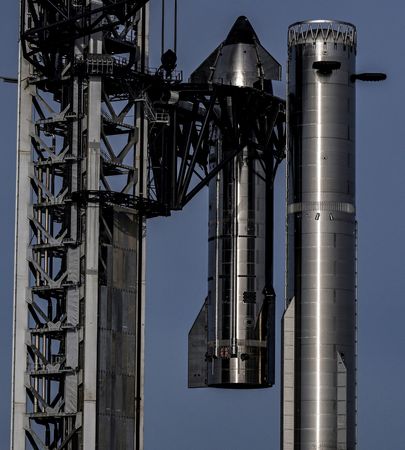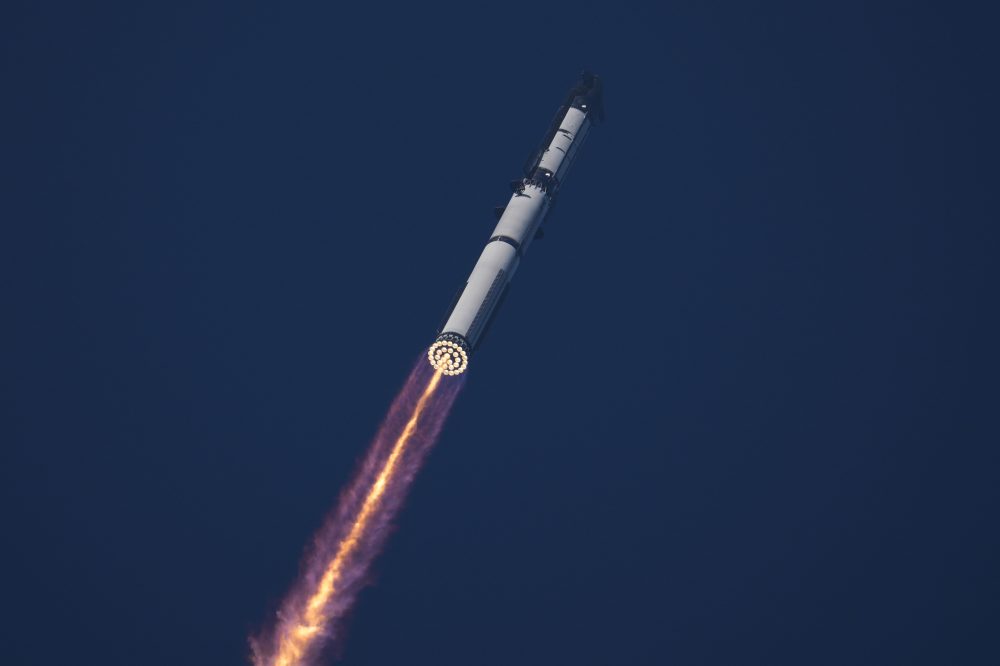

SpaceX’s enormous Starship rocket took to the skies Friday on its 13th test flight, traveling halfway around the globe with a payload of 20 of the company’s most advanced Starlink internet satellites on board.
Standing 407 feet tall — about 124 meters — the rocket lifted off from SpaceX’s launch facility at the southern tip of Texas. NASA kept a close eye on the mission, which represents a key milestone in the agency’s plans to use Starship as a lunar landing vehicle for future astronauts.
Prior to the launch, engineers replaced six of the 33 engines on the rocket’s first-stage booster. Those engines had failed to fire during a launch attempt the week before, forcing a last-second abort. A previous Starship test flight in May had also run into engine problems, which kept the booster from making a controlled descent back to Earth.
This was the second flight this year of the updated version known as V3. As with the previous V3 demonstration — which reached an altitude of up to 125 miles (200 kilometers) — neither the booster nor the spacecraft was recovered. Instead, both were intentionally dropped into the ocean. The booster splashed down in the Gulf of Mexico, while the stainless steel spacecraft came down in the Indian Ocean, more than 10,000 miles (16,000 kilometers) from the Texas launch site, wrapping up an approximately one-hour flight.
Before the spacecraft reentered the atmosphere over the Indian Ocean, the Starlink satellites had a brief window to operate on their own — no more than 20 minutes of solo flight time was expected.
After being released from Starship’s Pez-dispenser-style cargo bay, the satellites were set to unfurl their solar panels and antennas, then attempt to communicate using lasers with older Starlink satellites already circling the Earth. SpaceX currently operates more than 10,000 Starlinks, making it the operator of the world’s largest satellite network.
Six of the newly deployed satellites were fitted with cameras aimed at photographing Starship’s heat shield during the mission. The heat shield itself was outfitted with sensors designed to measure the intense forces the spacecraft endures at launch. While most of the shield’s thermal tiles were black, some were intentionally painted white to mimic missing tiles — part of a test to see how well the shield holds up under less-than-ideal conditions.
SpaceX is working to confirm that Starship’s heat shield can handle the intense heat of atmospheric reentry before the company attempts to bring the spacecraft back to its Texas launch pad. The company has already demonstrated the ability to catch a returning Starship booster using a pair of large mechanical arms at the facility. The same approach is planned for the spacecraft itself, which is designed to be fully reusable.
NASA is eager to see Starship complete its testing and achieve orbit in the near future. The agency needs the vehicle ready so the Artemis III crew — three Americans and one Italian astronaut — can practice docking their capsule with it ahead of a planned lunar mission next year.
Beyond moon missions, Starship is central to Elon Musk’s ambitions to establish a human settlement on Mars. Musk is already accepting bookings for tourist trips to both Mars and the moon.
The most recent test flight faced two delays — first from the July 16 launch abort, and then again on Thursday when thick cloud cover from Tropical Storm Bertha kept the rocket grounded.