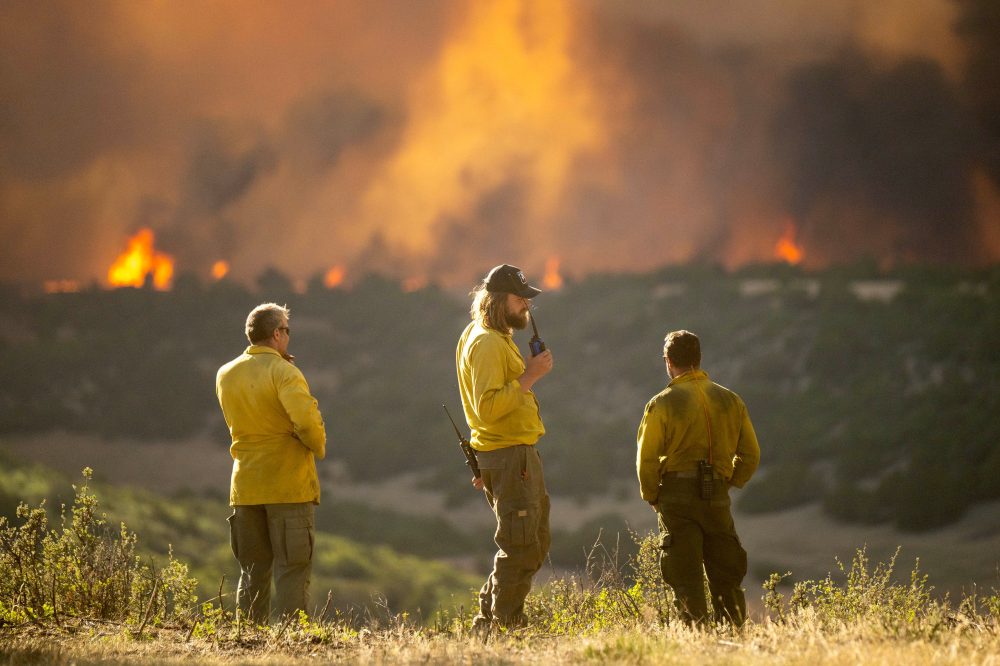

ALBUQUERQUE, N.M. — This has already proven to be a deadly year for those battling wildfires, and officials are working overtime to position resources where they can strike quickly before flames grow into catastrophic events that claim lives and destroy homes.
Fire managers face the constant challenge of anticipating where nature will strike next, deploying thousands of firefighters, hundreds of engines, fleets of bulldozers, helicopters, and air tankers to wherever they can have the greatest impact.
This season, those managers are contending with stubborn drought conditions worsened by historically low snowpack levels, along with stretches of hot, dry, and windy weather that have created ideal conditions for fire. Hundreds of homes have already been destroyed. Three firefighters lost their lives fighting fires in Colorado, and most recently, a helicopter assisting with a separate Colorado fire went down in a reservoir, killing the pilot.
While the national wildfire preparedness level has not yet reached its highest tier, available resources are being stretched thin as new fires ignite on a daily basis.
“The U.S. Wildland Fire Service is prioritizing pre-positioning of crews, engines and aircraft in areas with the highest likelihood of wildfire activity,” the agency said in a statement to The Associated Press. “This allows for quicker initial attack when new wildfires ignite, which is often the most effective way to keep fires small.”
The National Interagency Fire Center — a coalition of federal and state agencies that supports wildfire response on the ground — rates national preparedness on a scale of one to five, based on fire activity, resource demand, weather, and ground conditions. By late June, a spike in fire activity led coordinators to raise the level to four and redirect more crews toward the most active fire zones.
Since the start of July alone, more than 2,000 fires have been confirmed by the national fire center. The surge of fire activity across the West has resulted in more experienced incident management teams being called into service, with some traveling from Alaska and California to assist with fires in the Great Basin region.
As of Monday, 16 of those teams were overseeing nearly 17,000 people working across more than a dozen states.
Preparedness levels typically climb in July and August, but fire managers are hoping they can continue balancing resources without hitting the maximum level.
Over the past decade, fire managers have reached the highest preparedness tier an average of 25 days per year, with the longest continuous stretch occurring in 2021, according to federal data. The earliest that top designation was ever reached was June 21, 2002.
The country has ten geographic area coordination centers that manage the movement of firefighters and equipment across the nation.
Mike Morgan, director of the Colorado Division of Fire Prevention and Control, acknowledged during an early July news conference that his state was receiving assistance from an Alaska-based team.
“Thank God that they have the ability to free those resources up,” he said. “So I think at the moment I would say I feel pretty good about where we’re at. But I’m very concerned about where we go.”
In Utah, additional crews were brought in to help battle the Babylon Fire, currently the largest active wildfire in the United States at 166 square miles — an area larger than the city of Seattle.
In total, more than 5,600 square miles have burned across the U.S. so far this year — a combined area larger than Yellowstone and Grand Canyon national parks — outpacing the ten-year average.
The latest forecast shows above-normal wildfire potential throughout July across a broad swath of the country, from the Four Corners region — where New Mexico, Arizona, Colorado, and Utah converge — northward through Oregon, Idaho, and Washington. Conditions are not expected to ease until September.
Christopher Dunn, an assistant professor of wildfire risk science at Oregon State University, said these forecasts guide decisions about where and how to deploy resources, which shift as the fire season progresses from one region to another.
In a particularly busy year, states must decide whether to release resources to assist other areas or push federal officials to hold crews in reserve for potential local emergencies — a dynamic Dunn described as hoarding resources.
“So there is sort of this delicate balance that has to be walked there, where you share, they share, everybody shares,” he said, “and everybody benefits from that sharing while not overextending your resources so much that you find yourself in a losing position.”
That sharing, however, comes at a cost to the firefighters themselves. Longer time in the field means more overtime and a greater risk of burnout.
“With all this sharing and all of this increase in fire everywhere, we’re just going to see increased pressure on them to work more and work harder and essentially burn out quicker,” Dunn said.
Each fire season renews the ongoing debate about public investment in a permanent wildland firefighting workforce and what can be done to keep the most experienced personnel from leaving the profession.
“More experience is critical when dealing with extreme conditions,” said Camille Stevens-Rumann, a former wildland firefighter and associate professor at Colorado State University.
Even with ample resources in place, there is little firefighters can do when conditions include multiple consecutive days of strong winds, low humidity, and high temperatures. Stevens-Rumann said that is precisely why strategic pre-positioning of resources matters so much.
“They can be available for when those conditions die down, like in the evening,” she said. “But when we have day after day of red flag warnings and high winds, it’s really hard to control a fire.”
Despite her background as both a firefighter and a wildfire researcher, Stevens-Rumann said seeing fires close to her own home is a different experience entirely.
“There’s no denying it. It’s easy to disassociate that when you’re on a fire crew and you’re arriving to a place that you don’t have a connection to per se to fight a fire. You know, you’re there to do a job,” she said, “but when you see it in your own backyard, it’s definitely a totally different experience.”
This year, firefighters have been directed to aggressively attack every fire as fast as possible to prevent it from spreading — a shift away from a decades-long practice of allowing some fires to burn naturally in order to clear brush and dead vegetation that could fuel future blazes. Stevens-Rumann noted concerns about what this approach means for firefighter safety and whether the work being done on the landscape is truly effective.
“It doesn’t do us any good to build miles and miles of line that just get burnt over, over and over again,” she said, adding that newer strategies are helping managers identify where to make a stand more effectively.
Early detection remains a critical tool in the fight. Despite once numbering in the thousands, there are now only about 350 fire lookout towers still standing in the U.S., many of them staffed by volunteers because of shrinking budgets, according to Michael Guerin, chairman of the Forest Fire Lookout Association.
These towers are not limited to the West. New Jersey opened a new one this year, and they are also in use in Pennsylvania, Maine, and other eastern states.
Recent fire activity has forced the evacuation of some lookout towers in Colorado. Meanwhile, Guerin and fellow volunteers in California are bracing for conditions to worsen when the Santa Ana winds arrive.
Help may also be on the way from space. Officials with the California Department of Forestry and Fire Protection announced in early July that the first satellites have been launched into orbit as part of a future space-based wildfire detection network.
For now, lookout volunteers rely on maps, compasses, and their knowledge of local landmarks to help pinpoint fires for initial attack crews. But their role does not end there, Guerin said.
“We then become the overwatch — the people that keep them safe while they’re doing the hard work on the ground.”