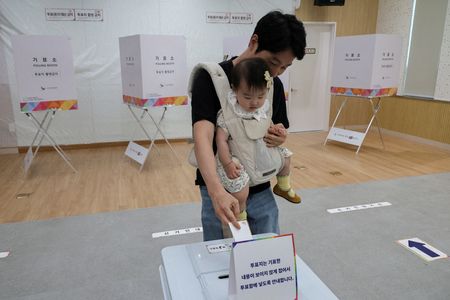

Government statistics released Wednesday reveal that South Korea’s fertility rate has climbed for the second year in a row during 2025, offering hope that the nation may be emerging from a prolonged demographic decline that has persisted for nearly ten years.
The Ministry of Data and Statistics reported that South Korea’s total fertility rate – representing the average number of children a woman is projected to bear throughout her childbearing years – reached 0.80 in 2025, an increase from 0.75 recorded in 2024.
The Asian nation experienced a resurgence in births beginning in 2024, driven by post-pandemic recovery and government initiatives, following eight straight years of declining birth rates that culminated in the globe’s lowest fertility rate of 0.72 in 2023.
Statistical data shows 5.0 births per 1,000 residents in 2025, compared to 4.7 in 2024. This figure exceeds China’s 5.6 rate from last year, Taiwan’s 4.6, and Japan’s 5.7 in 2024, where declining trends persist.
The recovery rate has surpassed the government’s optimistic projections of 0.75 for 2025 and 0.80 for 2026, with forecasts suggesting the total fertility rate could exceed 1.0 per woman by 2031.
Marriage statistics, which typically predict birth trends with a one to two-year delay, increased 8.1% in 2025 following a record 14.8% surge in 2024.
“The biggest part is that marriages are increasing a lot accumulatively,” ministry official Park Hyun-jung explained during a press conference. She highlighted growth in the population of people in their thirties – the typical age for marriage and childbearing – along with shifting social perspectives.
Seoul experienced the most dramatic increase in births, with the capital’s fertility rate reaching 0.63, representing an 8.9% jump from 0.58 in 2024, despite remaining the nation’s lowest rate.
Hallym University sociology professor Shin Kyung-ah cautioned that the figures require deeper analysis due to statistical factors like demographic composition shifts influencing the increase.
“Still, it is meaningful as an indicator suggesting positive changes, which will, at least indirectly, also help make people become more positive about having a baby,” Shin commented.
A government survey conducted every two years in 2024 found that 52.5% of South Koreans held favorable views toward marriage, rising from 50.1% in 2022. Citizens indicated their ideal family size averaged 1.89 children.
Birth numbers increased 6.8% to 254,457 last year, representing the largest percentage growth since 2007, while deaths climbed 1.3% to 363,389, causing the population to contract naturally for the sixth straight year.
President Lee Jae Myung’s administration intends to develop a comprehensive five-year demographic policy plan this year, addressing concerns about economic disruption from rapid population aging.
Officials also plan to expand existing childbirth support policies implemented in recent years and introduce programs to recruit skilled international workers as the domestic workforce shrinks.
The nation’s potential economic growth rate, currently estimated at approximately 2% annually, has dropped six percentage points over the past three decades – a steeper decline than most major economies – and could fall to 0.6% between 2045-2049, according to central bank projections.
Credit rating agencies have warned that South Korea’s government finances face pressure from increasing social welfare costs. The country’s public pension system, ranking third globally with $1 trillion in assets, is projected to become insolvent by 2071.
President Lee has advocated for regional collaboration on demographic challenges and proposed hosting the Asia-Pacific Economic Cooperation group’s inaugural population policy forum in South Korea this year during last year’s summit.
During January visits to China and Japan, Lee secured separate agreements with President Xi Jinping and Prime Minister Sanae Takaichi to pursue joint efforts addressing aging populations.
Government projections from 2022 indicate South Korea’s current population of 51.8 million could decrease by nearly one-third to 36.2 million by 2072.