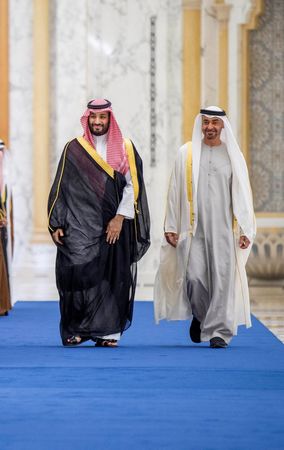

Senior officials from Saudi Arabia and the United Arab Emirates took to social media Tuesday in what appears to be a coordinated effort to publicly reaffirm their close ties, following a prolonged period of friction between the two powerful Gulf nations.
The posts appeared simultaneously on X at 7 p.m. Riyadh time and were shared by Saudi Minister of Media Salman Al-Dosary and Abdulla bin Mohammed Alhamed, who chairs the UAE National Media Authority.
Alhamed wrote that “Emirati-Saudi relations are an extension of a shared history and deep-rooted fraternal ties between two brotherly peoples, united by a single destiny.”
Al-Dosary echoed that sentiment, writing: “The relationship between the Kingdom and the Emirates is a relationship between two peoples united by a shared history and heritage, and wise leadership in both countries.”
Both officials also called on media outlets to reinforce those bonds rather than weaken them.
The public display of solidarity comes after years of growing disagreement between the two nations on issues ranging from oil production quotas to broader geopolitical matters. Those tensions became especially visible late last year when the two countries found themselves backing rival factions in the Yemen conflict. The situation escalated to the point where Saudi Arabia carried out an airstrike on what it described as a shipment of UAE military equipment destined for the Yemeni group that Abu Dhabi supported.
In the months that followed, pro-Saudi and pro-UAE voices on social media, along with various commentators and news organizations, engaged in unusually candid criticism of one another. In March, the UAE went so far as to block the X accounts of the Saudi television network Al-Arabiya.
Tensions also persisted during the Iran conflict, with the two Gulf neighbors frequently at odds over how to respond. In May, the UAE formally withdrew from OPEC, the oil producers’ organization that Saudi Arabia effectively leads.
Mohammed Baharoon, director-general of the Dubai Public Policy Research Center, offered perspective on the rift. “I think what we witnessed was a storm in a cup. We have seen worse before but it was never strategic,” he said. He added, “I am sure there has been adaptation from both parties but the reality remains that what we have in common far outweighs our divergences.”
The social media activity by senior media officials was preceded by another notable post. About an hour earlier, Turki Alalshikh — described as a close confidant of Saudi Crown Prince Mohammed bin Salman — shared a photograph on X that he said had been taken just days before. The image showed Saudi Defense Minister Khalid bin-Salman and UAE Vice President Sheikh Mansour bin Zayed Al Nahyan standing together with their arms around each other’s shoulders, both smiling.
Alalshikh captioned the photo: “Saudi Arabia and the UAE: a story of brotherly relations and a deeply rooted partnership.”
Responding to that post, Anwar Gargash, who serves as a diplomatic adviser to the UAE president, wrote: “Spears, when together, refuse to be broken… and break if they part.”
Gulf leaders have increasingly called for solidarity among the six-member Gulf Cooperation Council in recent weeks, citing threats from Iran and, more recently, warnings from the Iran-aligned Houthi movement targeting Red Sea shipping lanes. Saudi officials did not respond to questions about what prompted Tuesday’s coordinated posts.