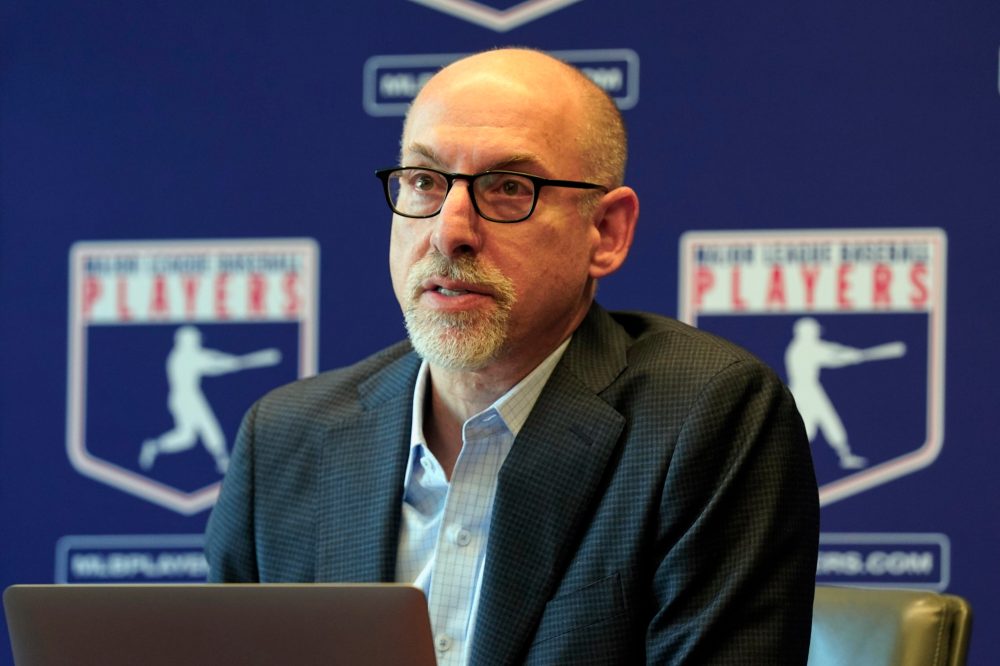

NEW YORK — Major League Baseball players are pushing back against management’s draft proposals, offering a counter-plan that would expand who can enter the amateur draft rather than restrict it — and the move is being seen as a clear sign that a labor battle is brewing this offseason.
During a two-hour negotiating session held Tuesday at MLB’s New York headquarters, the players’ union put forward a proposal that would make college sophomores eligible for the draft, in addition to players completing their junior years and high school seniors — the groups currently allowed under existing rules.
The union also called for moving the draft back to June, where it was held through 2020, and wants draft slot values to keep rising at the same rate as overall industry revenue through 2027, with no reductions allowed for the rest of any new agreement.
The current five-year labor deal between players and management expires December 1. A lockout by team owners is widely anticipated, which would freeze offseason trades and player signings and could put at risk spring training workouts scheduled to begin February 9, as well as opening day on March 24.
Back in May, MLB proposed a salary cap for the first time since players defeated a similar effort during a strike that lasted seven and a half months in 1994-95 — a work stoppage that resulted in the first World Series cancellation in 90 years. Players have vowed they will never agree to a salary cap.
Last month, MLB proposed eliminating draft eligibility for high school seniors and junior college players, arguing that college programs better prepare players for professional baseball. Management also proposed trimming the draft to just 12 rounds by 2027, down from the current 20.
The union’s proposal also calls for preserving players’ ability to negotiate contracts individually rather than being locked into fixed slot values, reducing penalties for teams that go over their signing bonus pools, allowing more draft picks to be traded, and keeping competitive balance round selections in place.
Under the players’ plan, revenue-sharing recipient teams not located in large markets would be eligible for a $2 million signing bonus pool increase during one draft between 2027 and 2031. Those same teams would also be allowed to sign two players drafted before the third round to major league contracts instead of minor league deals.
Revenue-sharing teams that reach the playoffs would receive an additional $1 million added to their signing bonus pool for the following draft.
Teams that go over their signing bonus pools by up to 15% would not lose a pick in the next draft — an increase from the current 5% threshold.
For players not selected in the first 10 rounds, the signing bonus pool exemption would jump from $150,000 to $1,000 above the slot value for the final 10th-round selection, which stood at $191,900 this year. For draft-and-follow players — those who return for an additional junior college season after being drafted — the maximum signing bonus would increase from $225,000 to $75,000 above that same 10th-round slot value.
The players said they would accept MLB’s idea of allowing draft picks to be traded during a roughly one-month window beginning in early November and again for the month before the draft.
Under the proposed trading rules, picks that are acquired could be passed along to another team, but no cash could be included in trades except to offset a player’s salary. Each team would be required to hold onto at least one first-round pick over any two-year span, and no team could acquire more than three additional picks within the first three rounds. Newly drafted players could not be traded for 90 days after signing or until the day after the World Series ends, whichever comes later. The union proposed limiting tradable picks to those in the first 10 rounds only.
MLB has argued that the union’s draft proposal, combined with its position on revenue sharing, would do nothing to address overall payroll concerns.
The union also proposed that penalty money collected from teams exceeding their amateur draft bonus pools be divided equally — half going into joint funds and half distributed to revenue-sharing recipient clubs that made the playoffs the previous season.