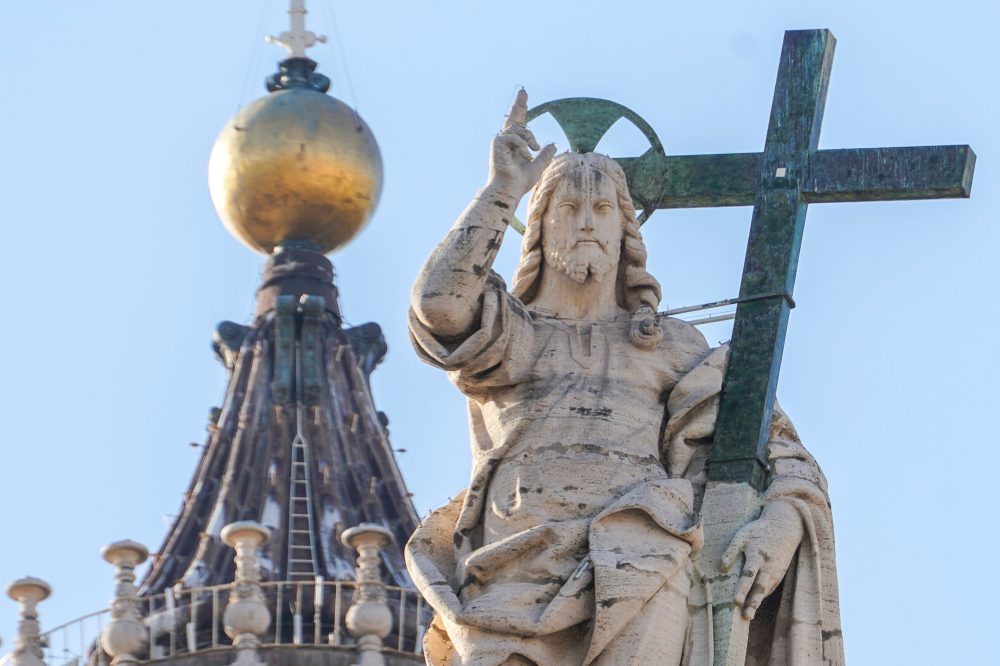

A fundamental Christian declaration proclaiming Jesus as divine sovereign has transformed into a divisive political statement across the United States, sparking debates about religious expression and hate speech.
The traditional proclamation “Christ is king” represents a cornerstone belief for Christians worldwide, with Catholics and numerous Protestant denominations marking Christ the King Sunday annually. However, this sacred declaration has evolved into something far more contentious based on its context and usage.
Political rallies, social media platforms, and public speeches by right-wing figures have increasingly featured this religious phrase in recent years. Sometimes it appears as support for establishing America as explicitly Christian or pledging national loyalty to Christian beliefs. Several current Cabinet members and former congressional representatives have incorporated the phrase into their public statements and online posts.
However, political activists have also combined the religious declaration with anti-Jewish rhetoric and harmful stereotypes targeting Jewish communities.
Far-right personalities and their supporters have embraced the phrase with growing frequency. Conservative commentator Candace Owens, known for promoting antisemitic conspiracy theories, markets merchandise featuring “Christ is King” branding on coffee mugs and clothing.
This trend reflects broader divisions within conservative politics, as traditional conservatives confront an increasingly outspoken faction whose criticism of Israel often includes overt antisemitism, according to critics. While some insist they oppose Zionism rather than Jewish people, this represents a significant departure from historically strong Republican support for Israel.
Research from the Rutgers University-affiliated Network Contagion Research Institute confirms that the phrase sometimes serves as clear hostility toward Jewish people, according to their 2025 findings.
Their analysis of social media content from 2021 through 2024 revealed dramatic growth in using “Christ is king” as hateful messaging targeting Jews. Researchers expressed concern about this departure from the phrase’s traditional role as an uplifting, sacred statement rooted in scripture.
“The weaponization or hijacking of ‘Christ is King’ represents a disturbing inversion of its original intent. Rather than sacralizing shared values, extremists have exploited this religious expression to justify hatred,” the report said.
A recent gathering of President Donald Trump’s Religious Liberty Commission brought these controversies into sharp focus during discussions about antisemitism.
During the February 9 hearing, witness Seth Dillon described frequently encountering people who follow the religious phrase immediately with offensive slurs against Jewish people.
“This should offend every Christian,” said Dillon, the CEO of the conservative satirical site The Babylon Bee.
Commission participant Carrie Prejean Boller repeatedly questioned witnesses about whether opposing Zionism constitutes antisemitism. She explained that her Catholic faith leads her to reject Zionism while denying any antisemitic intent. She directly asked Dillon whether he considered “saying ‘Christ is king’ is antisemitic.”
Dillon responded negatively, explaining that as a Christian, he regularly affirms that “Christ is my king” while emphasizing that circumstances matter significantly.
He described how followers of far-right personality Nick Fuentes, known as Groypers, have appropriated the phrase despite Fuentes spreading antisemitic viewpoints.
This represents “using the Lord’s name in an abusive manner,” Dillon said.
Supporters of Fuentes shouted “Christ is king” during the Million MAGA March in November 2020, a demonstration rejecting Republican Trump’s electoral loss to Democrat Joe Biden.
Texas Lieutenant Governor Dan Patrick, the Republican commission chairman, announced Prejean Boller’s dismissal from the panel following the meeting. He claimed she attempted to “hijack” the proceedings for personal purposes.
After her removal, Prejean Boller has posted extensively on X, condemning “Zionist supremacists” while repeatedly using “Christ is King.” She has also criticized military actions by the United States and Israel against Iran.
As a recent Catholic convert, she rejects the popular evangelical belief that contemporary Israel fulfills biblical prophecy.
The commission hearing represented just one venue for these ongoing “Christ is king” debates.
The Network Contagion Research Institute’s 2025 analysis found that while many social media references to “Christ is king” remain purely religious, extremist figures have “systematically co-opted” the phrase.
Researchers reported that Fuentes and similar extremists employ the declaration as a “white supremacist mantra publicizing their antisemitic beliefs.”
Fuentes has claimed Holocaust exaggeration, condemned “organized Jewry in America,” and described battling “satanic, globalist elites,” echoing antisemitic conspiracy theories.
The religious phrase “Christ is king” lacks inherent political meaning, according to Brian Kaylor, president and editor-in-chief of Word&Way, a progressive publication covering faith and politics.
However, this characteristic provides “deniability” for those using it politically, he explained.
“We’re at a dangerous point with the phrase ‘Christ is king’ because of the heavy activity and use of it on the far right in very fascist, antisemitic ways,” said Kaylor, a Baptist minister and author of several books on religion and politics. “We’re at the danger of that phrase losing its meaning to where this new antisemitic use is the dominant definition.”
The phrase has also gained traction among some Catholic and evangelical conservatives who strongly support Israel and consistently oppose antisemitism, including Defense Secretary Pete Hegseth and Secretary of State Marco Rubio.
Kaylor described the phrase as frequently serving as “a declaration of Christian nationalism” asserting that “the nation should be brought under the dictates of Christ.”
These controversies have exposed both religious and political divisions.
The Vatican maintains diplomatic relationships with Israel while recognizing Palestinian statehood. Pope Leo XIV has advocated for a two-state solution while condemning antisemitism. Throughout the Israel-Hamas conflict, popes Francis and Leo criticized both Hamas’s October 7, 2023, attacks and Israel’s extensive military response, with Leo demanding an end to Israel’s “collective punishment” of Gaza residents.
Other Catholics on the Religious Liberty Commission emphasized that Jesus and his disciples were Jewish, referencing a pivotal 1965 Vatican document that condemns antisemitism and rejects blaming all Jews, including contemporary ones, for Jesus’s crucifixion.
Patrick, the commission leader, characterized his dispute with Prejean Boller as reflecting “a real problem with a very small group in our Republican Party.” He warned that failing to reject antisemitism could “destroy our party,” speaking on “The Mark Levin Show” podcast.
Nevertheless, Prejean Boller has attracted support from Catholics for Catholics, a conservative lay organization describing itself as “militant organization dedicated to the evangelization of this great country.”
The group plans to present Prejean Boller with a Catholic Champion Award at a March 19 Washington event featuring speakers including Owens.
Prejean Boller has shared event announcements on X, including a Spanish-language statement translating to “We will not rest until we convert the USA into a Catholic nation.” The post concluded in English with “Christ is King!”