
ATLANTA — With England and Argentina set to clash in the World Cup semi-finals, Reuters went in search of the people who were actually there — inside the stadiums — when some of the most talked-about moments in soccer history unfolded.
Over six decades, these eyewitnesses experienced the anger, shock, joy, and heartbreak of matches that helped build one of the sport’s most intense rivalries.
1966 — The Rattin Incident
Rex Gowar, who grew up in Argentina and completed his schooling in England, attended the 1966 World Cup quarter-final at Wembley with two friends. Getting tickets, he said, was surprisingly simple.
“We just wrote away for tickets, it was so easy and so cheap back then,” Gowar recalled. “We knew England would be playing, but when we bought them we weren’t certain it would be against Argentina.”
The match’s pivotal moment came in the first half when Argentine midfielder Antonio Rattin was sent off by the referee — but refused to walk off the field, bringing the game to a standstill for several minutes.
“We were all so surprised by what happened,” Gowar said. “Rattin was haranguing the referee all the time, asking for explanations of why he kept blowing against Argentina for fouls.”
Gowar and his friends were positioned behind the goal near the team tunnel, giving them a close-up view as Rattin finally made his way off. “When Rattin eventually sauntered off, he passed in front of us before going down the tunnel,” he said.
“The abiding memory of that match was the English manager Alf Ramsey calling the Argentines animals, and there’s a picture of him stopping one of his team changing shirts with an Argentine player.”
Geoff Hurst netted the only goal as England claimed a 1-0 victory, eventually going on to win the entire tournament.
1986 — The Hand of God
Twenty years later, the two nations met again in another quarter-final, this time at the Azteca Stadium in Mexico City. The match carried extra weight — it came just four years after Argentina and Britain had fought a war over the islands known to the British as the Falklands and to Argentines as the Malvinas.
Photographer Gary Hershorn was covering his first-ever World Cup when the game took place.
“It was in everybody’s mind that there was a bigger geopolitical scale to this game than any other we covered during that World Cup,” Hershorn said.
Diego Maradona struck twice in rapid succession early in the second half. His first goal — later dubbed the “Hand of God” — was punched in with his fist, though the referee allowed it to stand. Hershorn, however, was at the wrong end of the stadium to witness it.
“Unfortunately, I was at the opposite end to where it happened,” he said. “So I didn’t get to see it or photograph it. In the moment when it happened, I wasn’t aware of it, not until after the game when I went back into our dark room did I have a sense that something big had happened.”
Gowar, covering the match as a Reuters reporter, was in the press box and also missed the handball in real time.
“I was way up in the press box and I missed it,” Gowar said. “I mean, I could have seen it, I was looking in that direction. It was all so quick. But a colleague beside me said ‘that was with his hand’. I think some people saw it straight away, but it was so sudden.”
For Hershorn, not capturing the moment remains a lingering regret. “I had a terrific run with Maradona,” he said. “I took a lot of really nice pictures of him over the course of the World Cup, but that one play was always a regret for me having actually not had anything.”
It was Gowar who ended up transmitting Maradona’s famous explanation to the world. An Argentine colleague passed him the quote from the locker room, and Gowar rushed it to his editors.
“There was some excitement about the quote — ‘a little with the head of Maradona and a little with the hand of God’ — in our newsroom, but the extent to which it would become a sort of ongoing narrative, I don’t think I thought that at the time,” Gowar said.
Argentina won the match 2-1 and went on to claim the World Cup title.
1998 — Beckham Sees Red
England reserve goalkeeper Nigel Martyn was on the bench in St Etienne when the two sides squared off in the round of 16. He remembers the team being locked in on the task at hand.
“I remember it just being a really important game that we were focused on winning,” Martyn said. “I think the feeling of rivalry was being more whipped up by the media.”
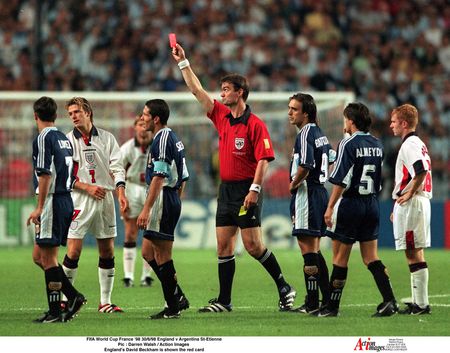
The first half finished level at 2-2, but shortly after the break, David Beckham was shown a red card for kicking out at Diego Simeone. England ultimately fell on penalty kicks, and much of the public fury was directed squarely at Beckham.
“I felt that it was unjust because there really wasn’t much in it, certainly not enough for a red card,” Martyn said. “I think it was very harsh some of the things that were said and written. He cared about the team and was crestfallen by getting sent off and us getting knocked out of the tournament.”
When the teams met again four years later, England had the last word. Argentina failed to advance from the group stage, and Martyn still savors the memory.
“The 2002 World Cup game against them felt a lot more of a grudge match,” he said. “And beating them 1-0 with a Beckham penalty felt like revenge.”