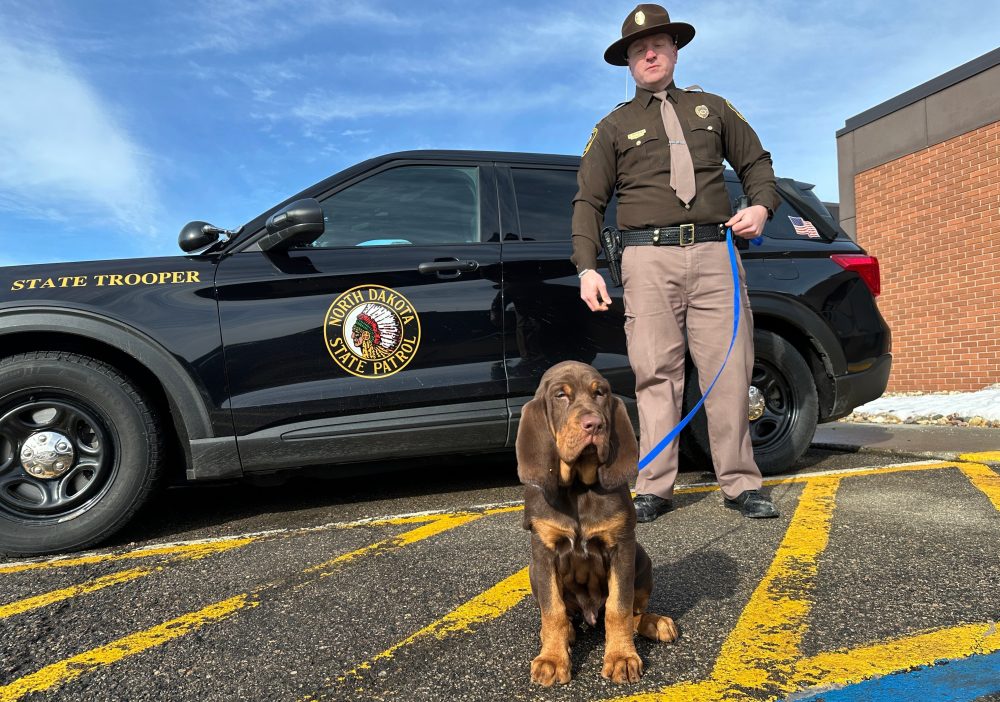

FARGO, N.D. — A 12-week-old puppy with droopy ears and four paws has become the latest addition to the North Dakota Highway Patrol’s specialized search team.
The youngster named Beau is entering the ranks of bloodhounds who handle challenging missing person cases throughout the upper Midwest region.
These canines search for lost children, individuals suffering from dementia, and wanted criminals. While the patrol employs drones and aircraft for search operations, bloodhounds provide a time-tested, simple-technology approach.
“These dogs are just specifically bred to search for people,” said Trooper Steven Mayer, who handles Bleu, one of the dogs.
Law enforcement agencies from Maine to Florida to Texas to Arizona to California utilize bloodhounds, according to Danny Jones, executive director of the U.S. Police Canine Association. While drones and helicopters can scout ahead of canines, bloodhounds offer unmatched capabilities.
“To actually get a direction and start moving in a direction, you’re going to need a dog on the ground to start that trail, and that’s the difference between the technology and actually having a dog such as a bloodhound on the ground,” Jones said.
These dogs possess approximately 300 million scent receptors within their noses, far exceeding humans and surpassing other dog breeds, Mayer explained.
Their large, drooping ears and skin folds assist in collecting odors that enable the dogs to follow human trails, sometimes after a week or longer, he noted. The canines have detected scents from walls people have touched, soil where individuals stumbled, and even vomit on vehicle doors.
The Highway Patrol started utilizing bloodhounds approximately 14 years ago, transitioning from multi-purpose dogs to specialized drug detection canines and tracking dogs. The state unit receives roughly 70 service requests annually, including one to Montana last year to assist in locating a suspect in the fatal shooting of four individuals at an Anaconda bar.
Two handler-dog teams traveled 10 hours to provide assistance. They came reasonably close to the suspect, who was positioned where the dogs were signaling, Mayer explained. Additional requests have originated from South Dakota and Utah.
Beau was born in Texas but has relocated to Fargo, North Dakota’s most populous city. His current instruction focuses primarily on house training and kennel training along with basic commands, plus exposing him to various locations, individuals and settings, said Trooper Dustin Pattengale, Beau’s handler. He will not be prepared for complete or certified tracking until reaching approximately 9 months of age.
“The basic training is just introducing him to scent articles and then ramping up the training to where he goes further and further and encompasses different trails, different types of environment,” Pattengale said.
Bloodhounds exhibit high energy, affection and compassion but can demonstrate stubbornness, excessive drooling and mischievous behavior, making them unsuitable for apartment living, Mayer noted.
His partner, Bleu, is a large, friendly canine with one eye, having lost the other after an injury while playing with another bloodhound. His tracking capabilities remain unaffected, Mayer stated.
Beau continues growing as a puppy, his lengthy ears becoming wet from dragging across the ground while he investigated a snow-covered area, continuously sniffing. He enjoys his beef liver rewards.
“He is a very energetic young pup. He’s pretty relaxed for the most part, most days, but he is eager. He likes to work. He likes to sniff,” Pattengale said.
Beyond search operations, North Dakota has assisted agencies through other means. Last year, Mayer traveled to Omaha, Nebraska, for a week to help the city police department train its initial bloodhound, Willow.
Omaha previously contacted the nearest bloodhounds, located in the Chicago area, for search missions, Omaha Police Sgt. Scott Warner explained. The benefit was evident and Willow joined the force early last year.
He anticipates Willow becoming a valuable resource for the region. Omaha intends to eventually have multiple dogs and handlers, he stated.
Willow has tracked missing individuals, including an elderly man on Christmas Eve, through diminishing light, steep terrain, mud and water.
Locating training mentors proves essential, Warner emphasized. Much of the bloodhound network operates through personal recommendations, he noted.
“I had no idea that North Dakota had a bloodhound program. There’s not a directory that I can look at that tells me where dogs are,” Warner said.
Mayer and his spouse have journeyed globally to assist with dog training, making trips to Hungary, Italy, South Africa and Wales, with plans later this year to visit Slovenia and Austria. They provide these services without charge.
Handlers represent a unique group of individuals, Mayer observed.
“They drop everything at the drop of a hat and they’ll leave their family, their friends, they’ll leave Easter dinner to go find a stranger that they’ve never met before,” he said.
North Dakota’s canines have gained popularity on the Highway Patrol’s social media platforms. Beau’s name was selected through a Facebook poll. Recent videos show him chewing a toy bear and another bloodhound, Lorace, running around in new boots.
“Everybody loves a dog, I mean, especially these little babies, these floppy-eared ones,” said Mayer, who hopes the dogs’ public presence generates quicker requests for their services.
“The more word we can get out about the program and the faster we get calls on it, the easier we can get out and be available to help people,” he said.