
NEW YORK (AP) — Throughout American history, presidents have traditionally steered clear of any appearance that they might financially benefit from their position in office.
Former President Harry Truman declined to attach his name to any commercial ventures, even after leaving the White House. Richard Nixon grew so concerned about potential conflicts involving his brother that he authorized surveillance of his phone calls. George W. Bush sold off his individual stock portfolio before assuming the presidency.
President Donald Trump has chosen a markedly different path.
The Trump family’s real estate empire is experiencing its most rapid international growth since the company’s establishment 100 years ago, with each new venture potentially influencing decisions on trade policies and military assistance.
Under the leadership of Eric Trump and Donald Trump Jr., the family enterprise has ventured into digital currencies through projects that generated billions in revenue while raising concerns about whether major investors received preferential government treatment.
The Trump sons have also acquired interests in multiple companies seeking government contracts with the administration their father leads. Recently, they secured ownership positions worth millions in a military drone manufacturer pursuing Pentagon contracts and deals with Gulf nations under Iranian threat who rely on U.S. military protection led by their father.
Both the White House and Trump Organization reject claims of ethical violations. When questioned about these issues at a recent cryptocurrency conference, Donald Jr. responded, “Frankly, it’s gotten old.”
While conflict of interest concerns date back to Trump’s initial presidential campaign a decade ago, ethics specialists and historians contend the situation has become more urgent as conflicts accumulate during his second presidency, which they describe as unprecedented, flagrant and threatening to democratic principles.
“I don’t think there’s any line right now between policy decisions and political calculations and the interest of the Trump family,” said Julian Zelizer, a presidential historian at Princeton University.
During Trump’s initial presidency, the Trump Organization completed no international deals. Within just over a year of his return to office, the company has finalized eight such agreements, all reportedly adhering to the organization’s self-imposed guideline against direct business with foreign governments.
However, governments in authoritarian and single-party nations typically maintain significant control over business activities — particularly when those businesses belong to a sitting president.
In Qatar, a Trump golf facility and residential project involves development by a company with Qatari government ownership. In Vietnam, where The New York Times documented government displacement of farmers to accommodate a Trump resort, the nation’s deputy prime minister formally endorsed the project at a signing ceremony. In Saudi Arabia, a proposed “Trump Plaza” resort along the Red Sea coast is being constructed by a Saudi developer with close royal family connections.
While determining whether these deals influenced U.S. policy changes favoring these nations remains nearly impossible, each country achieved its desired outcomes — Qatar gained access to advanced American technology, Vietnam received tariff reductions, and Saudi Arabia obtained fighter aircraft.
The Trump Organization also benefited significantly: tens of millions in licensing fees.
When asked about these projects, the Trump Organization stated it has avoided government deals, emphasizing that the Saudi partner operates privately and clarifying it is “collaborating” rather than forming a “partnership” with the Qatari entity that would violate its self-imposed restrictions.
Another potentially conflicting arrangement first emerged in a Wall Street Journal report in January — one year after the deal’s completion.
Just before inauguration, the Trump family sold nearly half of its World Liberty Financial cryptocurrency venture to a UAE government-connected firm managed by a UAE royal family member for $500 million.
A separate UAE entity, a government investment fund, placed $2 billion worth of a digital currency called a stablecoin into the offshore cryptocurrency exchange Binance through World Liberty. This arrangement allowed the Trump company receiving the funds to invest in secure options like bonds or money market accounts while retaining tens of millions in interest earnings.
Soon afterward, the Trump administration lifted a Biden-era limitation and authorized UAE access to advanced American semiconductors. Binance founder Changpeng Zhao subsequently received a Trump pardon despite pleading guilty to failing to prevent criminals from using his platform for money transfers related to child exploitation, drug trafficking and terrorism.
Zhao’s attorney denied any connection between Binance’s Trump family business relationship and the presidential pardon.
“Any claim of a quid pro quo by Binance or CZ, or preferential financial treatment by Binance, is a clear misstatement of the public record,” said Teresa Goody Guillen in an email to the AP, referring to Zhao by his initials.
Regarding the pardon, the White House stated federal authorities had unjustly penalized Zhao in what it termed “The Biden Administration’s war on crypto.”
World Liberty rejected conflict suggestions, asserting the UAE agreement had no relationship to presidential semiconductor policy.
World Liberty has also generated additional revenue for a new Trump limited liability company through “governance token” sales that provide buyers certain voting privileges in its operations, though not ownership shares, raising $2 billion last year. This translates to hundreds of millions for the Trumps through their World Liberty stake and a separate arrangement granting them a portion of sales proceeds.
One major token purchaser was Justin Sun, a cryptocurrency billionaire who, as a foreign national, faces U.S. legal prohibitions on political donations to American politicians. Between Trump’s election victory and inauguration, Sun invested $75 million in the tokens.
In February of last year, a federal lawsuit accusing Sun of investor fraud was suspended before reaching a $10 million settlement last month.
Additionally, commemorative “meme” coins featuring Trump’s image went on sale days before he assumed office last year.
Over the following four months, these coins generated $320 million, primarily benefiting Trump-related entities, according to blockchain tracker Chainalysis. This amount exceeds double the revenue collected during four years of operating his Washington D.C. hotel during Trump’s first presidency.
Unlike lobbyists or campaign contributors attempting to influence Trump, coin purchasers can buy anonymously. One who chose to publicize his purchase was Sun, who spent $200 million on the coins and gained Trump access at a gala event he hosted for major buyers.
Another family cryptocurrency venture, American Bitcoin, went public in September, providing Donald Jr. and Eric approximately $1 billion in paper wealth at that time. Months earlier, their father announced a new national bitcoin reserve, driving cryptocurrency prices to record levels.
Trump businesses aren’t entirely protected from crypto’s infamous volatility. Bitcoin and other digital token values have since plummeted, unsettling investors. Both American Bitcoin stock and Trump’s commemorative meme coins have dropped 90% from their peaks.
Last month, Trump announced another dinner with new top meme coin holders, temporarily boosting the coin before it declined again.
“Whatever constraints there were in the first term appear to have completely disappeared,” says Columbia University historian Timothy Naftali. “Do you want future presidents to be open to the highest bidder?”
When asked to comment, the White House said Trump operates in an “ethically-sound manner” and that any contrary suggestions are either “ill-informed or malicious.” It emphasized that his assets are managed by a trust overseen by his children and stated he has “no involvement” in family business transactions.
“There are no conflicts of interest,” said spokesperson Anna Kelly.
In a separate statement, the Trump Organization said it remains “fully compliant with all applicable ethics and conflicts of interest laws” and added, “The implication that politics has enriched the Trump family is unfounded.”
Trump told The New York Times in January that regarding potential conflicts of interest, “I found out that nobody cared, and I’m allowed to,” referencing a presidential exemption from federal statutes prohibiting federal officials from maintaining financial interests in businesses affected by policies they help create.
His assessment of American attitudes may be accurate, though they appear to be shifting even among Republicans. A Pew Research Center poll in January showed 42% of Republican voters expressed confidence in Trump’s ethical conduct in office, declining from 55% at the beginning of his second term one year ago.
Forbes estimates Trump’s current net worth at $6.3 billion, rising 60% since returning to office, a remarkable development considering the Trump Organization’s previous struggles.
The Trump International Hotel in Washington never achieved profitability before being sold. Two Trump hotel brands targeting middle-class travelers during his first presidency closed due to insufficient demand. Condominium buildings removed the Trump name from their exteriors after discovering it deterred rather than attracted buyers.
No new American condominiums are displaying the Trump name during his second presidency, but his brand holds value in Washington where individuals conduct federal government business.
Donald Jr. launched a private club in Georgetown, Washington, charging initiation fees up to $500,000 for founding members.
One of the few clubs with comparable fees, Montana’s Yellowstone Club, provides access to multiple resorts, 50 ski slopes and over a dozen restaurants across a members-only area matching Manhattan’s size.
Donald Jr.’s club operates from a building’s basement but offers something different — proximity to political power.
The club’s name is “Executive Branch.”
Other presidents and their families have pursued profit in ways that tarnished the office’s dignity.
Hunter Biden received payment as a Ukrainian gas company director while his father served as vice president. The Clinton Foundation accepted foreign donations, though after Bill Clinton left office. Jimmy Carter’s brother Billy capitalized on the family name by marketing beer.
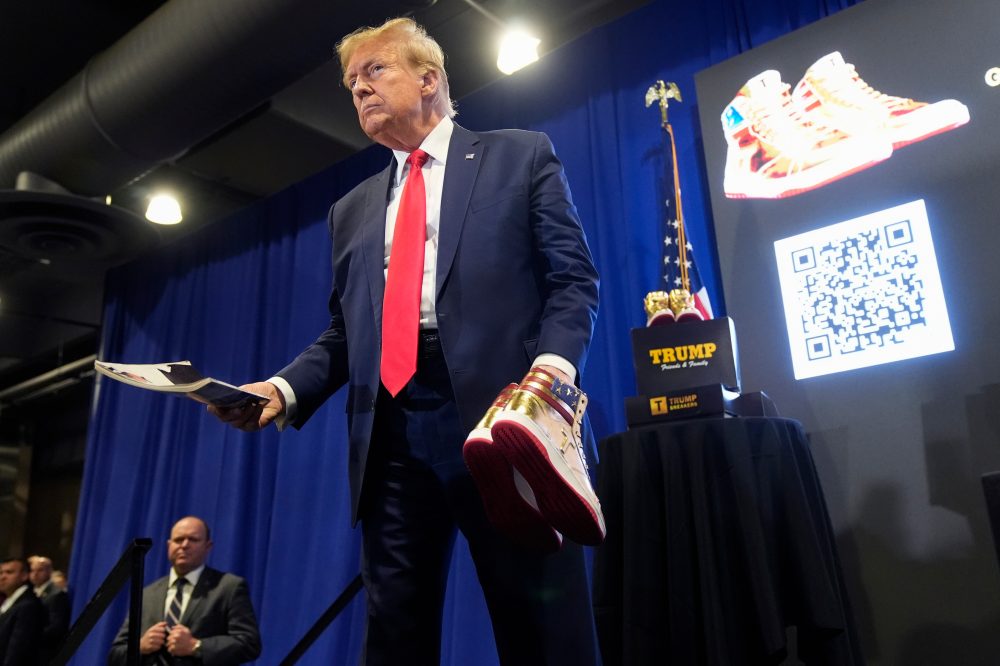
In Trump’s situation, the president himself markets merchandise, including $59.99 “God Bless the USA” Bibles, $399 sneakers marked “Never Surrender” and electric guitars priced up to $11,500 — shipping excluded — for presidential autographed models.
During the initial months of Trump’s second year back in the White House, this momentum continues.
In January, the Trump Organization announced its third Saudi Arabian deal in under a year, this time a “collaboration” with a company more directly connected to the government through ownership by the country’s sovereign wealth fund chaired by Crown Prince Mohammed bin Salman. When the AP asked whether the project outside Riyadh for Trump residences, a hotel and golf course violated the company’s commitment to avoid foreign government deals, the Trump Organization said it doesn’t “conduct business with any government entity” but didn’t address the project specifically.
Meanwhile, as the two eldest brothers’ new drone company pursues Pentagon contracts, other government contractors in which one or both have acquired ownership stakes this past year are receiving tens of millions in new taxpayer funding. This includes a rocket motor manufacturer, an AI chip supplier and a data analytics company, according to government contracting records.
When asked about potential conflicts following the drone deal announcement, Eric said, “I am incredibly proud to invest in companies I believe in.” A Donald Jr. spokesman said he doesn’t “interface” with the government regarding portfolio companies, adding that “the idea that he should cease living his life and making a living to provide for his five kids just because his dad is president, is quite frankly, a laughable and ridiculous standard.”
A new investment firm that the brothers joined as advisers last year has raised $345 million in an initial public offering to acquire stakes in American companies designed to support their father’s manufacturing revival goals. After the AP inquired about Trump’s chief business lawyer regarding language in a regulatory filing stating the firm would target companies seeking federal grants, tax credits and government contracts, he submitted a new document with that language deleted.
Zelizer, the Princeton historian, expects future presidents will demonstrate greater restraint in self-enrichment but worries about Trump’s message.
“He has shown politically there is no price to be paid to making money,” he said. “You know you can go there.”