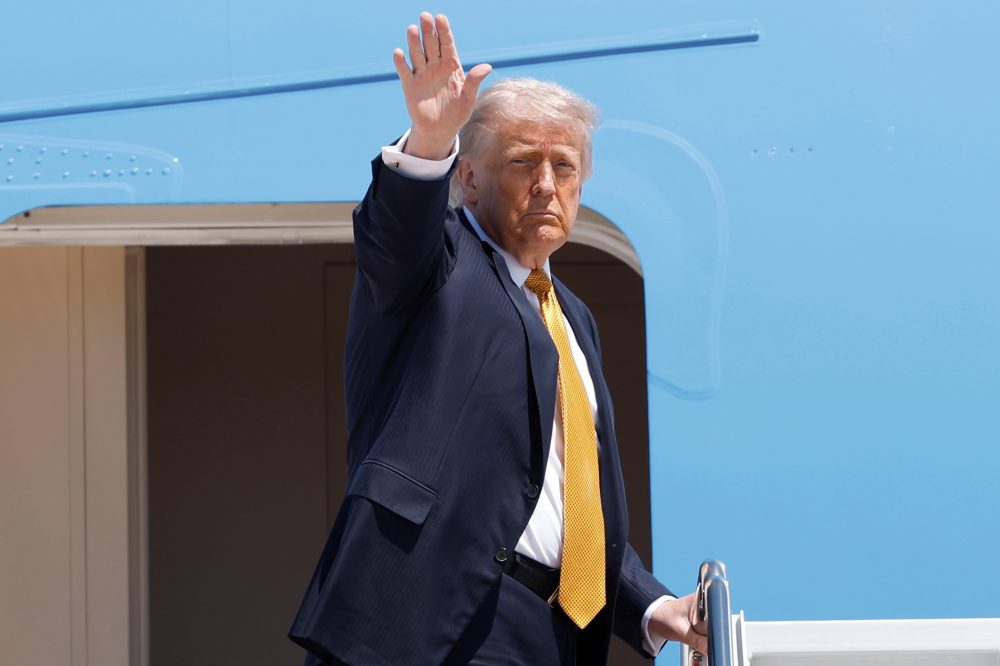

President Donald Trump departed Washington Tuesday evening for a crucial state visit to Beijing, where he will sit down with Chinese President Xi Jinping during a turbulent period marked by global tensions over warfare, trade disputes, and artificial intelligence concerns.
Speaking to reporters before leaving the White House, Trump emphasized America’s military dominance, stating: “We’re the two superpowers. We’re the strongest nation on Earth in terms of military. China’s considered second.”
The Beijing summit comes as Trump faces mounting domestic pressure from declining approval ratings, largely driven by ongoing conflict involving the United States and Israel against Iran, plus escalating inflation stemming from that military engagement. The president hopes to secure victories through agreements for China to purchase additional American agricultural products and aircraft, noting he plans to discuss trade matters with Xi “more than anything else.”
Trump’s team aims to launch discussions about creating a “Board of Trade” between the two nations to resolve bilateral disagreements. Such a mechanism could help avoid another trade conflict like the one sparked last year following Trump’s tariff increases, which China responded to by restricting rare earth mineral exports before both sides agreed to a one-year ceasefire last October.
However, Trump arrives in Beijing while Iranian issues continue consuming his domestic political focus. The ongoing warfare has effectively shut down the Strait of Hormuz, trapping oil and gas vessels and driving energy costs to heights that threaten worldwide economic stability. Despite Iran’s Foreign Minister Abbas Araghchi visiting Beijing recently, Trump dismissed the need for Chinese assistance with the Iranian situation.
“We have a lot of things to discuss. I wouldn’t say Iran is one of them, to be honest with you, because we have Iran very much under control,” Trump explained to reporters Tuesday.
Taiwan’s status will likely feature prominently in discussions, as Beijing objects to American plans for weapons sales to the independently governed island that China considers part of its territory.
Trump revealed Monday he would address an approved $11 billion arms package for Taiwan during his talks with Xi. Meanwhile, Taiwan’s position as the globe’s premier semiconductor manufacturer has made it crucial for artificial intelligence development, with American imports from Taiwan now exceeding those from China this year. Trump has worked to expand domestic chip production through both Biden administration initiatives and his own negotiations.
Even before departing, Trump expressed optimism about the trip’s outcome, discussing Xi’s planned return visit to America and expressing disappointment that White House renovations wouldn’t be finished in time.
“We’re going to have a great relationship for many, many decades to come,” Trump predicted regarding U.S.-China relations. “As you know, President Xi will be coming here toward the end of the year. So that would be exciting. I only wish we had the ballroom finished.”
After speaking with the Chinese leader, Trump described the upcoming meeting as “positive” as he departed with senior staff, business executives, and family members. His itinerary includes arriving in China Wednesday evening for a ceremonial welcome before checking into his hotel, attending a state dinner Thursday, and participating in a working lunch with Xi Friday before returning home.
Despite Trump’s public confidence, Scott Kennedy, a senior adviser on Chinese business and economics at the Center for Strategic and International Studies, believes China enters these talks “from a much stronger place.”
Chinese objectives include reducing technology restrictions on semiconductor access and finding pathways to lower tariffs, among other priorities.
“But even if they don’t get much on any of those things, as long as there’s not a blow-up in the meeting and President Trump doesn’t go away and look to re-escalate, China basically comes out stronger,” Kennedy explained.