
BAGHDAD (AP) — Military personnel from Israel established a temporary outpost in Iraq’s desert region during the recent U.S.-Israeli conflict with Iran, according to Iraqi and American officials who spoke with The Associated Press.
The Wall Street Journal initially broke the story about the covert Israeli military installation, characterizing it as a facility that housed special operations troops and functioned as a supply center for Israeli air operations.
News of the clandestine installation caused significant controversy in Iraq. Iraqi authorities reported that their military units investigated reports of an unauthorized armed presence in the Nukhaib desert region — a desolate stretch southwest of Karbala and Najaf — during early March and encountered hostile fire while approaching the site.
While Iraqi leadership has acknowledged the existence of a brief, unauthorized military presence in the desert area, they have not publicly identified it as Israeli. Nevertheless, two Iraqi security and intelligence sources, along with a high-ranking U.S. military official, confirmed the Israeli identity under anonymity due to lack of authorization for public statements.
Regarding the Israeli installation, the U.S. official noted that “base is a strong word to describe it” and characterized it instead as a “temporary staging area or camp to support operations in Iran.”
An Iraqi intelligence source reported that the Israeli unit had erected tents in the location and “its objective was to monitor rocket launches and drone activity conducted by some Iraqi militias.” Iraqi leadership believes the unit arrived through an aerial drop but remains uncertain about timing, the source explained. They also challenged characterizing the military presence as a “base.”
According to officials, a local shepherd spotted the military presence and alerted authorities.
Israeli military representatives refused to provide comment. The U.S. military had not responded to requests for comment at press time.
The United States and Israel launched attacks against Iran on Feb. 28, sparking a regional conflict that placed Iraq in a difficult position. Iraq serves as host to multiple Iran-affiliated militia groups, which conducted strikes against U.S. installations in Iraq and throughout the region, as well as against Israel. American and Israeli forces responded by targeting militia locations within Iraq.
Iraqi leadership, however, urged both parties to keep the country out of their dispute. The possibility that Israeli forces might have operated militarily within their territory without detection placed Iraqi officials in a compromising situation.
On Tuesday, Iraqi military units traveled to the desert location of the suspected Israeli installation to demonstrate to reporters that no evidence of permanent military occupation existed there.
“We believe it was a small force that came and stayed for no longer than 48 hours,” stated Gen. Abdul-Amir Yarallah, chief of the general staff of the Iraqi army during the site visit.
Maj. Gen. Tahseen al Khafaji, a spokesperson for the Iraqi defense ministry, informed the AP that on March 3, military command received intelligence about “a small enemy force in a specific area in the Najaf desert,” prompting Iraqi forces to investigate the location the following day.
“Within 25 kilometers, the force which went there faced an aerial attack, which led to the martyrdom of one of our fighters and injured two other fighters,” he stated.
Al Khafaji explained that Iraqi forces withdrew following the attack but returned the subsequent day to find no evidence of an installation and no personnel remaining.
“It is believed that the force was there for a very short time and it was a very small force,” he noted, adding that investigation efforts “did not show anything that indicates that the force was stationed there for a long time in that area.”
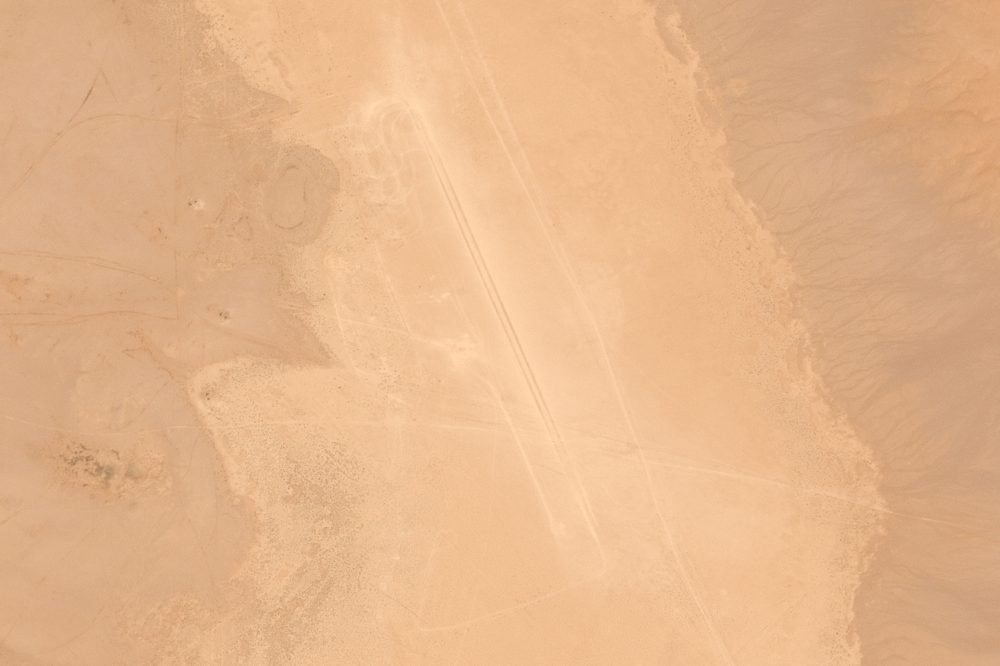
Airbus DS satellite imagery from March 8, examined by the AP, appears to reveal an artificial pathway carved into the terrain at the location, approximately 250 kilometers (155 miles) southwest of Baghdad. The pathway extends in a direct line through a dried lakebed from northwest to southeast, measuring roughly 1.5 kilometers (1 mile). This length would accommodate aircraft takeoffs and landings.
The closest settlement, al-Nukhaib, is located approximately 45 kilometers (27 miles) to the northwest along a route leading to the Saudi Arabian border. This distance would likely have avoided drawing significant notice, although Iraq’s airspace was busy with American and Israeli military aircraft during the active weeks of conflict with Iran.