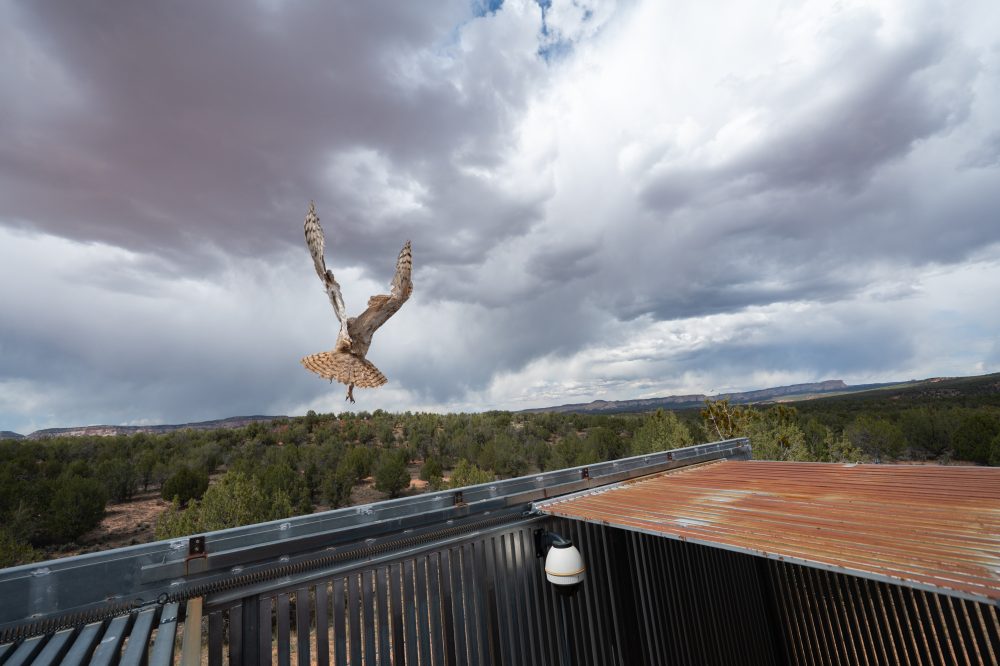

A young great horned owl that became trapped inside a concrete mixer in southwestern Utah has successfully returned to the wild after months of specialized rehabilitation and recovery.
The juvenile bird was discovered by construction workers at a resort building site in late October, completely covered in concrete after somehow getting inside the truck-mounted mixing equipment. Construction crews quickly rinsed off the owl and wrapped it in a towel before rescue efforts began.
Staff members at the Best Friends Animal Sanctuary in Kanab spent several days meticulously removing hardened concrete from the bird’s face, chest and right wing area. The painstaking process involved using surgical forceps to carefully break apart the dried material and cleaning individual feathers with toothbrushes and dish soap.
Following the initial cleanup, the owl began its lengthy rehabilitation process at the sanctuary’s specialized bird facility. Staff members monitored the bird closely, expecting it would naturally shed damaged feathers and grow replacements. However, when the anticipated molting process didn’t occur, veterinarians decided to perform a specialized procedure called imping in early May.
The imping technique involves using adhesive materials to attach donor feathers from deceased birds onto the existing feather shafts of the injured animal.
“The first few feathers were extremely nerve-wracking, but as we got into the groove, the imping became more comfortable, and everything went smoothly,” said Bart Richwalski, a supervisor at the sanctuary.
The concrete damage had destroyed the owl’s natural ability to fly silently while hunting. Great horned owls possess specialized downy feather coatings that eliminate sound during flight, but the concrete had damaged these features, causing the rescued bird to make audible whooshing noises when airborne.
Sanctuary workers spent weeks preparing for the surgical procedure, regularly examining the owl’s wing structure and trimming damaged feather shafts in preparation. During the 90-minute operation, the sedated bird received 10 new primary feathers and one secondary feather on its right wing, all carefully measured and positioned using feathers from a similarly-sized owl that had previously died.
The critical test came after the procedure: determining whether the owl could once again fly without making noise. After recovering from anesthesia in a large flight enclosure, the bird quickly took to the air. Richwalski used sound-measuring equipment to confirm the owl’s wingbeats were quiet enough for successful hunting in the wild.
When the enclosure’s roof was opened, the owl briefly hovered before accelerating upward and disappearing into the surrounding wilderness.
“It feels so, so good. I think my heart finally started beating again. The nervousness was starting to overtake the excitement, but once I saw him fly out that opening in the roof, it just was, it was a sight to see. It was so fun,” said Richwalski, who has cared for the owl since picking him up at the construction site.
Karla Bloem, executive director of the Minnesota-based International Owl Center, explained that the imping technique has been used by falconers “for eons” and represents a highly successful treatment method.
“I’ve never heard of it not lasting, because you use some pretty good stuff when you’re doing imping,” said Bloem, who has studied great horned owls for nearly three decades.
She noted that losing a few of the grafted feathers wouldn’t pose a problem, as long as most remain attached until the owl can naturally grow new ones during the upcoming summer season.
“And now it just needs to figure out, ‘whoa, I’m back in the big world again, hunting,’” she said. “Find a territory … you know, find one of the opposite sex and settle down and have kids.”