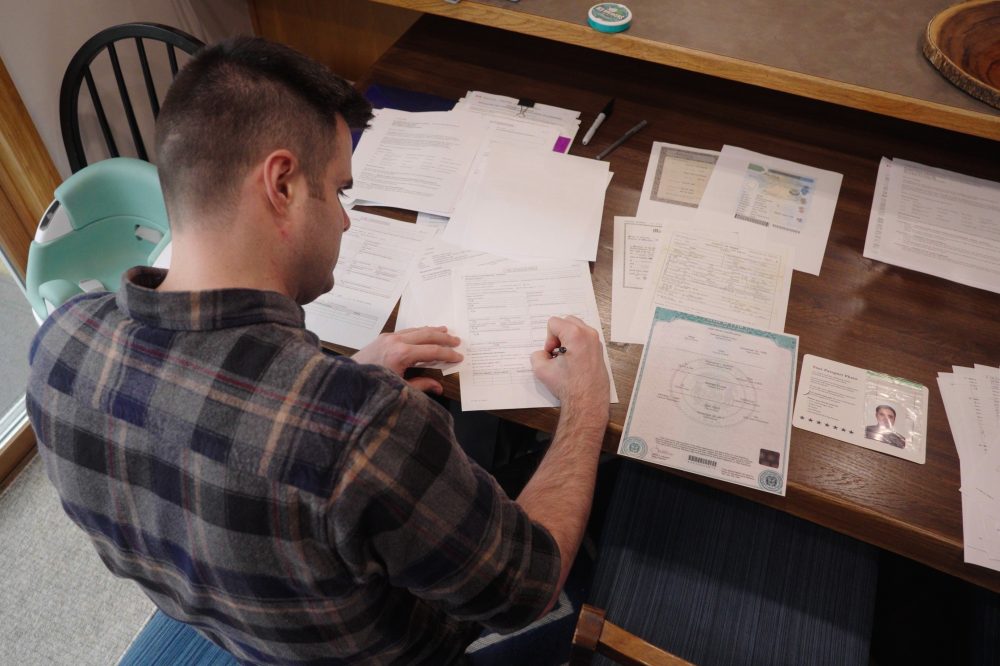

Millions of Americans now have a significantly simpler route to obtaining Canadian citizenship following recent legislative changes, creating a surge in ancestry research and citizenship applications across the country.
The development came as a revelation to individuals like Zack Loud from Farmington, Minnesota, who discovered that Canada’s updated regulations already recognized him and his siblings as citizens due to their Canadian grandmother.
“My wife and I were already talking about potentially looking at jobs outside the country, but citizenship pushed Canada way up on our list,” Loud explained.
Immigration attorneys on both sides of the border report being inundated with clients requesting assistance with citizenship proof applications since the updated legislation became effective December 15, 2025. Americans are investigating the streamlined process for various reasons including political concerns, family connections, employment prospects, and other personal factors.
Nicholas Berning, who practices immigration law at Boundary Bay Law in Bellingham, Washington, described his firm as “pretty much flooded with this.”
“We’ve kind of shifted a lot of other work away in order to push these cases through,” Berning stated.
Immigration lawyer Amandeep Hayer reported his Vancouver, British Columbia practice experienced a dramatic increase from approximately 200 citizenship cases annually to over 20 daily consultations.
Canada has been modifying its citizenship regulations for many years, addressing both historical legal interpretations and discrimination concerns.
The previous system limited Canadian citizenship by descent to just one generation – from parent to child. Canadian bill C-3 transformed this framework when it became law December 15, 2025, extending citizenship eligibility to anyone born before that date who can demonstrate direct Canadian ancestry, including grandparents, great-grandparents, or even more distant relatives.
Individuals born on or after December 15 must demonstrate their parent satisfied a 1,095-day residency requirement.
The updated legislation considers Canadian descendants as automatic citizens, though they must submit documentation to receive an official citizenship certificate. Hayer estimates millions of Americans qualify as Canadian descendants.
“You are Canadian, and you’re considered to be one your whole life,” said Hayer, who supported the new legislation before Canada’s Parliament. “That’s really what you’re applying for, the recognition of a right you already have vested.”
“The best way I can put it is like, if a baby’s born tomorrow in Canada, the baby’s Canadian even though they don’t have the birth certificate,” he explained.
While American applicants cite various reasons, many reference President Donald Trump’s immigration policies and other initiatives as factors driving their pursuit of dual citizenship.
Michelle Cunha from Bedford, Massachusetts, explained her decision to relocate to Canada followed years of political involvement and concluding she had “nothing left to give.”
“I put in my best effort for 30 years. I have done everything that I possibly can to make the United States what it promises the world to be, a place of freedom, a place of equality,” Cunha stated. “But clearly we’re not there and we’re not going to get there anytime soon.”
Troy Hicks, whose great-grandfather was born in Canada, said an international journey influenced his decision.
“I recently went to Australia and you know, first words out of the first person I talked to in Australia was basically an expletive about Trump and the U.S.,” explained Hicks from Pahrump, Nevada. “It was just like, whoa, I walked off a 20-hour flight and literally the first words of somebody’s mouth to me were that. … So the idea of doing that with a Canadian passport just seemed easier, better, more palatable.”
Maureen Sullivan from Naples, Florida, said the Trump administration’s immigration enforcement in Minnesota motivated her decision, particularly after her teenage nephew encountered federal agents near his St. Paul high school. Sullivan, whose grandmother was Canadian, views Canadian citizenship as a backup plan should circumstances in America “really go south.”
“When I first heard about the bill, I couldn’t believe it. It was like this little gift that fell in my lap,” Sullivan said. “There was kind of this collective excitement amongst the (family) who just felt like, we wanted to feel like we were doing something to take care of our security in the future if needed.”
Applicants with readily available documentation face a modest citizenship proof application fee of 75 Canadian dollars ($55).
However, expenses increase substantially for those requiring legal or genealogical assistance.
Cunha said she hired an attorney and anticipates total costs around $6,500.
Meanwhile, Mary Mangan from Somerville, Massachusetts, submitted her January application using guidance from internet discussion groups.
“There are some situations where a lawyer might be the right thing, but for many people, I would guess 90% of people can probably do this on their own,” Mangan noted.
Immigration, Refugees and Citizenship Canada’s website indicates certificate processing takes approximately 10 months, with over 56,000 individuals currently awaiting decisions.
The agency reported confirming citizenship by descent for 1,480 people between December 15 and January 31, though not exclusively Americans. During the previous year, 24,500 Americans obtained dual US-Canada citizenship.
Fen Hampson, an international affairs professor at Ottawa’s Carleton University, characterized Canadians as generally “welcoming people.”
“I think where people start looking askance is someone who’s never been to Canada, who has very thin ties. They can get a passport, becoming Canadians of convenience. People don’t like that,” he observed.
Hampson noted concerns that increased American interest might create delays for refugees and asylum-seekers escaping dangerous situations.
“Canadians don’t like queue jumpers,” Hampson concluded.