
President Trump issued a stark warning Wednesday, threatening to destroy one bridge or power plant in Iran for every attack Iran carries out against ships passing through the Strait of Hormuz.
The threat to strike infrastructure came as the ongoing conflict shows no signs of winding down, pushing fuel prices higher and threatening to disrupt the global economy. The critical waterway, which carries a significant share of the world’s energy supply, has remained largely closed due to Iranian attacks, with neither side showing willingness to back down.
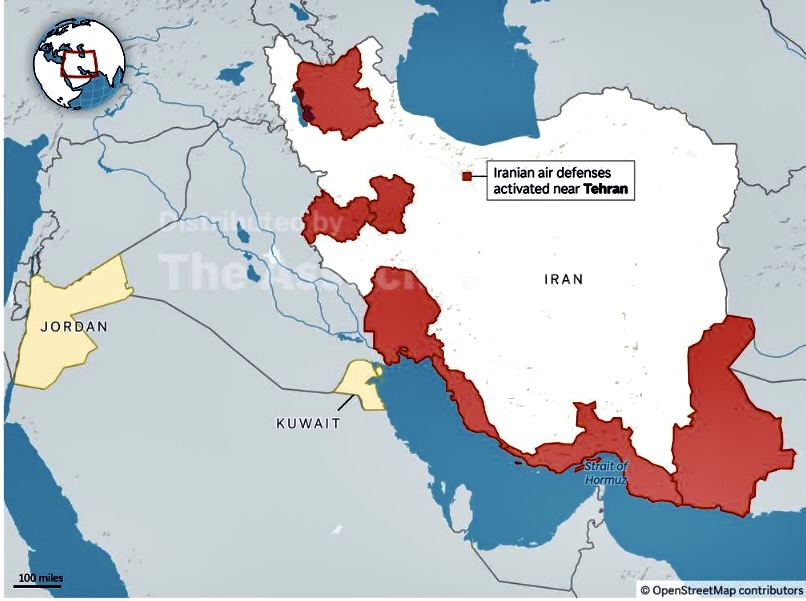
Overnight into Wednesday, U.S. forces launched another round of strikes on Iran, prompting Iranian air defenses to open fire over the capital, Tehran. Iran responded by firing missiles at a Jordanian city near the Israeli border, while missile alerts were also triggered in Bahrain and Saudi Arabia.
With peace talks largely at a standstill, both sides have shifted to attacking infrastructure as a form of leverage. Iran has targeted energy facilities and desalination plants — which supply drinking water to drought-prone neighboring Gulf nations — in retaliation for U.S. military strikes.
International law generally bars attacks on civilian infrastructure unless it is being used for military purposes. United Nations Secretary-General Antonio Guterres called such attacks “unacceptable” on Tuesday.
Trump Attends Dignified Transfer at Dover Air Force Base
President Trump flew to Dover Air Force Base in Delaware on Wednesday to pay his respects to four American servicemembers who lost their lives in the conflict with Iran.
Before leaving Washington, Trump told reporters that attending a dignified transfer ceremony is one of the hardest duties a commander in chief must carry out.
He offered a heartfelt message to the fallen and their grieving families, saying simply: “We love you.”
Among those honored were 19-year-old Army Private Isabella Gonzales of Carrollton, Texas, and 25-year-old First Lieutenant Tyler James Feehan of Hawaii. Both were killed when an Iranian missile struck a U.S. military base in Jordan.
The Defense Department also identified Army Sergeant Angel S. Rampersad, 28, of New York, as a victim of the same attack.
In a separate incident, Army Sergeant Michael Emmanuel Swinton, 30, of North Carolina, was killed when a drone detonated in Iraq.
The military describes a dignified transfer as a solemn ceremony held to honor servicemembers who gave their lives in service to the country.
Attacks Rattle Iran and Jordan
Jordan’s military reported intercepting four Iranian missiles over the city of Aqaba, while two additional missiles landed in what officials described as “uninhabited areas.” Videos captured by residents in the nearby Israeli city of Eilat showed plumes of smoke rising in the sky. Jordan also reported shooting down four Iranian drones.
Iran had largely avoided targeting Israel since hostilities resumed last month, apparently in an effort to prevent Israel from rejoining the conflict. However, the strike near Aqaba — visible from Israel’s Eilat — raised new fears of a broader regional war, particularly after a previous ceasefire agreement had fallen apart.
A missile alert also sounded in Bahrain, and Saudi Arabia urged residents of the Gulf city of Dammam to take shelter. Saudi officials later announced the threat had passed, without providing additional details.
The U.S. military confirmed Wednesday morning that it had wrapped up an 11th consecutive night of strikes on Iran, hitting targets that included aircraft hangars and storage facilities for drones.
Iran’s state-run IRNA news agency reported explosions in multiple provinces. According to Iran’s Health Ministry, U.S. strikes over the past 11 days have killed 53 people — including six women and three children — and left nearly 600 others wounded.
Iran’s paramilitary Revolutionary Guard vowed that its retaliatory strikes would press on.
Diplomatic Efforts Show Little Progress
Before the latest round of strikes, Iranian Interior Minister Eskandar Momeni traveled to Pakistan — a key go-between in the conflict — in an attempt to breathe new life into diplomatic efforts. However, it remained unclear what kind of deal could bring the war to an end, as the fighting has increasingly centered on control of the Strait of Hormuz.
Iran’s Interior Ministry spokesman Ali Zeinivand told IRNA that “diplomacy isn’t called off” and that communications were still ongoing, though he offered no further details.
At a regional summit held in the Philippines, U.S. Secretary of State Marco Rubio sharply criticized Iran’s conduct in the strait. “If we create a precedent in the Middle East where a nation state can decide that they are going to control an international waterway, charge a toll and if you don’t pay them, blow up your ships, we have created a very dangerous precedent which will repeat itself in other parts of the world, including in this region,” he said.
In response to Iran’s ongoing attacks, the U.S. reinstated a blockade on Iranian ports.
Trump Signals Possible Strike on Underground Nuclear Site
Speaking from the Oval Office on Tuesday, Trump stated that the U.S. had “no interest in meeting” with Iran.
He also hinted that American forces could soon target an Iranian nuclear facility currently under construction deep beneath a mountain.
The site, referred to as Pickaxe Mountain, is located on the southern edge of Iran’s Natanz nuclear enrichment complex, which was bombed by the U.S. during the 12-day war between Iran and Israel in 2025. Pickaxe Mountain has not been struck, and Iran continues to dig there.
Iran has long maintained that its nuclear program is entirely peaceful, even as it resumed enriching uranium to levels close to weapons-grade following Trump’s decision to withdraw from a 2015 nuclear agreement during his first term in office. The U.S. and other nations believe Iran operated a nuclear weapons program until 2003 and may attempt to revive it in the future.