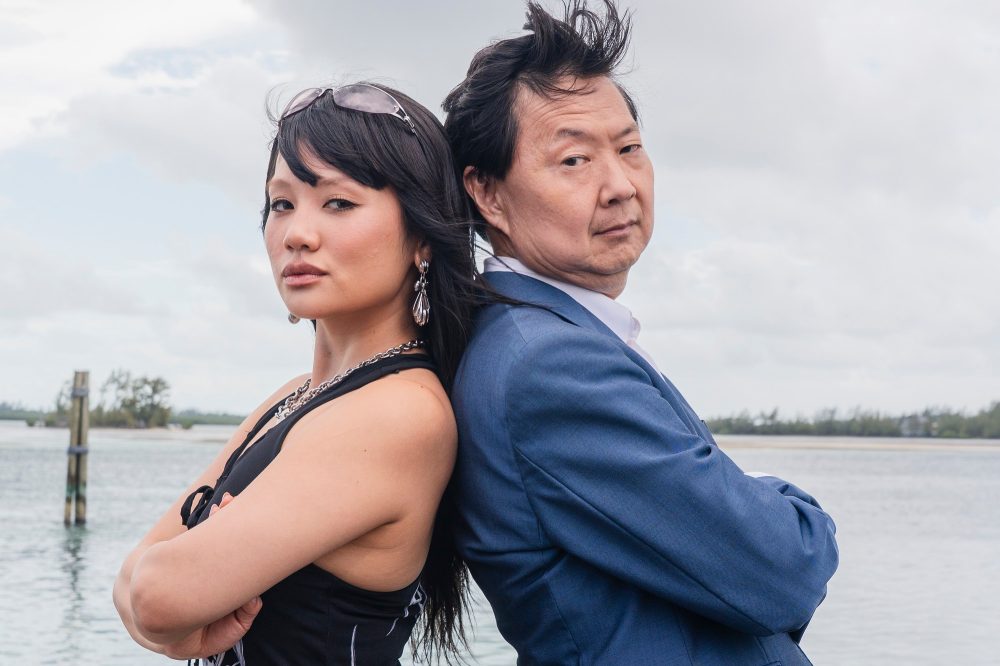

Singer Rei Ami, whose voice was a driving force behind the blockbuster film “KPop Demon Hunters,” recently had a close encounter with nature’s real-life hunters — watching from the ocean floor as roughly 16 reef sharks tore through a feeding frenzy around her.
She admitted to feeling some fear, but the experience moved her far beyond fright.
“I thought I’d be a bit more petrified, but I was enamored. I was in awe. It was witnessing nature,” she said. “You can’t put it into words the emotions and the feelings that you experience.”
Audiences can catch Rei Ami — and listen to a brand-new K-pop track she wrote inspired by her shark encounter off the Korean Peninsula — when Discovery Channel’s “Shark Week” launches this Sunday.
This year’s lineup features 20 new hour-long episodes diving deep into the world of these ancient ocean predators. Highlights include a record-setting dive into shark-filled waters and an investigation into what causes giant bull sharks to approach and confront people.
“Growing up, I always watched ‘Shark Week,’” Rei Ami said. “You see those epic commercials, with the great white jumping out and eating the chum and the tuna. That’s ingrained in my brain forever.”
Actor and comedian Ken Jeong joins Rei Ami to open the week with a show called “K-Pop Shark Heroes” on Sunday. While she participated in two cage dives and two free dives alongside hammerhead, reef, and bull sharks, Jeong chose to keep his feet firmly on dry ground.
“I’m more of the Christopher Nolan of the shark ‘Odyssey’ — just overseeing it,” Jeong joked. “Just overlooking everything. High and dry. That’s when I do my best work.”
The seven-night run of new programming concludes August 1, ending with episodes examining how great white sharks are pushing further north along the East Coast and how thresher sharks use their tails as weapons to stun and kill their prey.
One standout moment features high diver Molly Carlson, who leaps 50 feet — about 15 meters — from a helicopter into a Plexiglas cage in the open ocean, surrounded by circling reef sharks. While extreme heights don’t faze her, sharks are a different story.
“There was zero chances of me ever swimming with sharks. This was just not on my radar,” Carlson said. “That’s always been my thing, and so for me to be invited to be on ‘Shark Week,’ I was like ‘Why me?’”
Viewers will follow Carlson — who has been open about her personal battles with anxiety — as she confronts her deep-seated fear of sharks. She hopes her journey will encourage others facing their own fears.
“If I can inspire that next 16-year-old girl who wants to just hide in her room and never come out because she’s scared of so many things, then I’m absolutely going to find a way to do this,” she said. “You’re allowed to be scared and do it anyways. And so I think that was the big purpose behind this project for me.”
This season also features a search for a rumored 15-foot, roughly 4-meter, mako shark off the coast of Southern California — a find that would make it the largest ever recorded.
Marine biologist Kendyl Berna, a returning “Shark Week” participant who co-founded the ecology organization Beyond the Reef, explained that her team of scientists theorized that a marine heat wave had caused an abundance of prey in those waters, giving the sharks the conditions to grow to extraordinary sizes.
“Sharks are the cockroaches of the sea because they’ve been around for 450 million years. They’re older than dinosaurs, they’re older than trees. Sharks have just been around, but the form that they’re taking constantly changes,” Berna said.
“Shark Week” has cemented itself as a staple of summer television, offering viewers on land a safe front-row seat to watch these prehistoric apex predators glide through the water and bare their teeth. Beneath the dramatic music, catchy episode titles, and shark-related wordplay — including shows called “Chum Island: Catching a Killer” and “Sharkzilla Takes New York” — lies a foundation of serious science and genuine respect for the animals.
“While ‘Shark Week’ is very entertaining and thrilling, it is at the core very educational. And I think there’s still so much misinformation regarding sharks and how they behave,” Rei Ami said. “Through these episodes, people can understand, there’s really no reason to fear them, you know? And I hope that message gets received.”
“Shark Week” faces competition this year from National Geographic’s “SharkFest,” which also offers hours of shark-focused content, as well as Amazon Studios’ new film “The Devil’s Mouth,” in which bull sharks terrorize college students trapped in a flooded underground cave system.
This year’s programming also includes practical guidance on what to do if you come face-to-face with a shark — an increasingly relevant topic as human-shark encounters rise from Korea to Brooklyn. The advice is straightforward: stop splashing.
“It’s even more imperative that humans know how to act and react in a situation when they are in the waters and they see a shark,” Rei Ami said. “It would really, I think, help the public to understand how these apex predators work and behave.”