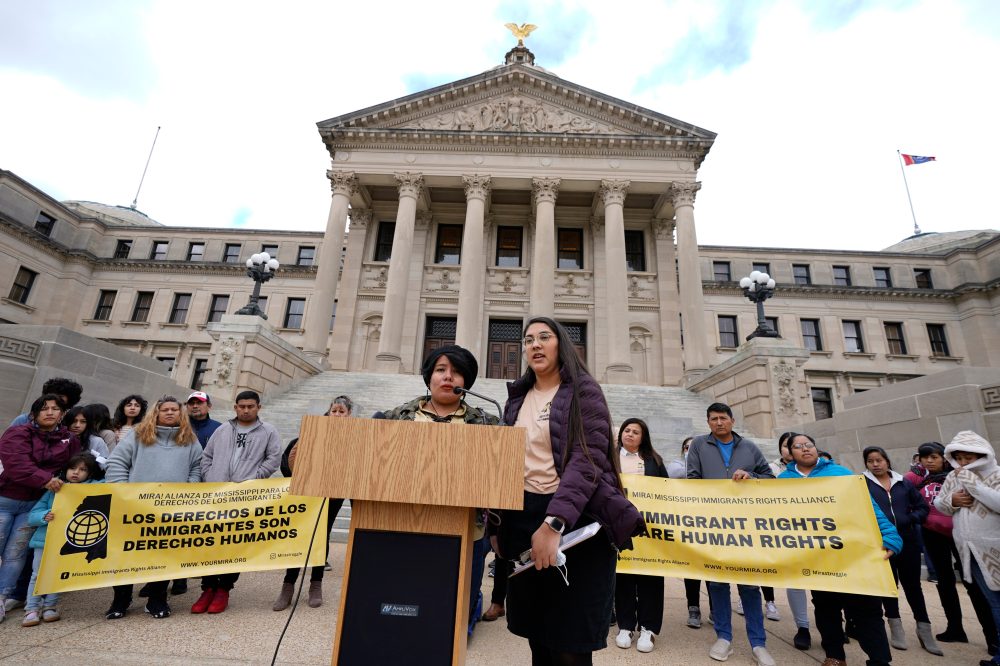

A newly enacted Mississippi law is giving the state’s leading law enforcement agency the authority to compile a registry of undocumented immigrants residing within its borders — and the move is drawing sharp criticism from those who advocate for immigrant communities.
The law, which takes effect Wednesday, directs the state Department of Public Safety to use every reasonable and lawful investigative tool at its disposal to identify and count all undocumented immigrants in Mississippi. The information to be gathered includes names, home addresses, country of origin, whether the individual is an adult or a child, any criminal history, and details about deportation proceedings.
The department is also required to share information about individuals suspected of breaking laws with state and local law enforcement. Notably, the law neither mandates nor prohibits sharing that database with U.S. Immigration and Customs Enforcement.
Republican state Sen. Angela Hill, the bill’s sponsor, defended the measure, arguing that states have both the right and the responsibility to help the federal government curb illegal immigration, which she said enables crimes like human trafficking and drug smuggling.
“The new law seems like commonsense to me,” Hill said. “In order to address the problems caused by illegal immigration, we need to understand the magnitude of the problem. Identifying the number and identity of illegal aliens in Mississippi is a concrete way to better understand the problem.”
The legislation arrives as immigration policy has become a flashpoint across the country. According to an Associated Press count, more than 100 immigration-related laws have been passed by states so far this year. Republican-led states have largely moved in step with President Donald Trump’s immigration agenda, requiring local sheriffs to partner with ICE, tightening eligibility for public benefits, and directing election officials to cross-check voter rolls against a federal citizenship verification system. Democratic-led states, by contrast, have moved to block cooperation with ICE and restrict immigration enforcement in sensitive locations like schools and hospitals.
The Mississippi law bears a resemblance to a 2021 executive order issued by Republican Florida Gov. Ron DeSantis, which directed that state’s law enforcement agency to use all lawful investigative means to identify undocumented immigrants transported from the southwest border to Florida. The Florida agency did not respond when the Associated Press sought information about the outcome of that order.
Unlike a one-time count, Mississippi’s law calls for an ongoing, two-year tracking effort — a scope that critics say makes it logistically difficult to carry out accurately.
“You can be undocumented today, and then have status tomorrow, and then lose it again next month, and then regain it three months from now,” said Efrén Olivares, vice president of litigation and legal strategy at the National Immigration Law Center, a nonprofit that advocates for low-income immigrants.
“It’s practically unworkable, but it’s also very worrisome, because it’s eerily reminiscent of other countries that have created lists of certain groups of people,” Olivares added.
Jessica Vaughan, director of policy studies at the Center for Immigration Studies — a nonprofit that supports tighter immigration restrictions — acknowledged that officials would need to develop “a credible and fairly foolproof way of correctly determining someone’s immigration status.” Still, she said the law “makes a lot of sense,” noting that it “raises the likelihood that someone’s illegal presence is going to come to the attention of federal authorities.”
Mississippi already has one of the smallest undocumented immigrant populations in the nation. A report from the American Immigration Council, drawing on 2023 Census Bureau data, estimates fewer than 28,000 undocumented immigrants live in the state — less than 1% of its total population.
Victoria Francis, deputy director of state and local initiatives for the American Immigration Council, called the law “very concerning for a bunch of different reasons,” including the possibility that it could pull law enforcement resources away from public safety duties and toward investigating people from other countries who may be contributing economically to their communities.
“A mandate like this invites profiling and turning entire communities into targets,” Francis said.
Lydia Grizzell, policy and advocacy manager for the American Civil Liberties Union of Mississippi, warned that the law could erode the trust between police and the communities they serve.
“That increases the likelihood of individuals not reaching out to law enforcement when it’s needed — and that is opposite of the mission,” she said.