
When simmering frustration among young Indians pushed a group called the Cockroach Janta Party into the national spotlight in May, its founder made clear that followers were fed up with both Prime Minister Narendra Modi’s ruling party and the opposition for ignoring their problems.
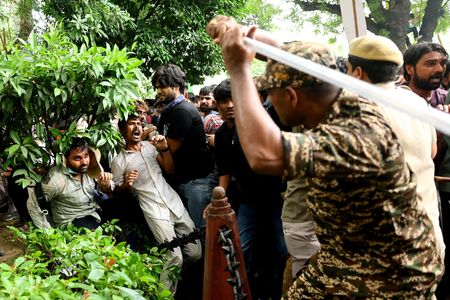
But by Monday, CJP leaders had shifted course — reaching out directly to opposition lawmakers and asking for their backing after police deployed batons and tear gas against protesters who had marched on parliament to demand accountability over damaging exam leaks and widespread corruption.
Opposition lawmakers moved quickly to show their support on Tuesday, following a night in which many young demonstrators were left injured.
That display of solidarity could prove valuable for opposition parties looking to attract younger voters, while also expanding the reach of the CJP — a movement that has primarily focused on calling for the education minister’s resignation in response to the exam paper leaks.
The turnout in Delhi far exceeded expectations, with tens of thousands taking to the streets. Footage of the government crackdown spread rapidly across social media, prompting nearly every major opposition party to align itself with the movement, which has stated it intends to remain outside of electoral politics.
Political analysts say the growing involvement of established parties brings both potential benefits and serious risks for the student movement. Core concerns — such as stopping exam leaks and increasing job opportunities for young people — could be pushed aside in favor of broader political agendas. At the same time, party backing could provide the movement with funding, organizational infrastructure, and a larger national stage.
For an opposition that has suffered repeated losses to Modi since he first came to power in 2014 — riding a wave of anti-corruption sentiment — India’s young population represents a major political prize. Individuals under 30 are estimated to account for more than half of India’s 1.42 billion people, and many have grown increasingly frustrated by a shortage of jobs despite years of strong economic performance.
India’s next national parliamentary elections are scheduled no later than April 2029, though important state contests are coming sooner. Key states including Uttar Pradesh — the country’s most populous, currently governed by Modi’s party — and Punjab are both set to hold elections next year.
“I think the opposition has got a clear sense that there is a very strong sentiment against the government on this issue at least,” said Sanjay Kumar, a professor at the Centre for the Study of Developing Societies in Delhi, referring to the education minister.
“If the movement remains undirected … the chances of a further crackdown on the movement are much higher. So the opposition parties see it as an opportunity and they will try to develop a soft corner among the protesters,” Kumar added.
Some Indian media outlets with ties to the government have already accused opposition figures of attempting to exploit the protests for political gain.
Congress leaders Rahul Gandhi and Priyanka Gandhi Vadra staged a protest outside Modi’s official residence on Tuesday evening, calling on Education Minister Dharmendra Pradhan to step down over the leaking of exam papers for medical school admissions — a scandal that affected millions of students and forced a retest.
“An attack on students is an attack on every Indian family,” Rahul said moments before he was taken into police custody. “PM Modi believes he can get away without answers, without consequences. He cannot. Not this time. The voice of India’s students will not be ignored.”
Modi himself has remained publicly silent on the paper leak controversy. A cabinet minister, speaking after a meeting of the ruling coalition, said Modi told them “strongest possible steps are being taken to protect the interest of the students.”
Numerous senior opposition leaders made their way to protest camps set up in sweltering heat roughly 3 kilometers from parliament. Some lawmakers offered legal help to demonstrators who had been detained, while others arranged for food and supplies to be delivered.
“There is now a one-upmanship among political parties over who can best position themselves as the champion of India’s youth,” said Rasheed Kidwai, a political analyst and visiting fellow with the Observer Research Foundation.
“Every political party is acting according to its own electoral calculations, particularly with state elections approaching in Punjab and Uttar Pradesh,” Kidwai said.
The CJP said it welcomed the support from opposition parties, while emphasizing the movement’s independence.
“It’s not a political protest. It’s a movement of the masses, it is a movement of students and we appreciate the support we are getting from the opposition parties,” a CJP spokesperson said. “It was CJP which invited the opposition and now they are coming and giving us the support. It motivates us. We won’t let any politics happen here.”
Political analyst Sandeep Shastri offered a word of caution, warning that the movement’s original leaders and goals could be drowned out if parties become too involved.
“Whenever there is a movement like this, and given the visibility it is receiving, it is very tempting for every political formation to jump on the bandwagon,” Shastri said. “So if political parties join this movement, there is a strong chance that the leaders who actually started it, as well as the issues driving it, will take a back seat.”