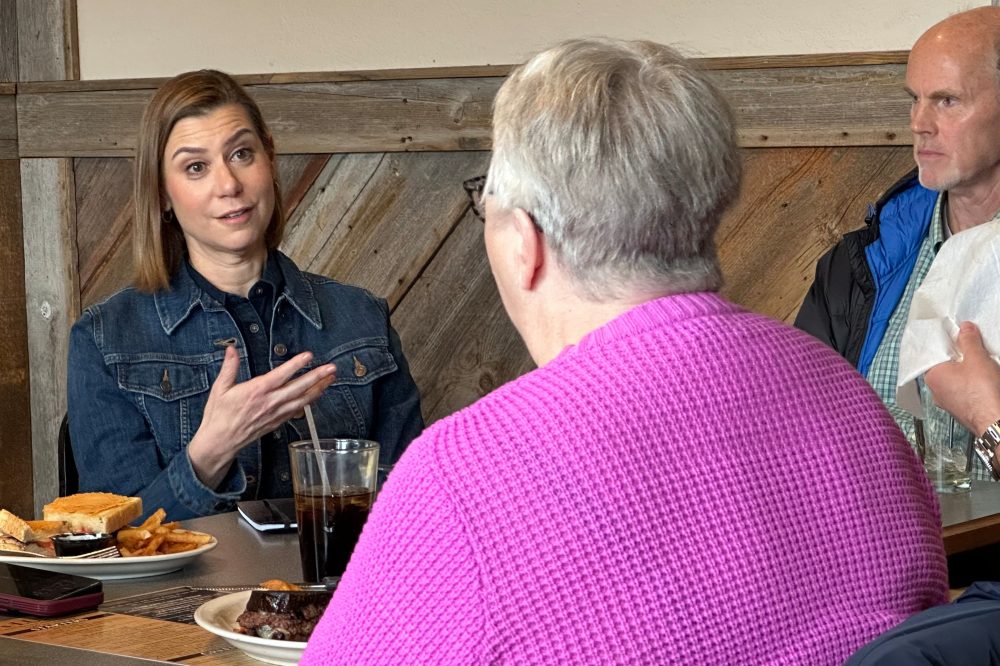

INDIANOLA, Iowa — Michigan Senator Elissa Slotkin engaged in a candid discussion with supporters of President Donald Trump during a Tuesday visit to Iowa, where she was campaigning for Democratic House candidates.
The senator, who is being mentioned as a possible 2028 presidential candidate, questioned five Iowa residents about political division in America and local concerns in their communities. Slotkin also inquired about their ideal candidate qualities and their reasons for choosing Trump over Vice President Kamala Harris in the recent election.
“What would have gotten you to actually consider a Democrat?” Slotkin asked as the discussion winded down.
She hadn’t told them yet she was one.
These conversations represent part of Slotkin’s broader effort to understand how Democrats might regain support in regions like Iowa, which supported President Barack Obama twice before backing Trump in the past three presidential contests.
“Frankly, sometimes the national party forgets about the middle of the country,” she told reporters, expressing her desire to be “a part of a new generation of Democrats” and push the party to be better.
“I think what works in the middle of the country can work on the coasts, but not the other way around. And I think we saw that in the last election.”
The Iowa visits also allowed the former CIA analyst to build name recognition beyond Michigan, as many voters — including those at Tuesday’s lunch — were unfamiliar with her background and positions.
After winning her Senate seat in 2024 following six years in the House, Slotkin was among six congressional Democrats with military or intelligence experience who created a video urging service members to refuse “illegal orders.” Trump labeled the lawmakers as seditious and threatened severe consequences, while the Justice Department opened an investigation into the video.
Slotkin explained Tuesday that they produced the video “for moments exactly like this,” speaking shortly before Trump temporarily suspended his threats against Iran’s “whole civilization.”
Her Iowa schedule also included a fundraising event and a county party gathering. She participated in a healthcare-focused town hall with state Senator Sarah Trone Garriott, a Democrat challenging U.S. Representative Zach Nunn in a highly competitive House race.
Slotkin delivered similar messages to both the Trump supporters and the Democratic audiences in Des Moines.
The senator expressed concern that political discourse has become so polarized that certain subjects are off-limits even in family conversations. She told both groups about hearing widespread frustration across party lines regarding healthcare costs and quality.
However, speaking alongside Trone Garriott, Slotkin articulated her own policy positions more clearly, advocating for a public health insurance option available to all ages. She offered guidance on persuading Republican neighbors to vote Democratic, arguing that Republican officials don’t support universal healthcare access.
“That is just the fundamental disagreement that we have between frankly Democrats and Republicans right now,” she said.
Iowa’s significance for Democratic presidential hopefuls has diminished since the party restructured its early primary calendar, removing Iowa from its traditional first-in-the-nation status. The state party eliminated its distinctive caucus system in 2024.
Iowa Democrats are now lobbying to reclaim an early primary position for 2028, competing with Michigan and other states for the first Midwest slot. The Democratic National Committee won’t determine the new order for several months.
“I’m not announcing anything,” Slotkin told reporters Tuesday, joking about the “cage match” between Iowa and Michigan for early primary placement.
Ed Klavins, a Trump supporter who attended the focus group, recognized Slotkin’s political aspirations.
“She’s trying to figure out what she can do differently to have a better chance of getting reelected and maybe higher office,” said Klavins, an Urbandale retiree who didn’t know Slotkin would be the featured guest and received $200 plus lunch for participating.
Klavins seeks politicians from both parties willing to challenge conventional thinking. He told Slotkin he wants candidates who avoid pandering to perceived voter preferences. He supports Trump’s approach to national security priorities, including border enforcement and addressing Iranian threats.
Despite their political differences, Klavins appreciated Slotkin’s willingness to listen, saying it “makes her a little more genuine in my eyes. I like her.”