
NABATIYEH, Lebanon — Shiite Muslims around the globe came together Friday in large numbers to observe Ashoura, one of the most significant days in their faith, with major gatherings taking place in Iran, Iraq, Lebanon, and other nations. The occasion honors the memory of Hussein, grandson of the Prophet Muhammad, who was killed in the seventh century.
Ashoura falls on the 10th day of the Islamic month of Muharram and serves as the final day of a 10-day mourning period. It commemorates the day Hussein was slain along with family members and companions while fighting against the forces of Caliph Yazid, a ruler to whom Hussein refused to submit.
Hussein’s death deepened the historic divide between Sunni and Shiite Islam and has long stood as a symbol of standing against tyranny and injustice.
This year’s observance took place in the aftermath of a war involving predominantly Shiite Iran and both the United States and Israel, which launched military strikes against the country on February 28. Those strikes resulted in the deaths of senior Iranian officials, including Supreme Leader Ayatollah Ali Khamenei. The 86-year-old Khamenei served not only as Iran’s highest political authority but also as the final voice on all religious matters, and was deeply venerated by Shiite communities worldwide. A funeral procession for Khamenei is set to be held in early July.
In the Iraqi Shiite holy city of Karbala, enormous crowds assembled Friday to mark the occasion. Hussein was buried there following the battle in 680 AD, and his shrine draws millions of Shiite pilgrims each year. In Baghdad, thousands took to the streets in procession, with some participants cutting their heads with razors and performing other acts of self-mortification as expressions of mourning — practices that are controversial and widely criticized within the broader Shiite community.
In Lebanon, where a fragile ceasefire between Israel and the Iran-backed Hezbollah group remains in effect, thousands of mourners dressed in black gathered in Beirut’s southern suburbs at a shrine dedicated to Hezbollah’s longtime former leader, Hassan Nasrallah, who was killed during a series of large-scale Israeli strikes in 2024.
Among those gathered, women held photographs of sons and brothers who had died in the war, many of them fighters for Hezbollah. Others carried images of Nasrallah or Iran’s Khamenei, who was killed in February in the U.S. and Israeli attack. Many wept openly. While expressions of grief for Imam Hussein are a traditional part of Ashoura, many in attendance were also mourning deeply personal losses.
One mourner, Nagham Jaber, said her fiance was killed in the war. “This war was truly harsh on all of us, and now we are feeling the meaning of Ashoura more than usual,” she said.
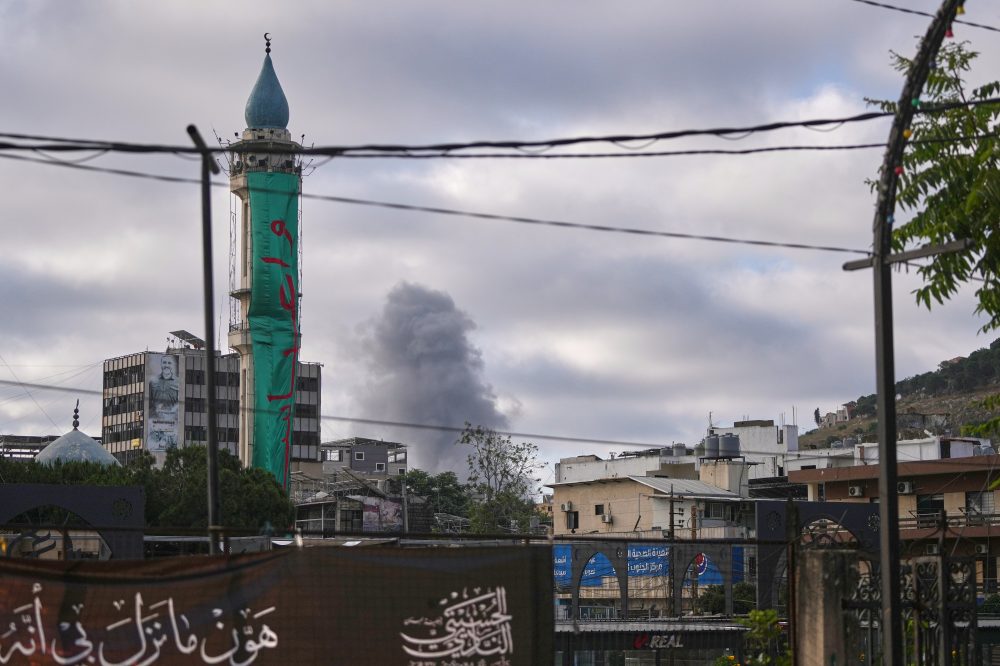
In the southern Lebanese city of Nabatiyeh — typically a central location for Ashoura observances — dozens gathered near the city’s main square, much of which has been left in ruins by Israeli airstrikes in recent weeks. Some participants inflicted head wounds on themselves as a form of mourning, a practice that is widely opposed within Shiite Islam, including by Hezbollah itself.
Earlier Friday, state media and journalists from The Associated Press on the ground reported two Israeli airstrikes on the nearby village of Nabatiyeh al-Fawqa. It was not immediately known whether the strikes caused any casualties.
“Despite all the hardships, everything happening to the Shiite Muslim community, and the wars we are facing, we came to reaffirm our loyalty, our love and our unwavering passion for Imam Hussein,” said Khader Kamal, one of those gathered at the event.
For Shiite Muslims, who represent the second-largest branch of Islam after the Sunni majority, the death of Hussein carries profound religious and historical weight and plays a central role in shaping community identity.
Hezbollah’s leader, Naim Kassem, addressed followers in a speech Friday, drawing a parallel between the historical events of Ashoura and what he described as current attacks by the U.S. and Israel. He said his movement and its supporters had been subjected to what he called a “war of elimination.”
“America and Israel also wanted to eliminate Iran by removing the regime and controlling the country,” Kassem said. He also commented on a recent agreement reached between Washington and Tehran, saying, “The memorandum of understanding is a declaration of defeat for America and Israel.”