
BATON ROUGE, La. — President Donald Trump’s chosen candidate for a Louisiana U.S. Senate seat is hoping to lock up the Republican nomination Saturday, adding another chapter to the president’s ongoing effort to replace GOP members who have defied him with candidates loyal to his agenda.
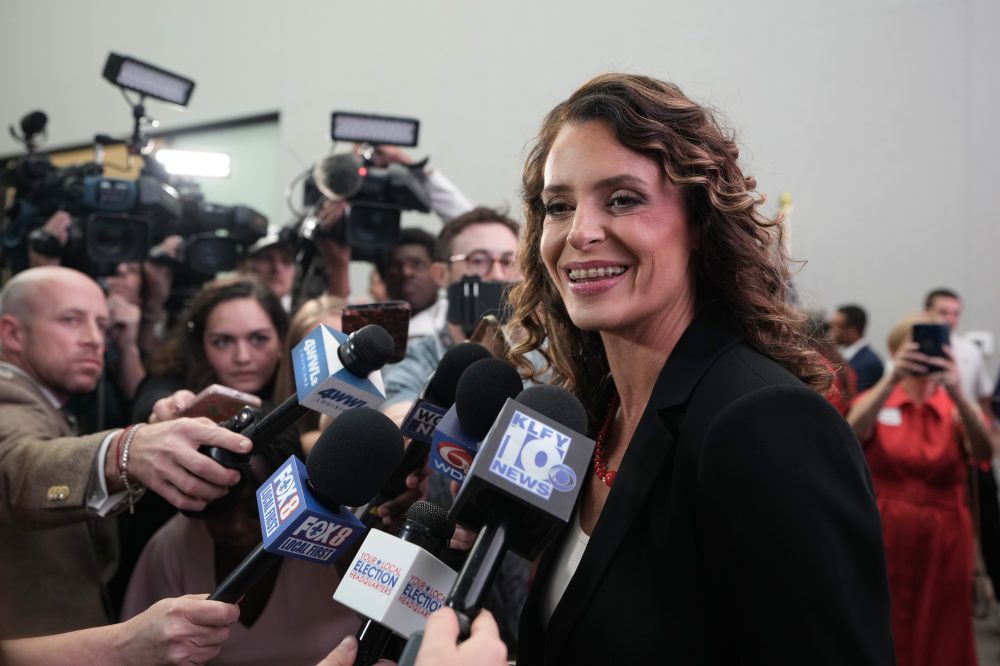
U.S. Rep. Julia Letlow, who carries Trump’s endorsement, is squaring off against state Treasurer John Fleming in the runoff election. The two advanced past two-term Sen. Bill Cassidy in the May 16 primary after Trump publicly turned against Cassidy, who had voted to convict the president following his 2021 impeachment trial.
Should Letlow prevail, it would represent the latest in a string of primary victories for Trump’s preferred candidates. Last month, Kentucky Rep. Thomas Massie, Texas Sen. John Cornyn, and five Indiana state senators all lost their reelection races to challengers Trump had supported.
Letlow entered the House of Representatives in 2021 following the death of her husband, Luke Letlow, who had won the same congressional seat but passed away before he could be sworn in. She secured Trump’s endorsement before formally joining the Senate primary race in January.
In the May primary, Letlow came out on top with nearly 45% of the vote. Fleming trailed with roughly 28%, while Cassidy received close to 25%.
“We have a chance to send a clear message that Louisiana stands with President Trump,” Letlow said during an online rally with the president on Thursday. “He endorsed me because he knows I will stand with him.”
Letlow enters the runoff with several advantages, including her first-place finish in May, strong campaign spending on her behalf, and backing from prominent Republican figures. She also has the support of Gov. Jeff Landry, who consulted with Trump last year about her potential Senate candidacy, as well as U.S. House Majority Leader Steve Scalise.
In last month’s primary, Letlow won parishes ranging from the rural northern part of the state to the New Orleans region in the southeast. She even carried six of the 13 parishes that Fleming once represented in Congress, including Caddo Parish, home to Shreveport.
Fleming, who was a founding member of the conservative House Freedom Caucus during his time in Congress, later served in Trump’s first administration. He has made a point of reminding voters that he did not step down following the January 6, 2021, attack on the U.S. Capitol by Trump supporters.
Fleming has positioned himself as a true believer in the president’s “Make America Great Again” movement, arguing that his voting record is more conservative than Letlow’s. His campaign ads have described him as MAGA “long before it was cool.”
Fleming has also told voters that White House allies of Gov. Landry blocked him from getting through to Trump to seek his endorsement. He says he eventually managed to reach the president by phone and reminded him of their history together.
“I said nobody has been more loyal to you than me,” Fleming recalled during a June campaign appearance. “He said, ‘You’re fantastic! Why didn’t you call?’”
Louisiana political consultant Mary Patricia Wray, who works with both Republican and Democratic candidates, said she expects Fleming to do well in rural areas, but believes Letlow holds the overall advantage.
“Higher-information voters in more populous areas are going to fall into that Letlow camp,” Wray said. “She is the more institutional-looking candidate.”
Both campaigns have spent roughly $1 million each on advertising. However, a super PAC backing Letlow has outspent everyone, pouring in $4 million since the primary, according to ad-tracking firm AdImpact.
Fleming has run ads targeting Letlow’s past public support for diversity, equity and inclusion policy — something Trump has worked to eliminate. Letlow, a former college administrator, acknowledged supporting DEI when she was interviewing for the presidency of the University of Louisiana-Monroe in 2020, but says she now opposes it.
Fleming also reposted an AI-generated video on the social platform X this month that falsely depicted Letlow saying she had backed DEI because she “didn’t know any better.” The fabricated video also made reference to her late husband, who died from COVID-19 complications.
Fleming said he did not produce the video “but it’s getting passed around Louisiana for a reason.”
Letlow called the sharing of the video “disgraceful and indefensible,” particularly because of the reference to her deceased husband.
Letlow has focused on issues important to social conservatives, including her backing of federal legislation that would prohibit transgender women and girls from competing in school sports.
Fleming built a significant portion of his campaign around opposition to carbon capture and sequestration — a process that involves injecting carbon dioxide underground to cut down on industrial pollution. Plans to expand the technology, including proposed pipelines, have generated strong pushback in rural Louisiana communities and created divisions within the state Republican Party.
Fleming has argued that such projects violate private property rights and that federal subsidies supporting the technology amount to wasteful spending.
On the Democratic side, Jamie Davis, a crop farmer from northeast Louisiana, is facing Gary Crockett, a Navy veteran and business executive. Both candidates have focused on lowering the cost of living and preserving social safety net programs.
Louisiana leans heavily Republican — Trump won the state by 22 percentage points in the 2024 election.