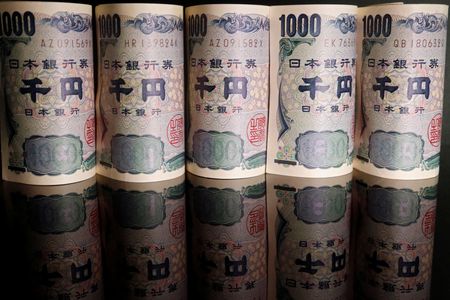

HONG KONG, June 5 (Reuters) – Japan’s currency approached a crucial 160-per-dollar threshold on Friday, triggering warnings from Japanese authorities, as the American dollar gains strength from Middle Eastern conflict concerns driving investors toward safer assets.
The yen dropped to the significant 160-per-dollar benchmark during early trading hours, reaching this level for three consecutive sessions despite official cautionary statements from authorities. Market observers widely regard the 160 threshold as a potential trigger point for government market intervention.
Finance Minister Satsuki Katayama stated Friday that Japan stands prepared to act appropriately whenever necessary regarding foreign exchange matters and maintains authority to implement “decisive action” to counter extreme market volatility.
The Japanese currency now faces its fourth consecutive week of losses, a pattern unseen since February, essentially eliminating intervention-driven gains accumulated over recent weeks at an expense of $73 billion.
“The critical question remains whether officials are willing to resume their battle against formidable macro headwinds” including elevated energy prices, robust U.S. data, and higher yields, wrote Tony Sycamore, market analyst at IG.
Earlier intervention attempts in late April produced only temporary effects, he noted, adding that the dollar would require sustained weakness below 155 to meaningfully challenge the current upward trajectory.
Japanese real wages increased 1.9% in April compared to the previous year, according to Friday’s government statistics, representing the fourth straight month of growth. The Bank of Japan, scheduled to examine interest rates June 15-16, views consistent wage and price increases as fundamental requirements for additional rate increases.
Sources informed Reuters that the BOJ anticipates raising interest rates unless significant Middle East conflict escalation disrupts markets, as rising fuel expenses from energy disruptions contribute to growing economic price pressures.
MIDDLE EAST CONFLICTS STRENGTHEN DOLLAR APPEAL
U.S. President Donald Trump’s initiatives to end Middle Eastern fighting and establish peace with Tehran encounter new challenges after Iran-backed Hezbollah militia dismissed a fresh Lebanese ceasefire Thursday while Israel announced it would maintain troop presence in the country.
This week’s renewed hostilities, including confrontations between Iranian and American forces, have driven Brent futures solidly above $90 for weekly gains while supporting dollar strength through safe-haven investment flows.
The euro remained at $1.1612, gaining 0.02% during Asian trading, while sterling held steady at $1.34228. Both currencies approach minor weekly decreases.
The risk-sensitive Australian dollar declined 0.1% to $0.71265, and the New Zealand dollar stayed flat at $0.5867 despite a 2% weekly increase.
The dollar index, measuring the greenback against multiple currencies including the yen and euro, showed minimal change at 99.434, tracking toward a 0.5% weekly gain.
Regarding upcoming data, markets eagerly anticipate nonfarm payroll figures scheduled for release later globally. A Reuters economist survey projected an 85,000 job increase for May, slower than April’s 115,000 rise. The unemployment rate forecast remains unchanged at 4.3%.