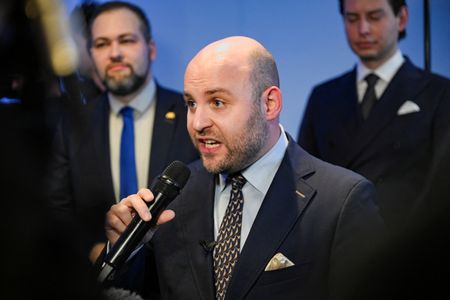

A leading figure from Germany’s far-right Alternative for Germany party has conducted meetings with high-ranking Russian officials, including sanctioned energy executives and advisors to Russian President Vladimir Putin.
Markus Frohnmaier, who serves as the AfD’s parliamentary foreign policy spokesperson, participated in Putin’s signature economic summit in St Petersburg despite explicit warnings from Germany’s foreign ministry, which stated it “explicitly advised the AfD against these trips”.
Through posts on social media platform X, Frohnmaier revealed he had conducted meetings with Gazprom CEO Alexei Miller and Kirill Dmitriev, Putin’s special envoy for investment and economic cooperation, during Wednesday’s events.
All three individuals – Dmitriev, Miller and Gazprom – face Western sanctions related to Russia’s military conflict in Ukraine.
Frohnmaier, who has consistently advocated for Germany to restore diplomatic ties with Russia for energy supply purposes, indicated the discussion with Miller centered on pipeline infrastructure and complete restoration of Russian gas shipments to Germany.
“Germany is caught in a severe economic downward spiral, and a key driver of this is the high cost of energy,” Frohnmaier stated.
“That is why all options must be put back on the table, including the recommissioning of Nord Stream and the resumption of trade relations with Russia.”
Gazprom officials also verified the meeting occurred with Frohnmaier.
“Looking forward to building a great FUTURE together with AfD, Germany’s most popular party,” Dmitriev posted on his X account.
Germany’s economic foundation relied heavily on affordable Russian energy resources for many years. Before Moscow’s military action in Ukraine began, Russia provided more than one-third of crude oil imports and over half of natural gas supplies.
The nation has faced significant challenges recovering from the disruption caused by the Nord Stream pipeline shutdown, which suffered damage from explosions in September 2022, forcing Berlin to seek alternative energy sources urgently.
The blasts damaged both pipelines in Nord Stream 1. Nord Stream 2, which was completed in 2021, maintains one undamaged pipeline, but Germany suspended the project and operations never commenced.
Russian officials have blamed Ukraine for the pipeline attack, though Kyiv has consistently rejected any responsibility.
Current polling data indicates the AfD, presently the main opposition party in parliament, is gaining ground against Chancellor Friedrich Merz’s conservatives, who maintain a coalition with the centre-left Social Democrats.
With two significant state elections approaching in eastern Germany this September, the AfD aims to secure governmental control for the first time in Saxony-Anhalt, while polling suggests the party could capture the most votes in Mecklenburg-Vorpommern.
The party, which has also achieved notable success in recent western German elections, has criticized Merz’s robust Ukraine support and indicates it would seek to rebuild diplomatic ties with Moscow.
“At a time when many seem more comfortable with confrontation than conversation, genuine dialogue matters more than ever,” Frohnmaier posted on X following his meeting with Dmitriev.