
JERUSALEM (AP) — With American military forces building up across the Middle East, the Islamic Republic of Iran confronts the possibility of major military action from the globe’s strongest armed forces, with potential targets including leadership, military installations, nuclear facilities, and essential infrastructure.
Tehran’s military strength pales in comparison to U.S. capabilities and has been further diminished following Israel’s military campaign last year and domestic unrest. However, the nation retains the ability to cause significant harm to American troops and regional partners, particularly if regime survival becomes the primary concern.
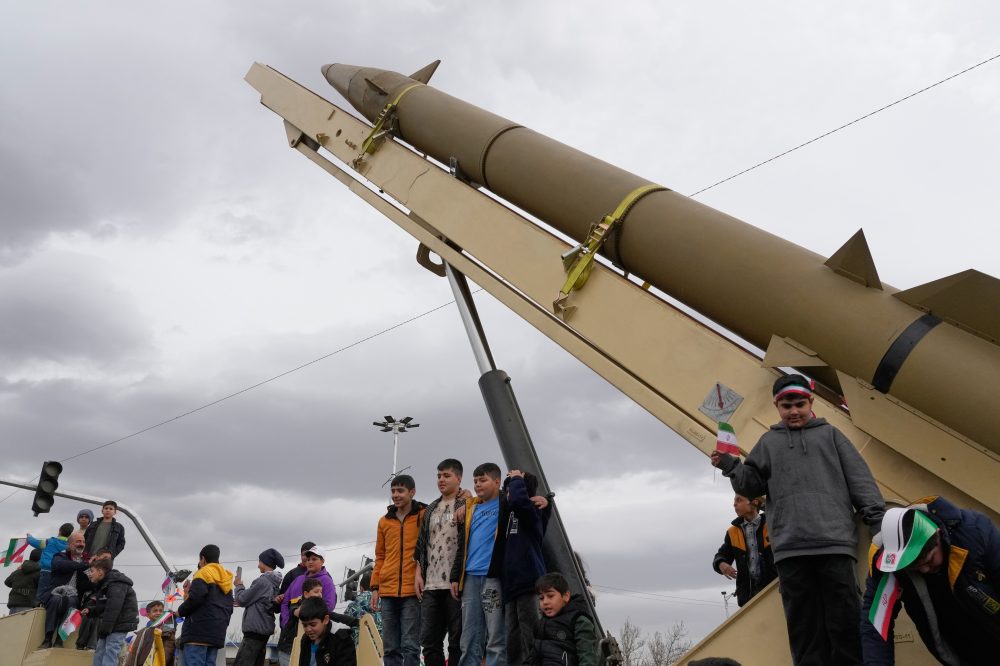
Despite substantial losses sustained in June, Israeli intelligence indicates Iran maintains hundreds of missiles with the range to strike Israeli territory. The country possesses an even more extensive collection of shorter-range weaponry capable of reaching American military installations throughout Gulf nations and naval forces, which will soon include a second aircraft carrier group.
Tehran has repeatedly issued warnings about blocking the Strait of Hormuz, a crucial passage for international petroleum commerce, and asserted it achieved partial closure during recent military exercises.
Supreme Leader Ayatollah Ali Khamenei issued threats about destroying U.S. naval vessels, while senior government figures have declared that American aggression would trigger broader regional conflict. Iran’s United Nations representative Amir Saeid Iravani stated that “all bases, facilities and assets of the hostile force in the region” would become valid military objectives.
During the 12-day conflict in June, Israeli forces conducted extensive bombardments against Iran’s long-distance missile stockpiles, along with military commanders and nuclear infrastructure. American forces targeted Iran’s primary atomic facilities, with President Donald Trump declaring at that time they had been “obliterated.”
The full scope of destruction and subsequent reconstruction efforts remains unclear. Iranian forces maintained their missile and drone attacks against Israel throughout the hostilities, progressively penetrating the country’s advanced defensive systems.
Danny Citrinowicz, an Iranian affairs specialist at Israel’s Institute for National Security Studies, noted that Iran’s short-range missile capabilities remained mostly intact. This situation could encourage Iranian retaliation against the tens of thousands of American military personnel stationed in Qatar, Saudi Arabia, Jordan, the United Arab Emirates, and other regional locations.
“Iran may be weak. But it still has ways to inflict real pain on the United States — and much more incentive to try than it did before,” Nate Swanson, head of the Atlantic Council’s Iran Strategy Project, wrote in Foreign Affairs. “Iranian officials feel they need to give Trump a bloody nose or they will perpetually be at risk.”
Following the assassination of its leading military commander in 2020, Iran fired missiles at an American installation in Iraq and struck a U.S. facility in Qatar during the final stages of last year’s warfare. These attacks, which seemed deliberately signaled beforehand, resulted in property damage without casualties as warning systems and defensive measures activated successfully.
Tehran could execute operations beyond the immediate region. Intelligence agencies have linked the country to utilizing criminal organizations and militant factions for planning or executing attacks globally, targeting dissidents, Israelis, and Jewish communities.
Israeli military action last year eliminated multiple high-ranking officers and nuclear researchers, exposing significant security weaknesses. Trump previously claimed American intelligence had located Khamenei’s whereabouts, describing him as an “easy target.”
Following the recent apprehension of Venezuelan leader Nicolás Maduro, Trump might pursue targeted elimination operations designed to topple Iran’s multi-decade Shiite religious government, which he recently described as something that “would be the best thing that could happen.”
Iranian leadership has spent eight months addressing previous vulnerabilities and strengthening internal protection measures. Citrinowicz suggested contingency arrangements likely exist should Khamenei be eliminated. Instead of designating a single replacement, authority would probably transfer to a small governing body during active conflict.
Analysts believe the death of 86-year-old Khamenei, who has controlled Iran for more than thirty years, would not automatically destroy the Islamic Republic. Leadership might ultimately transfer to a trusted associate, similar to Venezuela’s transition, or to Iran’s Revolutionary Guard forces.
Regional allies express clear anxiety about widespread warfare, while Prime Minister Benjamin Netanyahu has promised severe retaliation for any Iranian assault on Israel.
Arab Gulf nations have historically regarded Iran with suspicion and depended on American protection, yet prefer avoiding military involvement. Saudi Arabia and the United Arab Emirates, hosting thousands of U.S. service members, have declared they would prohibit use of their airspace.
A Gulf diplomatic source revealed regional leadership maintains communication with both Iran and America to prevent warfare, cautioning about serious ramifications including petroleum price increases. The official requested anonymity when discussing these confidential negotiations.
Iran maintains its own partnerships, including Yemeni Houthi fighters, Iraqi militant organizations, Lebanon’s Hezbollah, and Hamas in Palestinian areas. However, this self-proclaimed Axis of Resistance experienced major defeats during fighting that spread throughout the region following Hamas’s October 2023 Gaza offensive.
Another nearby objective could enable Iran to cause broader economic damage.
Approximately twenty percent of global oil commerce travels through the Strait of Hormuz, located near Iranian coastline. The U.S. Navy maintains commitment to keeping this waterway accessible, but Iranian interference could disrupt commercial activity, similar to the Houthis’ successful Red Sea disruption over the past two years.
Iranian authorities have not directly threatened the strait during current tensions, but military forces achieved partial closure last week during training exercises, demonstrating potential vulnerability during wartime.
Additional vital petroleum infrastructure would fall within striking distance. In 2019, attacks on oil facilities temporarily reduced Saudi Arabia’s output by half. Yemen’s Houthis accepted responsibility, though American officials subsequently attributed blame to Iran.
After initially threatening military response to Iran’s suppression of demonstrators, Trump redirected focus toward the nuclear program, warning that “bad things” would occur without a negotiated agreement. Both parties plan another round of indirect discussions in Geneva on Thursday.
Iran has consistently maintained its atomic program serves peaceful purposes, while America and other nations have long suspected Tehran ultimately intends weapons development. After Trump abandoned a 2015 nuclear accord, Iran accelerated uranium enrichment activities, accumulating stockpiles of near-weapons grade material.
Iran’s largest facilities suffered American and Israeli strikes, causing considerable surface damage. Whether enriched uranium was relocated before attacks or stored underground remains unknown. Iran claims enrichment capabilities have been eliminated since then, while simultaneously preventing inspections.
Iran is still considered far from producing functional nuclear weapons, though radioactive materials could create hazards during extensive military strikes.