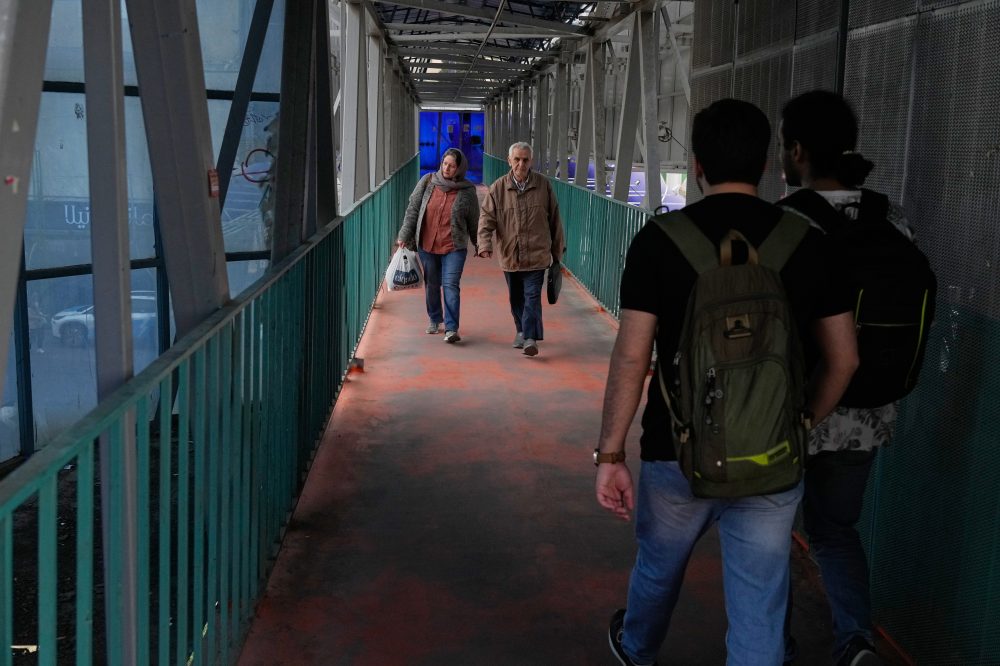

DUBAI, United Arab Emirates (AP) — Iranian citizens are expressing deep concern as America positions unprecedented military strength throughout the Middle East, while diplomatic negotiations scheduled for Geneva this week represent what many consider a final opportunity for Iran’s leadership to reach an agreement with President Donald Trump.
Many describe feeling hopeless about their situation. Already weakened by years of economic sanctions that intensified after Trump pulled out of the international nuclear agreement in 2018, Iranians recently endured their nation’s most violent suppression of protesters in modern times, with security forces killing thousands and arresting tens of thousands more in January.
With Geneva negotiations set for Thursday, numerous citizens express fear about potential military conflict that could exceed the devastating Iran-Iraq war of the 1980s.
However, unlike that previous conflict which united Iranians in patriotic defense, the possibility of war with America has created deep divisions among citizens who range from steadfast government supporters to those believing their nation is fracturing.
“Every morning when I get up, my brain is full of chaos,” said Sepideh Bafarani, a 29-year-old woman who works in a woman’s clothing store. “It’s a possible war … and an ongoing bad economic situation.”
Rasool Razzaghi, a 54-year-old resident in Tehran, the Iranian capital, summed up the approaching talks with a similar concern.
“I predict that if both sides really mean what they are saying, a war will start,” he said.
Trump has spent recent weeks discussing an “armada” now positioned near Iran’s coastline, featuring the aircraft carrier USS Abraham Lincoln. Additionally, he has deployed the USS Gerald R. Ford, the globe’s largest aircraft carrier, from Caribbean waters toward Middle Eastern positions.
Analysis from Washington’s Center for Strategic and International Studies indicates at least 16 U.S. Navy vessels have been assembled in the region.
This deployment mirrors Operation Desert Fox from 1998, when American and British military forces conducted four days of bombing campaigns against Iraq due to Saddam Hussein’s failure to meet U.N. Security Council requirements regarding weapons inspections. Combined with carriers and ground-based aircraft in Jordan, the force includes stealth F-35 fighters and additional warplanes capable of executing significant strikes against Iran.
Iranian citizens have monitored this military concentration with increasing alarm, either by circumventing internet restrictions or accessing satellite news broadcasts. Meanwhile, Iranian state television continues broadcasting footage of domestic military exercises and officials promising massive retaliation against any American attack.
Tuesday reports from Iranian state TV described Revolutionary Guard exercises involving missile launches, drone flights, and coastal target practice, though specific timing and locations weren’t provided.
“I don’t know. I’m not so optimistic,” a passer-by told The Associated Press on Tuesday in Tehran, declining to give his name for fear of reprisals. “It’s not an equal situation. One side has entered the talks with a lot of power, it has lot of equipment. On the other hand, Iran is in a weak position. They want total surrender, but I think that’s not viable.”
Steve Witkoff, Trump’s billionaire associate now functioning as his Middle East envoy, has stated the president couldn’t understand why Iran “hadn’t capitulated” considering the forces positioned against it regionally and in Europe. Iranian Foreign Minister spokesman Esmail Baghaei rejected Witkoff’s remarks Monday, declaring “the word ‘capitulation’ does not exist in the Iranians’ dictionary.”
Beyond public rhetoric, uncertainty remains regarding what Iran might propose to Trump. Tehran maintains its intention to continue uranium enrichment, which Trump has consistently demanded must cease. Iran also refuses to negotiate regarding its ballistic missile program or regional proxy support, both additional Trump requirements.
Communication with Iranian citizens remains challenging as internet and phone services continue experiencing disruptions following last month’s nationwide demonstrations. Tehran residents often remain wary of speaking with journalists, frequently assuming all reporters work for the government. Iran’s theocracy maintains control over all domestic radio and television broadcasting.
Those willing to speak with AP repeatedly referenced the 1980s Iraq conflict, a traumatic experience for anyone old enough to remember.
“I remember many bad situations but even during Iran-Iraq war in 1980s it was not like this,” said Hassan Mirzaei, a 68-year-old taxi driver. “I am in shock without any hope — especially when there is word about war.”
He added: “I have two orphaned grandchildren, and I need to work to feed.”
“Everybody is worried because (of) the consequences of war with a country like America,” said the Tehran passer-by. “We once fought Iraq for eight years, but it was a country at the same level with us. Going to war with America, Israel and NATO will have very horrible and unpredictable consequences.”
“What can we do,” he added. “We can’t leave your country. We have no choice but to adapt.”
However, not all citizens oppose their government. Ami Mianji, a 33-year-old who runs an auto repair shop, described Iranians as a brave people who are not afraid of war.
“I do not care about threats by Trump and others, eventually Iranians will push back any warmonger,” Mianji said.
For many younger citizens, however, the recent protest crackdown has destroyed any remaining trust in their government.
“I have no hope,” said one student who spoke to the AP on condition of anonymity also fearing reprisals. “Iran is refusing to back down from its positions for sure, because if it does, it would have officially given up its 40-year-old ideology.”
“I have no hope,” he added. “The leaders of both countries speak often and none of them is willing to concede to reach a deal. So the likelihood for war is high.”