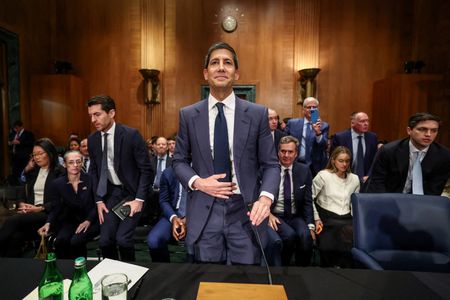

Federal Reserve nominee Kevin Warsh has expressed his desire for robust debate among policymakers once he assumes leadership of the nation’s central bank, describing his preference for what he calls a “good family fight” at decision-making meetings.
However, Warsh may encounter significant pushback if he attempts to implement the dramatic interest rate reductions that President Donald Trump anticipates from his Fed chair pick when Jerome Powell’s term concludes on May 15.
Among the 19 Federal Reserve officials responsible for setting interest rates, who are scheduled to meet Tuesday for what will likely be their last two-day policy session under Powell’s guidance, approximately half maintain hawkish positions. These officials prioritize concerns about potential inflation increases over employment market deterioration, making them reluctant to support rate reductions.
Roughly one-third of the officials hold centrist views, while only three have advocated for immediate cuts to borrowing costs. Fed Governor Stephen Miran, who belongs to this dovish group, is preparing to resign to allow Warsh to join the Federal Reserve’s Board of Governors.
The Senate Banking Committee is anticipated to move forward with Warsh’s nomination on Wednesday for full Senate consideration, improving prospects that the 56-year-old attorney and financial expert will be positioned to lead the Fed’s June 16-17 meeting.
Regarding employment conditions, Warsh shared his perspective with legislators during his confirmation hearing last week: “I think broadly speaking, the economy is running about close to full employment … if Americans that want a job can find a job, by the Fed’s metric we’re at full employment.”
This assessment may find agreement among his future colleagues. While monthly job growth has declined significantly over the past year, the number of people seeking employment has also decreased, primarily due to reduced immigration levels and the ongoing retirement of aging U.S.-born workers. These factors have maintained relatively low unemployment, which dropped to 4.3% in March.
Nevertheless, some Fed officials express concern about employment market vulnerability, particularly those with more dovish leanings.
“I continue to see weakness in the labor market that leaves it vulnerable, starting with data showing low numbers of both hires and people losing their jobs,” Fed Governor Christopher Waller stated earlier this month.
Currently, most Fed policymakers view the employment situation as stable and are examining inflation data to guide monetary policy decisions.
On inflation matters, Warsh testified during his confirmation that he believes inflation “has improved somewhat in the last year,” a perspective that differs from many Fed officials who cite the Trump administration’s new import tariffs as contributing to stagnant inflation progress. They also express concerns that the Iran conflict and substantially higher oil prices could drive inflation upward again.
Core inflation, measured by the year-over-year change in the core Personal Consumption Expenditures Price Index, reached 3% in February, with economists projecting an increase to 3.2% in March. The 12-month PCE Price Index change, which the Fed aims to keep at 2%, is estimated to have reached 3.5% in March.
During his testimony, Warsh indicated his preference for trimmed-mean measurements, which exclude the most rapidly rising and falling prices to provide a clearer picture of overall price trends. The Dallas Fed’s trimmed mean reading was 2.3% in March.
If these remarks suggested Warsh’s interest in reconsidering the Fed’s 2% inflation target, he may find limited support. Nearly all current central bank policymakers have indicated no interest in revising this goal, particularly given the Fed’s failure to meet it for five consecutive years.
However, most central bankers already examine various inflation indicators. Dallas Fed President Lorie Logan, whose regional bank produces the most recognized trimmed-mean measure, ranks among the central bank’s most hawkish policymakers.
Powell has characterized the Fed’s monetary policy as “well-positioned,” language adopted by many colleagues that indicates satisfaction with maintaining the current 3.50%-3.75% policy rate range, which the central bank is expected to preserve at this week’s meeting.
Some hawkish-leaning officials have even suggested modifying the Fed’s policy statement to show equal consideration for rate increases and decreases as potential next steps. Others argue that inflation pressures warrant postponing any rate cuts, possibly until next year. Financial markets currently expect no rate reductions this year.
At his confirmation hearing, Warsh did not repeat his earlier support for immediate rate cuts that he had expressed while Trump was considering his Fed chair selection. His silence on this topic may reflect his belief that Fed policymakers should avoid providing “forward guidance” about upcoming decisions or rate projections.
Warsh did not object when questioned about Trump’s suggestion that the Fed should reduce its policy rate to 1% by year’s end, a dramatic decrease typically associated with recessions and crises rather than economic growth.
Concerning the Fed’s balance sheet, Warsh told lawmakers that interest rate discussions should include balance sheet considerations because “those tools should be working in concert, not at cross purposes.” He contends that reducing the balance sheet would provide room for lowering short-term rates, a viewpoint that has gained public support from only one Fed policymaker so far.
Most of Warsh’s prospective colleagues view balance sheet discussions as separate from interest rate policy, except during crises. Warsh advocates shrinking the balance sheet while most Fed officials expect modest expansion aligned with economic growth and currency demand. They do appear to agree with Warsh that balance sheet changes should occur gradually.
Warsh’s belief that artificial intelligence will likely boost long-term economic productivity finds receptive listeners among policymakers. Enhanced productivity growth could potentially justify rate cuts by allowing faster economic expansion without inflation risks.
However, timing remains crucial. Several Fed officials have cautioned that artificial intelligence investment may currently contribute to price pressures. The long-term rate implications remain uncertain as AI will also impact employment in ways Fed policymakers are just beginning to understand.