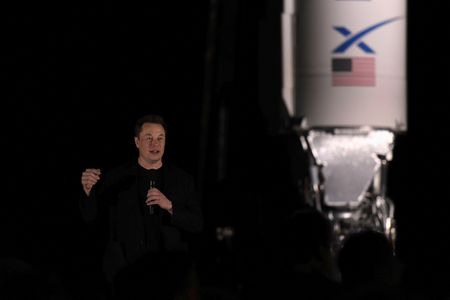

SpaceX directors have given the green light to an extraordinary pay structure for company founder Elon Musk that connects his earnings to some of the most ambitious goals ever set by a corporation: establishing a human settlement on Mars and creating orbital data facilities.
Information about Musk’s unprecedented compensation arrangement, which had not received broad media coverage previously, emerged from SpaceX’s private filing documents submitted to federal securities regulators in recent weeks and examined by Reuters.
The ambitious incentives offered to Musk by SpaceX illustrate the difficulty of maintaining the focus of the multi-venture business leader as the rocket company moves toward going public. Corporate governance specialists warn this could also create friction between SpaceX stakeholders and Tesla investors, where Musk serves as chief executive.
Blending science fiction aspirations with financial obligations, SpaceX’s board gave approval in January to a compensation structure for the world’s wealthiest individual that would grant him 200 million super-voting restricted shares if the company achieves a $7.5 trillion market valuation and creates a sustainable human settlement on Mars housing no fewer than 1 million residents, based on portions of the company’s regulatory filing examined by Reuters.
His space-focused performance package additionally provides up to 60.4 million restricted shares granted on March 23 if SpaceX achieves distinct valuation benchmarks and runs orbital data facilities delivering no less than 100 terawatts of computing power – an enormous energy requirement equivalent to 100,000 gigawatts, or roughly 100,000 one-gigawatt nuclear facilities operating simultaneously. Both compensation awards include super-voting Class B restricted stock, providing 10 votes for each Class A share, and become available in portions as company value increases.
Nevertheless, Musk will receive no shares whatsoever if the company cannot meet the board’s ambitious valuation benchmarks, which lack specific deadlines beyond his ongoing employment. Since 2019, he has earned a basic annual salary of $54,080 from SpaceX.
Determining the compensation package’s worth remains impossible since SpaceX operates as a private company. The rocket manufacturer plans an initial public offering around Musk’s June 28 birthday, potentially valuing the enterprise at approximately $1.75 trillion, according to Reuters reporting.
By December 31, Musk possessed 68.8 million previously granted Class B stock options with an exercise price near $42 that expire in 2031, enabling him to capture any gains beyond that threshold if he uses the options before expiration.
Forbes estimates Musk’s current wealth at $776 billion. Beyond SpaceX, he could potentially more than double that figure by meeting separate, demanding performance objectives at Tesla, the electric vehicle manufacturer he also leads. According to the registration documents, he controlled roughly 20% of Tesla’s shares as of November.
Neither SpaceX nor Tesla provided responses to comment requests. Both The Information and Reuters have previously covered SpaceX compensation targets for Musk connected to Mars colonization and orbital data centers.
Executive pay specialist Eric Hoffmann, who serves as chief data officer for corporate governance consulting company Farient Advisors, stated he was unaware of anything even remotely similar in other companies’ compensation arrangements.
“I’m not a physicist or astronomer and I wouldn’t know where to start,” Hoffmann explained. “The measuring stick is, has it been done in human history? These haven’t. So that’s hard.”
Currently, SpaceX and Tesla are essentially competing for Musk’s attention, according to Hoffmann. He pointed out how Tesla’s board argued just last fall that it required generous compensation to maintain Musk’s focus on the automotive company. Tesla previously revealed that Musk actually threatened to depart if shareholders rejected the proposal.
“What’s interesting about this situation is now, SpaceX and Tesla, both effectively controlled by Elon Musk, are now bidding against each other for his attention,” Hoffmann observed.
Equilar Director of Research Courtney Yu also noted the Mars colonization and space data center objectives were remarkable because he could not recall any other corporation – except Tesla – employing metrics beyond traditional financial measures like earnings or revenue to establish CEO compensation.
The responsibility lies with the respective company boards, SpaceX and Tesla, to decide how to best allocate Musk’s time, Yu explained. Although a $7.5 trillion market value for SpaceX might appear extraordinary, Yu said in a phone conversation, “it does help with setting expectations for investors as to what the goals of the company really are.”