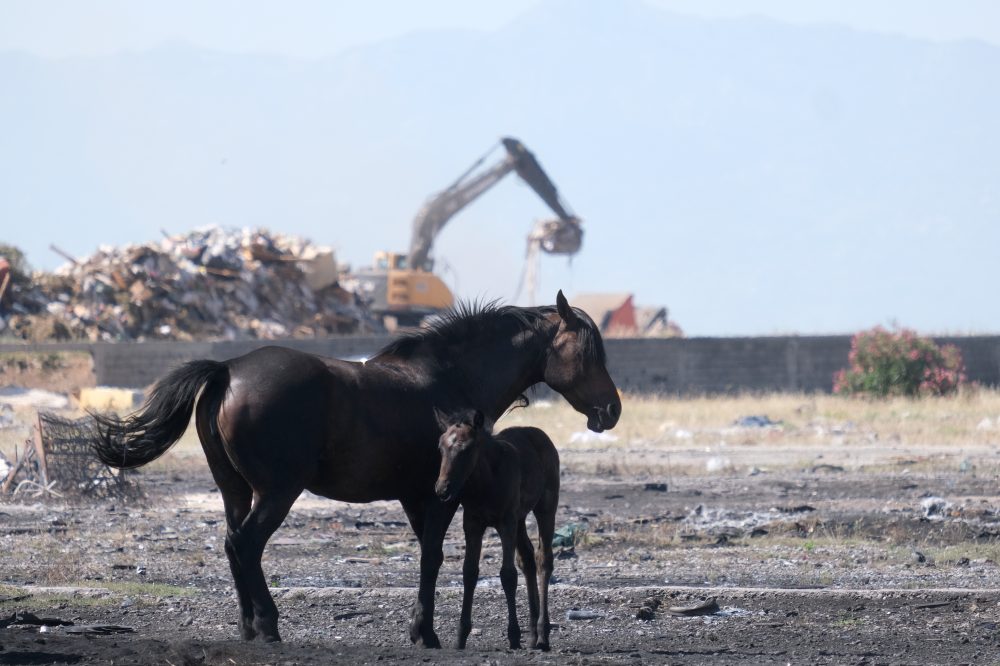

PODGORICA, Montenegro — A dangerous heat wave that has been scorching western Europe has now moved into the Balkans, and animal welfare advocates in the small nation of Montenegro are sounding the alarm over a long-standing problem with abandoned animals.
Multiple horses without owners have been spotted wandering the outskirts of Montenegro’s capital city, Podgorica, exposed to extreme heat with no shelter, water, or food available. Temperatures in the area have climbed to nearly 40 degrees Celsius — about 104 degrees Fahrenheit — leading activists to warn that the animals’ lives may be at risk.
Animal protection activist Marta Darmanovic pointed out just how close to civilization these animals are. “This is only 4 kilometers (2.4 miles) from the city center,” she said. “It is not in the middle of nowhere.”
Across Europe, the ongoing heat emergency has shattered temperature records in numerous countries, overwhelmed healthcare systems, and left residents struggling to find relief from the heat. In France, this week’s temperatures have already surpassed those recorded during a devastating 2003 heat wave that was linked to the deaths of 15,000 people, many of them elderly.
Back in Podgorica, the open land where the horses have congregated sits near an illegal dumping site and several informal, unregistered settlements. It remains unknown how the animals ended up there or whether anyone claims ownership of them.
Darmanovic was sharply critical of the country’s failure to build proper facilities for large animals. “It is simply unbelievable that a country does not have a shelter for large animals, for confiscated horses, confiscated livestock, stray livestock and wild animals,” she said. “Montenegro has effectively legalized animal abuse because it has failed to provide even minimum infrastructure needed for the regulations to be enforced.”
Montenegro, an Adriatic nation with a population of just 620,000, is working toward European Union membership by 2028. Countries seeking to join the EU are required to have animal welfare laws in place as part of the accession process.
Branko Kovacevic, who leads Podgorica’s Municipal Inspection Administration, acknowledged the situation and said the city has already set up shelters for dogs and cats. His agency, he said, is now trying to address the issue of large animals within the framework of existing regulations.
“Horses and some other abandoned domestic animals keep appearing,” Kovacevic said. “As far as the law allows us, we deal with the problem.”
He also acknowledged a troubling gap in responsibility, saying that “unfortunately, nobody is responsible” for ensuring these animals have access to food or water.
Although Montenegro and the broader Balkan region are more accustomed to hot summers than countries like France or Britain, officials have still urged residents to remain indoors and stay hydrated. Cooler temperatures are expected to arrive by Tuesday and Wednesday.
Meanwhile, in the eastern Croatian city of Osijek, zoo animals are getting a special treat to help them cope with the heat — ice cream made from fruit and meat. A zoo employee named Zeljko Busljeta told Croatian broadcaster HRT that the monkeys have been choosing to stay inside and rest during the hottest parts of the day.
“They like cold water melons, melons and grapes,” Busljeta said. “They also get lemonade and cold tea.”