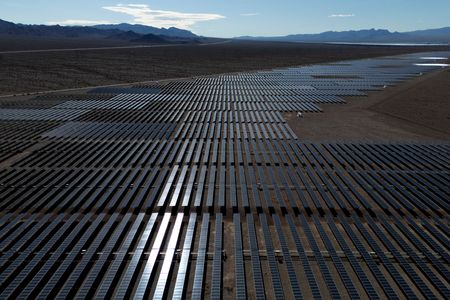

The Trump administration is quietly putting together a plan to ban imports of foreign inverters — the devices that connect solar panels and battery systems to the power grid — amid growing fears that China could exploit them to disrupt electricity supplies across the country. Five people with knowledge of the effort confirmed the move to Reuters.
The rule under development by the U.S. Federal Communications Commission would cover new foreign models of inverters and could be made public before the year is out, according to the sources, who requested anonymity because the matter has not been officially announced.
Part of what pushed the Trump administration to revisit the idea was a decision made in May by the European Commission to prohibit Chinese-manufactured inverters from publicly funded energy projects, according to the same five sources. However, they noted the U.S. proposal could still be changed or dropped entirely.
The FCC and the White House both declined to offer any comment on the draft measure. The Chinese Embassy in Washington pushed back, saying it “firmly opposes the overstretching of the concept of national security and its unjustified suppression of Chinese companies,” and called on the U.S. to provide “a fair, just and non-discriminatory environment” for Chinese businesses.
This latest move reflects Washington’s renewed and more cautious approach to addressing technology-related threats from China — a shift that follows a period last year when President Donald Trump was pursuing a period of reduced tensions with Beijing.
During that stretch, the Trump administration took a notably softer line on China, in part because Beijing had aggressively wielded export controls over rare earth minerals.
China is the world’s top producer of inverters, with Sungrow Power Supply and Huawei among its leading manufacturers. Chinese companies have been expanding their foothold in Western markets by undercutting competitors on price.
Reuters previously reported that U.S. experts who examine grid-connected equipment for security vulnerabilities discovered unauthorized communication devices — not listed in product documentation — hidden inside some Chinese solar inverters.
Uri Sadot, CEO of energy security firm SolarDefend, described the stakes plainly: “Europe and America are waking up to the risk of losing sovereign control over their power systems through inverters.”
Huawei has already faced extensive U.S. sanctions in other sectors due to national security concerns and allegations of intellectual property theft.
Heather Conley, a Europe expert at the American Enterprise Institute, a conservative think tank based in Washington, said the measures could point to greater alignment between the U.S. and Europe on China policy. She noted that Group of Seven leaders agreed this month to work together to reduce dependence on China for critical minerals.
The U.S. Department of Defense is already prohibited from purchasing solar photovoltaic cells, modules, or inverters made by a foreign entity of concern — a category that includes Chinese companies — under the National Defense Authorization Act for fiscal year 2026.
The Trump administration had previously explored banning Chinese inverters, according to nine people familiar with the situation. Last summer, the White House’s National Energy Dominance Council directed the Commerce Department to fast-track such a ban, but that effort lost momentum, three of the sources said.
Efforts to ease tensions with Beijing led the Commerce Department to set aside a range of punitive actions targeting Chinese technology, Reuters has reported, including measures aimed at Chinese-made drones and routers.
The Commerce Department did not respond to requests for comment.
The FCC later moved forward on its own, issuing bans on new foreign models of drones and routers in December and March, respectively. Those bans allow companies to seek waivers to sell new equipment in the U.S. market, though none have been approved for Chinese firms so far.
The FCC told Reuters in a statement that those bans were “entirely country neutral and did not target any country in particular.”
In Europe, officials are weighing additional steps to strengthen security around inverters, including the possibility of designating certain suppliers as high-risk. If adopted as part of an updated Cybersecurity Act, some Chinese inverter suppliers could face being blacklisted. A European Commission spokesperson stressed that the act does not single out any specific country, but rather establishes a framework to identify nations that raise cybersecurity concerns.