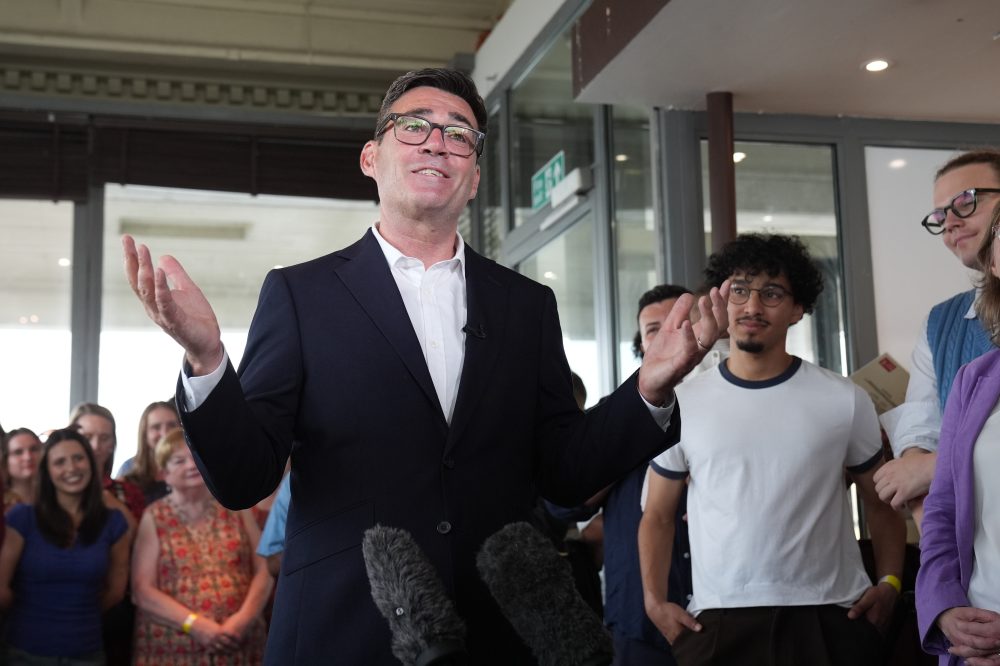

LONDON (AP) — Andy Burnham spent years working his way up before reaching the top — and now that he’s there, the clock is already ticking.
A decade ago, Burnham walked away from a 20-year career climbing the Labour Party ranks in London to head north and take on the role of Greater Manchester’s mayor. Just one month ago, he secured a return to Parliament by winning a high-stakes special election. This Monday, he will be sworn in as Britain’s 59th prime minister.
The abrupt collapse of Prime Minister Keir Starmer’s government after only two years in power has thrust the 56-year-old Burnham into the country’s top job — largely untested on the national stage and unfamiliar to much of the British public outside Manchester. He steps through the door of No. 10 Downing Street carrying enormous expectations and serious doubts about whether he can meet them.
“A whole range of people across the Labour movement and in the country have projected onto Andy Burnham their hopes and their fantasies about how the country should be run and what Labour should stand for and what Andy Burnham stands for,” said Joshi Herrmann, founder of Manchester news site The Mill. “He has got lots of people’s hopes up.”
Though Burnham made his reputation in Manchester, he was actually born in Liverpool and grew up in a commuter village situated between those two rival cities in northwest England.
His father worked as a British Telecom engineer and his mother as a receptionist. He was raised in a tight-knit Catholic family. Burnham has described himself as “not particularly religious,” but says Catholic teachings and the center-left Labour Party shaped his values and commitment to social justice.
In a recent interview with the Times, Burnham expressed sadness that his father, who has Alzheimer’s, is unaware of his son’s historic achievement. “The way I look at it, it’s his achievement as well,” Burnham said. “A whole family achievement, although he doesn’t know it.”
Burnham and his brothers were the first in their family to attend university — and not just any university. He studied at Cambridge, one of England’s oldest and most esteemed institutions.
“He needed a lot of persuading to apply because he felt that as a working-class boy, going off to Cambridge wasn’t for him,” said Stephen Harrington, Burnham’s former English teacher at St. Aelred’s Catholic High School, in comments to the BBC. “He didn’t believe in himself. But he did it, and the rest is history.”
Burnham has spoken openly about feeling like an outsider at Cambridge, where many classmates had attended elite private schools in the wealthier south of England. Nevertheless, he earned a degree in English and met his future wife, Dutch fellow student Marie-France van Heel, now a marketing executive. The two wed in 2000 and together have a son and two daughters.
After finishing his studies, Burnham worked as a journalist for trade publications before shifting to roles as a researcher and adviser to Labour politicians.
He was elected to Parliament in 2001 representing the Manchester-area constituency of Leigh, and steadily rose through government ranks under Labour Prime Ministers Tony Blair and Gordon Brown. Between 2007 and 2010, he served in Brown’s Cabinet, holding the positions of chief secretary to the Treasury, culture secretary, and health secretary.
A pivotal moment in his career came in 2009, when he was heckled while attending a memorial for the 1989 Hillsborough Stadium disaster, in which 97 Liverpool soccer fans were crushed to death. Families of the victims had spent years fighting to correct a false police narrative that blamed unruly fans for the tragedy.
Burnham became a fierce advocate for those families, helping push for a new inquest, a formal apology, and legislation requiring public officials to be truthful about disasters regardless of any reputational damage to themselves or their institutions.
After Labour lost power in 2010, Burnham ran for the party’s leadership twice — in 2010 and again in 2015 — falling short both times. In 2017, with Labour at a low point nationally, he left Parliament to pursue the mayoralty of Greater Manchester.
The mayoral role suited him well. He demonstrated a talent for coalition-building, an eye for opportunity, and a strong practical streak. His governing philosophy became known as “Manchesterism” — a business-friendly form of socialism focused on channeling both public and private investment into areas like transportation, housing, and infrastructure.
Manchester, once a manufacturing hub widely credited as the birthplace of the Industrial Revolution, had suffered greatly as British industry declined. Under Burnham’s leadership, the city experienced a revival, with new high-rise buildings rising on former industrial sites. He was also praised for bringing a fragmented public transit system under unified public control and improving its performance.
He traded in suits and ties for jeans and dark T-shirts, talked openly about his love for bands like Oasis, The Smiths, and New Order, and spent free time playing soccer or competing in DJ battles spinning 1990s music.
During the COVID-19 pandemic, he publicly clashed with Conservative Prime Minister Boris Johnson over what Burnham called a “London-centric” approach to managing the crisis — one he argued was unfairly punishing cities in the north. That confrontation earned him the nickname “King of the North,” a reference to the television series “Game of Thrones” that spoke to both his regional advocacy and his broader political ambitions.
Burnham has described his time away from national government as “unfinished business,” and his opportunity came when Starmer was pressured to resign by Labour colleagues worried about the party’s declining popularity.
To return to Parliament, Burnham needed a seat. A sitting Labour lawmaker stepped down, triggering a special election in the Manchester-area constituency of Makerfield. Burnham handily defeated the candidate from the anti-immigration party Reform UK, reinforcing his image as an election winner.
When the contest to replace Starmer as Labour leader was held, Burnham was the sole candidate.
He now promises to deliver “a new politics based on unity and hope” and “an economy that works for everybody,” regardless of where they live. A central element of his agenda is expanding the powers of regional leaders, and he has announced plans to establish a satellite prime ministerial office — a “No. 10 North” — in Manchester.
Herrmann noted that Burnham possesses real strengths, particularly his ability to craft a compelling narrative and a level of empathy that sets him apart from many politicians. He added that Burnham holds “a set of principles about trying to make the country fairer, trying to bring people out of poverty, that he really does believe in.”
Critics, however, argue that Burnham’s policy positions are short on specifics — particularly around how he intends to fund his various commitments. He will also confront many of the same stubborn challenges that derailed Starmer, including a sluggish economy, strained public services, and a cost-of-living crisis. His lack of experience in foreign affairs — from the ongoing war in Ukraine to managing relations with U.S. President Donald Trump — is also seen as a vulnerability.
Still, Sacha Lord, a Manchester music entrepreneur who served as Burnham’s nighttime economy adviser, says the new prime minister has a tougher edge than many people realize. “He’s not scared of locking horns with people,” Lord said. “Everybody thinks Andy’s this nice, cheeky-chappy guy. But trust me, when he wants something … he tends to get it.”