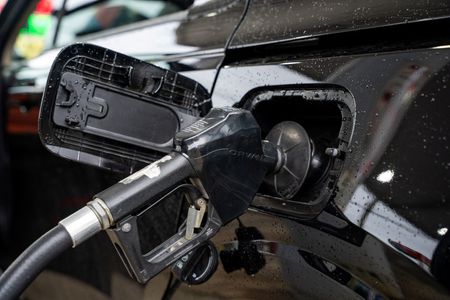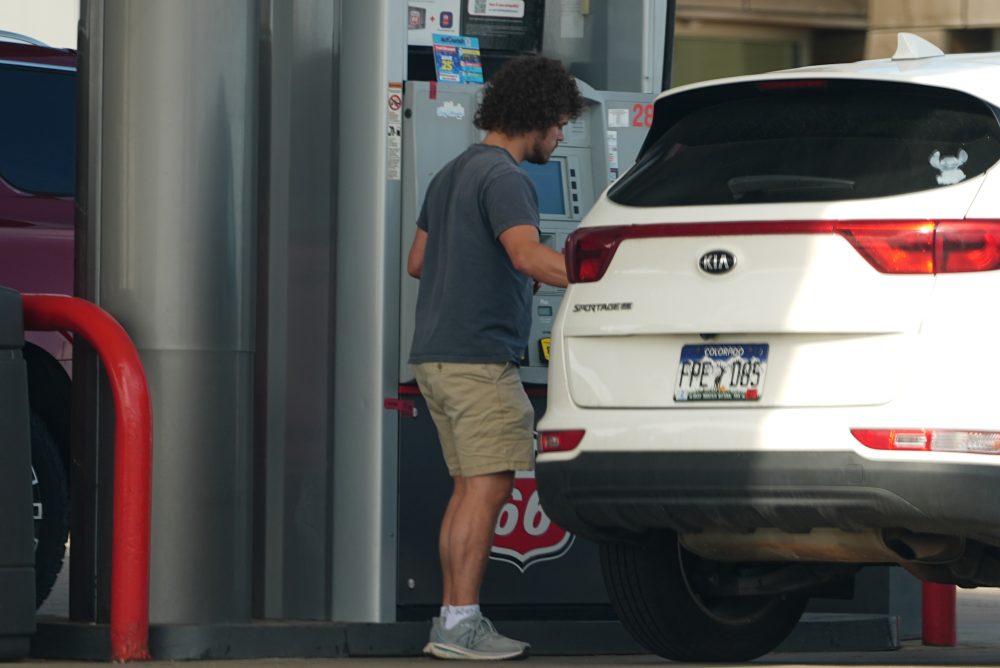

NEW YORK (AP) — With gasoline prices putting a squeeze on family budgets during the ongoing conflict with Iran, President Donald Trump is advocating for a temporary halt to the federal gasoline tax.
The president lacks the authority to implement this change independently, and he hasn’t detailed the proposed duration of such a suspension. However, members of Congress from both political parties have already been advocating for pausing the federal gasoline tax, with some proposed legislation calling for a moratorium lasting until October 1.
Supporters of halting the gasoline tax contend it would deliver essential financial relief to families and businesses currently facing economic hardships, particularly affecting lower-income households who bear the greatest burden. This situation stems from disruptions to global oil supplies and other essential commodities since the U.S. and Israel entered the conflict approximately three months ago, causing energy costs and gasoline prices to surge.
However, a tax suspension is unlikely to create a substantial or immediate reduction in pump prices. Critics also caution about possible long-term ramifications. While the federal gasoline tax represents only a small portion of what Americans spend on fuel, it generates billions in revenue that federal highway and mass transit programs depend upon.
Here’s the current situation.
The federal gasoline tax currently equals approximately 18.4 cents per gallon. However, motorists wouldn’t see that complete amount removed from their fuel costs immediately following a suspension.
“You can’t suspend the tax and then expect everyone to wake up the next morning and gas is suddenly 18 cents cheaper,” stated Carl Davis, research director at the Institute on Taxation and Economic Policy, a nonprofit organization. “It doesn’t work that way.”
This occurs because the federal gasoline tax isn’t imposed directly at gas stations, but instead at the wholesale distribution level. The expectation behind a suspension is that retailers will eventually transfer the tax reduction to customers through reduced prices, though Davis emphasizes this outcome isn’t certain — pointing out that state-level experiences show minimal relief that requires time to reach consumers, if drivers benefit at all during temporary tax holidays.
Fuel suppliers might also retain portions of the savings to increase their profit margins. Considering this factor, the University of Pennsylvania’s Penn Wharton Budget Model projects that approximately 72% of a federal gas tax reduction would actually benefit consumers — equivalent to roughly 13.2 cents of the complete 18.4-cent per gallon rate.
Even with these savings, the financial benefit for typical drivers remains modest. Should the federal gas tax be suspended from June 1 through October 1, the Penn Wharton Budget Model calculates that a household refueling a 15-gallon tank weekly would save approximately $35 during those four months.
Meanwhile, current U.S. gasoline prices remain significantly elevated compared to pre-war levels — with the national average reaching about $4.50 per gallon on Monday, according to AAA, versus $2.98 in late February. As families continue experiencing financial pressure from increased expenses, Davis observes that many drivers might find it difficult “to even notice” a tax reduction if they receive it.
Trump has personally recognized that the federal tax represents a small percentage of gasoline costs. However, “it’s still money,” he informed reporters on Monday.
The U.S. gasoline tax also serves as the primary revenue source for federal highway and mass transit programs. Suspending it could eliminate billions of dollars in funding — which experts caution may create long-term problems in the future.
Based on current fuel pricing and consumption patterns, the government could forfeit $8.35 billion in revenue during a four-month suspension, the Penn Wharton Budget Model confirmed to the AP on Monday. Should the federal diesel tax (currently 24.4 cents per gallon) also be paused, that amount could approach $11.5 billion.
Congressional legislation suggests compensating for any Highway Trust Fund revenue losses with general treasury funds, but critics worry this approach could increase the federal deficit and potentially threaten the long-term viability of infrastructure projects. The federal gasoline tax has remained static since 1993, which experts argue has already weakened the Highway Trust Fund’s buying power when adjusted for inflation.
With specific details of a potential tax suspension remaining uncertain, future outcomes are difficult to forecast. However, “you could very easily imagine some kind of combination of higher national debt and lower funding for roads and bridges and other transportation projects,” Davis explained. “Eventually there will be a consequence.”
In addition to federal taxes, each state imposes its own separate gasoline taxes. These rates vary from as little as 9 cents per gallon in Alaska to nearly 71 cents in California, based on government data from early this year.
To address elevated prices during the Iran conflict, several states — including Indiana and Georgia — have recently enacted temporary suspensions of their gasoline taxes. Kentucky and Utah have decreased their rates. Additional states are considering similar measures.
However, other states may find it challenging to implement comparable actions.
Unlike the federal government, states generally must maintain balanced budgets annually. Beyond essential transportation infrastructure, some states also depend on fuel tax revenues to support education, environmental programs and other public services.
Numerous factors influence what drivers pay at gas stations. State and federal taxes, seasonal demand patterns and more expensive fuel formulations required for warmer weather all contribute. However, crude oil costs — the primary component in gasoline — represent the largest portion.
Despite worldwide government efforts to increase supply during the war, including accessing emergency oil reserves, elevated oil prices persist. Both Brent, the international benchmark, and U.S. crude are currently trading above $100 per barrel — rising from approximately $70 just months earlier.
Global attention focuses on the Strait of Hormuz, where one-fifth of the world’s oil previously flowed. However, Tehran and Washington remain deadlocked over the strategic waterway, while broader ceasefire negotiations continue to stagnate.
Industry analysts have consistently cautioned that if the conflict continues and supply chains face prolonged disruption, prices for gasoline and numerous other products could keep rising.
“This is really a foreign policy problem,” Davis noted. “There’s not a fiscal policy band-aid that can be slapped on.”