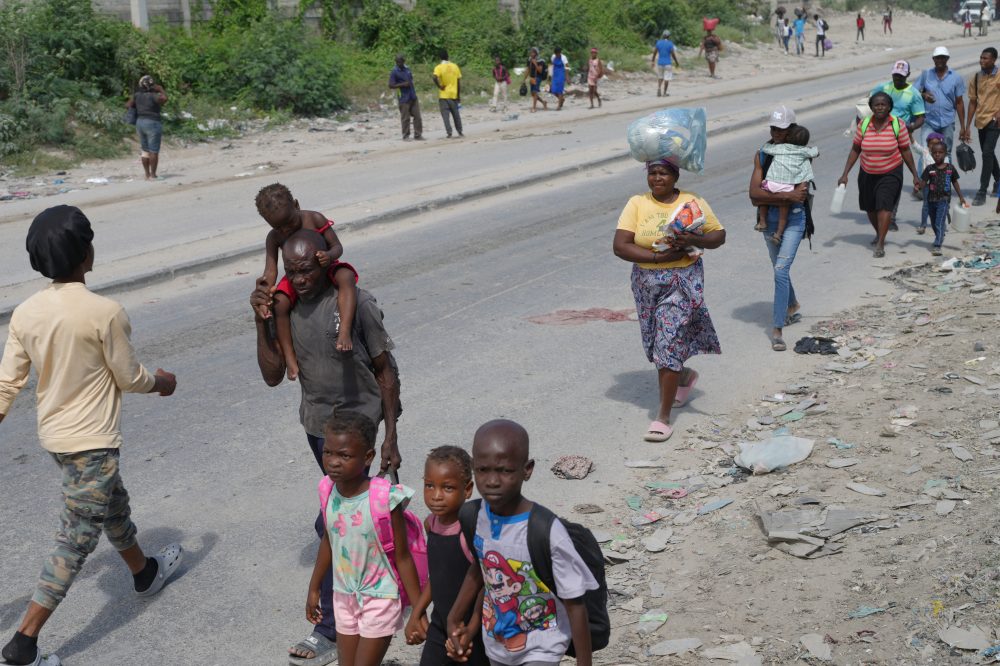

PORT-AU-PRINCE, Haiti — Dozens of people gathered at a major intersection in Haiti’s capital city Tuesday, holding tree branches and calling for police intervention after deadly gang warfare over the weekend drove hundreds of families from their homes in the Cite Soleil district.
Among the demonstrators was 67-year-old Roselaine Jean-Pierre, who joined about two dozen others demanding government action even as gunfire echoed through nearby streets.
“I did not do anything to deserve this,” said Jean-Pierre, who abandoned her residence Sunday and has been sleeping on Port-au-Prince’s streets since then.
Several demonstrators reported witnessing killings during the weekend violence in Cite Soleil, where charred vehicles and dead livestock littered the area. Government officials have not provided casualty figures.
“I know of seven people that have been killed and also people that have been shot,” said Michel-Ange Toussaint, who had briefly returned to her Cite Soleil residence to collect clothing.
According to Toussaint, the civilian attacks started Sunday evening around 6 p.m., causing many residents to escape the neighborhood seeking refuge. “It is our good feet that saved us,” Toussaint said.
Criminal organizations have seized control of more than 90% of Port-au-Prince following President Jovenal Moïse’s assassination at his residence in July 2021. Law enforcement reports these groups have extended their criminal operations — including theft, abductions, sexual violence and rape — beyond the city into rural areas. The country has remained without a president since the killing.
The medical humanitarian organization Doctors Without Borders issued a Monday statement announcing they had evacuated their Cite Soleil medical facility due to Sunday’s violent confrontations.
International peacekeeping forces connected to a United Nations mission began arriving in Haiti in April to help combat the persistent violence.
The U.N. Security Council authorized a 5,550-member peacekeeping force in late September, though the full deployment to the Caribbean nation remains incomplete. An undisclosed number of soldiers from Chad have been stationed there so far.
Research published this year by the International Organization for Migration revealed that criminal gang activity has forced more than 1.4 million Haitians from their homes, with roughly 200,000 now residing in overcrowded and inadequately funded shelter locations throughout the capital city.