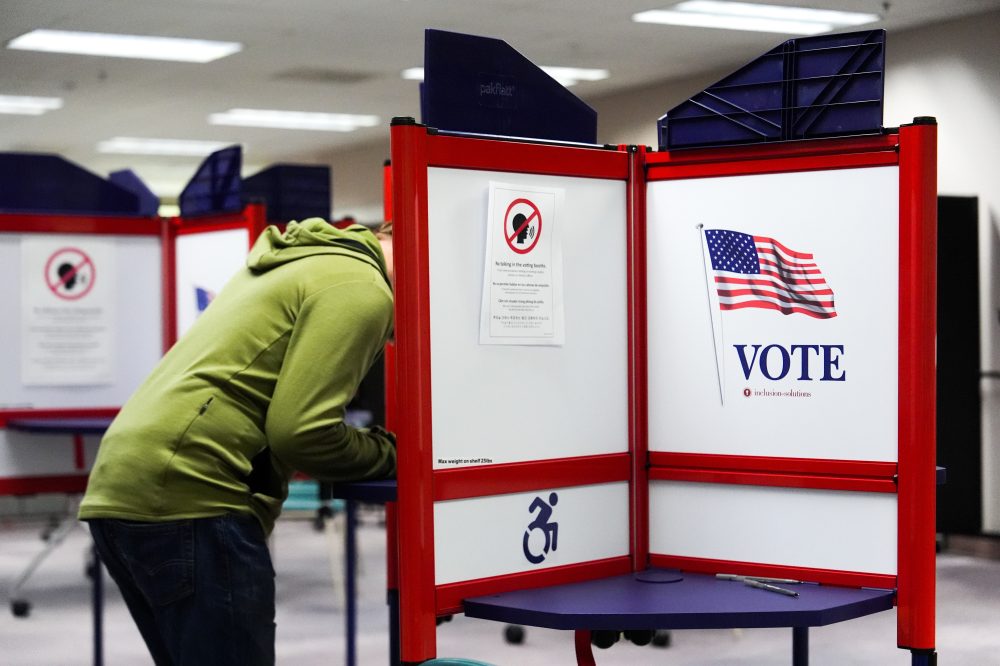

A federal court has rejected the Department of Justice’s attempt to obtain Massachusetts voter registration records on Thursday, delivering another blow to the Trump administration’s nationwide campaign to gather comprehensive voter information.
U.S. District Court Judge Leo Sorokin ruled that federal prosecutors failed to meet legal requirements for accessing state voter databases under federal law. The Obama-appointed judge determined that the attorney general’s office did not provide adequate justification for demanding the records.
“Put simply, the statute requires a statement of why the Attorney General demands production of the requested records,” Sorokin wrote. That statement has to be factual, “not just a conceivable or possible basis.”
The Justice Department declined to comment on the decision, stating in an email that it “does not comment on ongoing litigation.”
Federal officials claim they need the voter information to strengthen election security measures, but state leaders from both parties across the country have pushed back, arguing the requests breach state and federal privacy protections. Many officials worry the government plans to use the sensitive information for alternative purposes, including identifying potential non-citizens on voter rolls.
At a Rhode Island court proceeding last month, a Justice Department lawyer revealed that officials want unredacted voter data to share with the Department of Homeland Security for citizenship verification purposes. DHS has recently expanded its Systematic Alien Verification for Entitlements (SAVE) program for this specific goal.
“Our intention is to run this against the DHS SAVE database,” DOJ attorney Eric Neff told U.S. District Judge Mary McElroy during a March 26 hearing challenging the federal government’s authority to access the voter data.
Federal prosecutors have filed lawsuits against at least 30 states plus Washington D.C., demanding access to voter data that includes birth dates, home addresses, driver’s license numbers, and partial Social Security numbers.
According to the Brennan Center, at least 12 states have either delivered or agreed to provide their complete voter registration databases to the department: Alaska, Arkansas, Indiana, Louisiana, Mississippi, Nebraska, Ohio, Oklahoma, South Dakota, Tennessee, Texas and Wyoming.
In the Massachusetts decision, Judge Sorokin determined that the Justice Department ignored procedural requirements established by a 1960 civil rights statute for requesting voter records.
This legislation, created to combat racial discrimination in voting, mandates that state voter files be accessible to the U.S. attorney general only when officials provide a detailed explanation of why the information is needed and how it will be utilized.
The department’s request for Massachusetts voter data contained no reference to the Civil Rights Act and failed to cite specific concerns about Massachusetts’ compliance with federal voting regulations, the judge noted. Most critically, it lacked any factual foundation for the demand, Sorokin determined.
In legal filings, the Justice Department argued it needed the data to examine “Massachusetts’ possible lack of compliance” with federal voter registration requirements. Officials also contended that the Civil Rights Act serves as an investigative tool for identifying federal election law violations and maintained that the attorney general shouldn’t be required to prove violations before seeking evidence.
“These arguments miss the point,” Sorokin wrote.
Massachusetts Attorney General Andrea Joy Campbell praised the decision as a significant victory for voters and legal principles.
“The privacy of our voters is not up for negotiation, and I will continue to defend the integrity and security of our elections from the Trump Administration’s cruel and harmful agenda,” she said in a news release.
Four other federal judges in different states have rejected similar Justice Department lawsuits.
A Michigan federal judge ruled that laws referenced by the Justice Department don’t mandate disclosure of the voter records requested by federal officials. A California federal judge stated the administration “may not unilaterally usurp the authority over elections,” which the Constitution grants to states and Congress. An Oregon federal judge concluded the federal government wasn’t entitled to unredacted voter registration lists containing sensitive information.
A Georgia federal judge dismissed a DOJ lawsuit due to improper filing location. Federal officials then refiled the case in the correct jurisdiction, where it remains pending.
The Justice Department has filed appeals challenging the Oregon, California and Michigan dismissals.