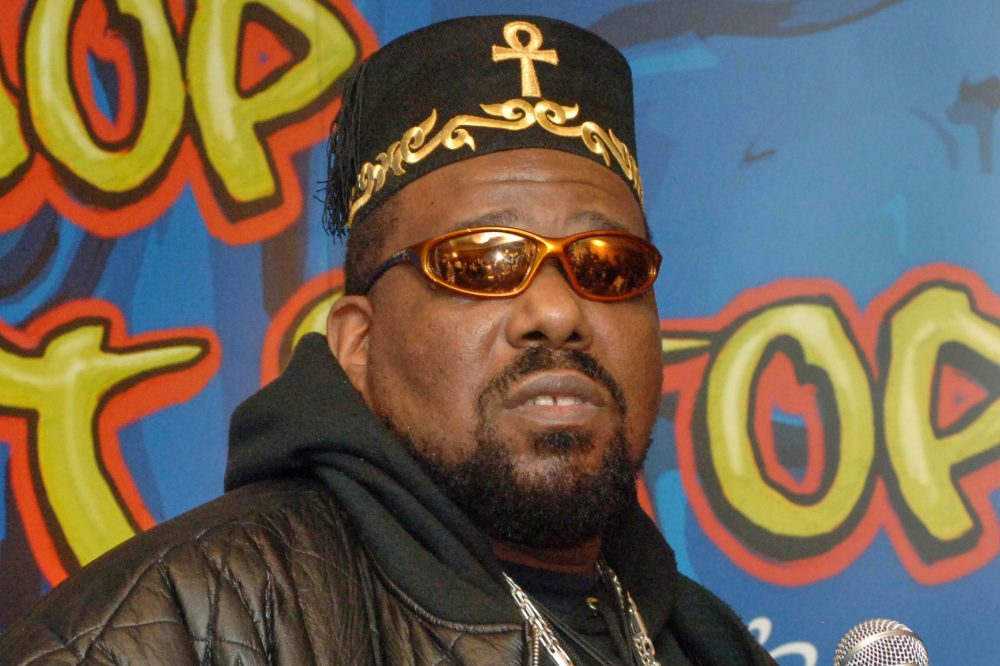

Lance Taylor, known worldwide as Afrika Bambaataa and recognized as one of hip-hop’s founding fathers, passed away Thursday in Pennsylvania after battling prostate cancer. He was 68 years old.
The music world responded with an overwhelming wave of tributes honoring Bambaataa’s transformative influence on hip-hop culture, though his legacy became complicated in recent years due to multiple allegations of sexual misconduct involving minors.
Born in 1957 in the South Bronx, Bambaataa rose to fame with revolutionary songs including his 1982 hit “Planet Rock” and established the Universal Zulu Nation artistic movement.
“When you talk about Afrika Bambaataa, Kool Herc, Grandmaster Flash, these are the three founding fathers of the whole culture,” rapper Fat Joe told The Associated Press of Bambaataa’s legacy in 2023.
Taylor grew up during a turbulent period when the South Bronx was experiencing severe urban decay due to systematic segregation and economic abandonment. Throughout the 1970s and 1980s, property owners frequently set fires to their buildings for insurance payouts rather than maintaining them, leaving predominantly Black and Puerto Rican residents with limited opportunities.
Raised by his mother in government housing, Bambaataa had Caribbean roots from Jamaica and Barbados. His early musical education came from his mother’s extensive record collection, according to a 1998 interview with Frank Broughton.
His talent for reimagining and blending classic songs became his trademark at neighborhood parties he organized in local community centers during the early 1970s. He drew significant inspiration from Kool Herc, widely regarded as hip-hop’s originator.
Throughout the decade and into the 1980s, Bambaataa’s DJ performances gained massive popularity, leading to his creation of electronic tracks that helped define the emerging hip-hop and electro-funk scenes. He pioneered the use of beat breaks and was among the first to incorporate the legendary Roland TR-808 drum machine.
“We was playin’ everything, everything that was funky,” he explained. He emphasized that his events stood out because “other DJs would play they great records for fifteen, twenty minutes. We was changing ours every minute or two. I couldn’t have no breakbeat go longer than a minute or two.”
During this period, Bambaataa used his connections with the Black Spades street gang to create the Zulu Nation, named after the South African people who inspired him. His philosophy centered on “peace, love, unity and having fun,” and he aimed to harness hip-hop’s growing influence to end neighborhood gang violence.
He eventually renamed his organization the Universal Zulu Nation to welcome “all people from the planet earth.”
“At the core our music made people feel like they belong to a movement and not a moment, our music offered Hope something positive to believe in, it gave people identity, unity, and a way out,” Ellis Williams, a producer known as Mr. Biggs, wrote in an email to the AP. Mr. Biggs was a member of the group Afrika Bambaataa and Soulsonic Force that included Bambaataa.
However, Bambaataa’s reputation became tarnished in recent years when multiple individuals came forward with sexual abuse accusations.
In 2016, Bronx activist and former music executive Ronald Savage publicly accused Bambaataa of molesting him in 1980 when Savage was a teenager.
“I was scared, but at the same time I was like, ‘This is Afrika Bambaataa,’” Savage told the AP in 2016, providing detailed accounts of that incident and four additional encounters.
Bambaataa strongly rejected these accusations.
Following Savage’s public statements, several other men shared similar allegations against Bambaataa. In June 2016, the Universal Zulu Nation issued a public statement apologizing to “the survivors of apparent sexual molestation by Bambaataa,” acknowledging that some organization members were aware of the abuse but “chose not to disclose” it.
“We extend our deepest and most sincere apologies to the many people who have been hurt,” the organization stated.