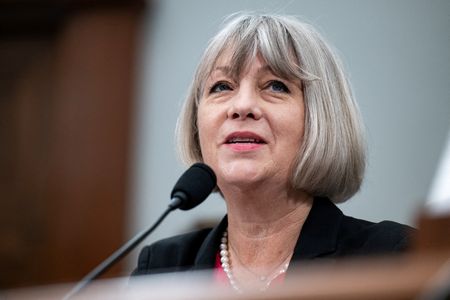

Federal Reserve Chairman Kevin Warsh stepped onto the world stage Wednesday, appearing alongside some of the globe’s most powerful central bankers at an annual economic forum in Sintra, Portugal — hosted by the European Central Bank.
Warsh took part in a question-and-answer session starting at 9 a.m. EDT, sharing the stage with ECB President Christine Lagarde, Bank of England Governor Andrew Bailey, and Bank of Canada Governor Tiff Macklem.
All three of those central bank leaders signed an unprecedented letter earlier this year expressing support for former Fed Chair Jerome Powell during his standoff with the Trump administration over the Federal Reserve’s independence. That dispute reached a significant turning point this week when the U.S. Supreme Court ruled that Fed Governor Lisa Cook could not be removed from her position, despite President Donald Trump’s announcement last year that he had fired her.
Powell has been widely praised by his international peers for defending the Fed’s independence — a quality seen as essential to keeping global financial markets stable. Warsh, however, has largely avoided commenting publicly on matters like the attempted removal of Cook or the legal pressure directed at Powell.
Trump chose Warsh to replace Powell, who remains on the Fed’s Board of Governors. Warsh officially became chair in late May.
Wednesday’s forum appearance was Warsh’s first time speaking publicly since a June 17 press conference following his inaugural policy meeting as chair, during which the Fed left interest rates unchanged. At that press conference, Warsh struck a firm tone, vowing to bring inflation down to the central bank’s 2% target.
His remarks sent investors scrambling to increase their bets that the Fed could raise interest rates as soon as September. That puts the U.S. central bank somewhere in the middle — following the ECB’s recent decision to raise rates, while the central banks of England and Canada have held back on tightening policy due to economic softness at home.
Analysts at Yardeni Research said ahead of Wednesday’s appearance, “We were surprised by Warsh’s hawkishness,” adding that the forum could give him a chance to either refine or reaffirm his message — most likely the latter, as he has signaled a desire to step back from offering so-called “forward guidance” about future rate moves.
The first policy statement released under Warsh’s leadership contained no hints about the future direction of interest rates. During his press conference, Warsh explained that he wants markets to become less dependent on rate signals from the Fed, arguing that such guidance makes the central bank less flexible and investors less self-reliant.
This represents a significant shift for the Fed, where open discussion about the economy and interest rates has long been considered a cornerstone of public accountability and sound policymaking.
While some of Warsh’s counterparts — including Lagarde — have also pulled back on rate guidance, analysts pointed out that Warsh went further by avoiding commentary on the economic outlook altogether, even declining to explain how various developments might influence Fed decisions. Some of his own colleagues at the Fed appear more willing to engage on those topics.
Cleveland Fed President Beth Hammack, speaking to CNBC on Tuesday from the sidelines of the Sintra conference, said, “I think it is important that we are transparent in communicating how we make decisions,” while keeping an open mind on possible outcomes. She added, “If inflation continues to persist and I don’t see any restraint from policy, we may need to raise rates.”
Inflation remains a central theme at the forum, along with discussions about short-term factors like oil prices and longer-term developments such as the rise of artificial intelligence. But Warsh has made clear he intends to draw firm boundaries around what the Federal Reserve concerns itself with.
After Trump’s reelection, Powell had already scaled back the Fed’s participation in international efforts among central banks to assess and address the financial risks posed by climate change. Some argue that understanding climate-related risks is a natural part of financial oversight, while some U.S. Republican elected officials criticized that work as “woke” and unfairly hostile to fossil fuel companies.
Warsh has been a vocal critic of what he views as Fed “mission creep” into areas beyond its core mandate — even as his international counterparts consider climate change an unavoidable factor in understanding the broader economy.
The Bank of England stated on its website: “When left unmanaged, these effects can pose a threat to the stability of the wider financial system, and the safety and soundness of firms we regulate.”