
NICOSIA, Cyprus (AP) — Escalating fuel shortages and surging energy costs stemming from ongoing conflict with Iran have prompted European Union officials to explore funding alternative energy transportation corridors throughout the Middle East that would avoid unstable regions such as the Strait of Hormuz.
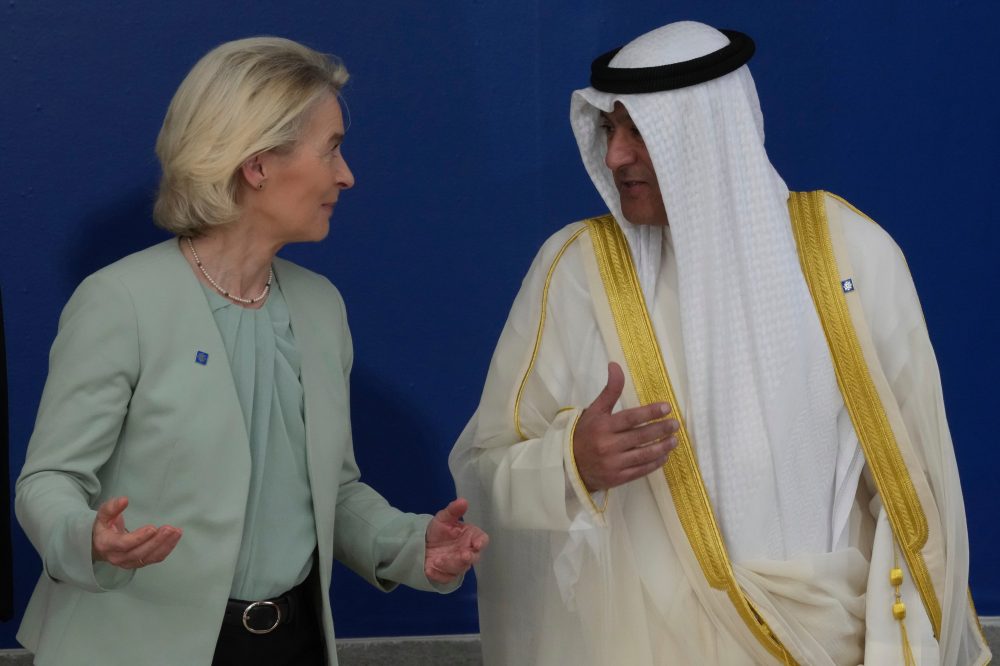
During an informal gathering of EU leadership in Cyprus’s capital, European Commission President Ursula von der Leyen announced Friday that the bloc stands prepared to collaborate with Persian Gulf nations on developing new energy delivery systems to global markets that would remain immune to warfare and regional tensions.
“The events of the past month have taught us a hard lesson,” von der Leyen stated during a press briefing following the leadership meeting. “Our security is not just related, it is intrinsically linked. A threat to a merchant vessel in the Strait of Hormuz is a threat to a factory, for example, in Belgium.”
While the EU leadership emphasized strengthening defense partnerships and highlighted the bloc’s Red Sea maritime security operations as a potential naval protection model for the Persian Gulf, von der Leyen concentrated her public statements on European assistance for rebuilding and constructing Middle Eastern energy facilities.
“We are also ready to team up with the Gulf countries to diversify export infrastructure away from solely the bottleneck of the Hormuz Strait,” she declared, additionally proposing EU support for repairing Gulf energy systems damaged during the conflict.
Approximately one-fifth of global oil and gas shipments typically transit through the Strait of Hormuz, though the ongoing war has effectively shut down this crucial waterway, causing fuel costs to surge dramatically.
During Friday morning trading, Brent crude climbed 98 cents to reach $100.33 per barrel, while U.S. benchmark crude increased 81 cents to $96.66 per barrel.
Von der Leyen reiterated that due to these oil and gas price increases, the 27-member bloc’s energy expenses have jumped by 25 billion euros ($29.3 billion) over the past 43 days.
Both von der Leyen and European Council President Antonio Costa declined to provide specific information about which initiatives are under consideration or their anticipated timelines. However, von der Leyen mentioned the India-Middle-East-Europe Economic Corridor connecting the EU with the world’s most populous democracy.
Von der Leyen indicated that an upcoming summit between the EU and Gulf Cooperation Council later this year would provide both parties an opportunity to examine such initiatives.
Cyprus currently holds the rotating EU presidency, positioning this island nation near Lebanon, Syria, Israel and Turkey as a key regional player. Cyprus President Nikos Christodoulides has worked to strengthen ties between the bloc and Middle Eastern countries to support their economies and enhance regional security.
This regional emphasis was highlighted by the distinguished attendees at the informal EU summit: Syrian President Ahmad al-Sharaa, Egyptian President Abdel-Fattah El Sissi, Lebanese President Joseph Aoun, Jordan’s Crown Prince Hussein and GCC Secretary-General Jasem Mohamed AlBudaiwi.
“We know that Europe needs Syria as much as Syria needs Europe,” Al-Sharaa remarked, while Aoun requested EU assistance for reconstructing his conflict-torn nation.
Costa commended Aoun for prohibiting Hezbollah’s military operations, which he described as “an existential threat” to Lebanon, promising to help the country eliminate the militant organization.
Costa emphasized that “the European Union is not part of the conflict, but we will be part of this solution.”
Human rights organizations criticized EU leadership for failing to increase pressure on Israel regarding its Middle Eastern military operations.
EU officials including German Chancellor Friedrich Merz stated they would maintain sanctions on Iran until numerous concerns are addressed, including terminating its missile development and regional proxy support.
“It’s too early to talk about relief of any kind of sanctions,” Costa explained.
Cyprus experienced direct attack early in the conflict when a Shahed drone launched from Lebanon on March 2 struck an aircraft hangar at a British military installation on the island’s southern shoreline. Greece, France, Italy, Spain and the Netherlands deployed warships equipped with anti-drone technology to protect the island.
This incident has renewed focus on a mutual assistance provision within the EU’s founding treaties for situations when member states face attack.
Christodoulides reported that EU leaders agreed to begin developing a formal response mechanism, concluding that “ad hoc arrangements” prove unreliable.