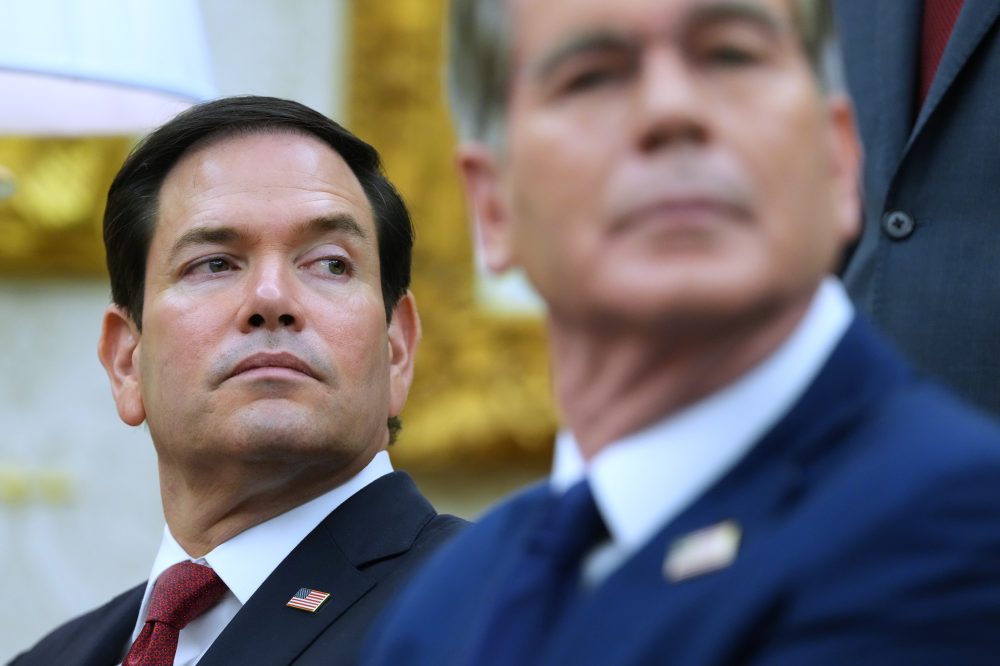

Secretary of State Marco Rubio hosted a gathering of officials from more than 60 nations Thursday, making it the latest move by the Trump administration to spotlight what it describes as a dangerous rise in left-wing political terrorism — an issue Republicans are pushing hard ahead of this November’s midterm elections.
The focus on left-wing violence comes despite research indicating that such incidents remain rare in the United States, particularly when compared to historically higher levels of violence from the far right.
Speaking in sweeping terms about what he called an “alarming rise” in politically motivated violence from the left, Rubio joined other U.S. officials in warning of dire consequences if those he described as “communists and Marxists” are not stopped. He called on attendees — drawn largely from European and Latin American nations — to join forces against what he argued has been a “blind spot” in how countries approach counterterrorism.
“So many people in positions of power have repeatedly dismissed acts of violence and even terrorism as legitimate forms of political expression, so long as they served a left-wing cause,” Rubio said in his opening remarks. “A bomb planted by a neo-Nazi group was ‘a nefarious and murderous act of evil.’ It is, but a bomb planted by a Marxist revolutionary; well, that’s just merely a tragic excess of idealism.”
A report released last year by the Center for Strategic and International Studies found that left-wing terrorism attacks had, as of July 4, 2025, exceeded those from the far right for the first time in over three decades. However, analysts note the increase reflects a very low baseline — and a simultaneous decline in far-right incidents.
According to the report, left-wing incidents averaged just 0.6 per year between 1994 and 2000, while right-wing incidents averaged 20.6 annually during that same period. Between 2016 and 2024, left-wing attacks averaged four per year compared to 22.7 on the right. By early July 2025, far-right incidents had fallen sharply to just one, while five left-wing incidents had been recorded.
The report’s authors caution that far-right terrorism could quickly return to elevated levels, and that combating terrorism across the political spectrum remains essential.
President Donald Trump and his political allies have made opposition to the far left a centerpiece of their messaging ahead of the November congressional elections. Trump has repeatedly claimed that the Democratic Party’s growing left wing consists of communists seeking to “completely destroy the traditional American way of life” and even carry out political assassinations.
Vice President JD Vance has similarly warned about communism as a political movement “something we haven’t seen in the U.S.,” while House Speaker Mike Johnson has spoken out against what he calls “radical candidates” who are “self-described, self-identifying Marxists.”
For Rubio, his perspective on this issue is deeply personal. He is the son of Cuban immigrants who came to Miami in May 1956, just before communist leader Fidel Castro took power in Havana. The former Florida senator said Thursday that Cuba’s intelligence and ideological network “helped to build the far left in our country and in our hemisphere.”
Stephen Miller, Trump’s deputy chief of staff and the primary architect of the administration’s immigration policy, spoke after Rubio and emphasized what he sees as an urgent need to defend American institutions from left-wing threats.
“If your civilization is your home, you must defend it with the same passion and force as if an enemy intruder is inside your own house where your family lives,” Miller said. “That is the level of dedication and urgency that is required.”
Critics have noted that this ideological framing repeatedly blurs the line between democratic socialism — which typically focuses on goals like universal healthcare, higher taxes on the wealthy, and tighter corporate regulations — and communism, which calls for the elimination of private ownership.
The administration’s focus has intensified over the past year, following the election of democratic socialist Zohran Mamdani as New York City mayor and the recent primary victories of several of his allies in New York City congressional races, where they defeated sitting incumbents.
One concrete step the administration has taken is the use of financial sanctions. In November, the State Department designated four antifa, or anti-fascist, groups in Europe as foreign terrorist organizations. Treasury Secretary Scott Bessent told Thursday’s conference that cutting off these groups’ financial networks is the most effective way to neutralize them.
“We have spent decades developing the world’s most sophisticated financial counterterrorism capabilities, and now we are mobilizing some of the same tools that we have deployed against terrorists abroad to confront this emerging threat here at home,” Bessent said.