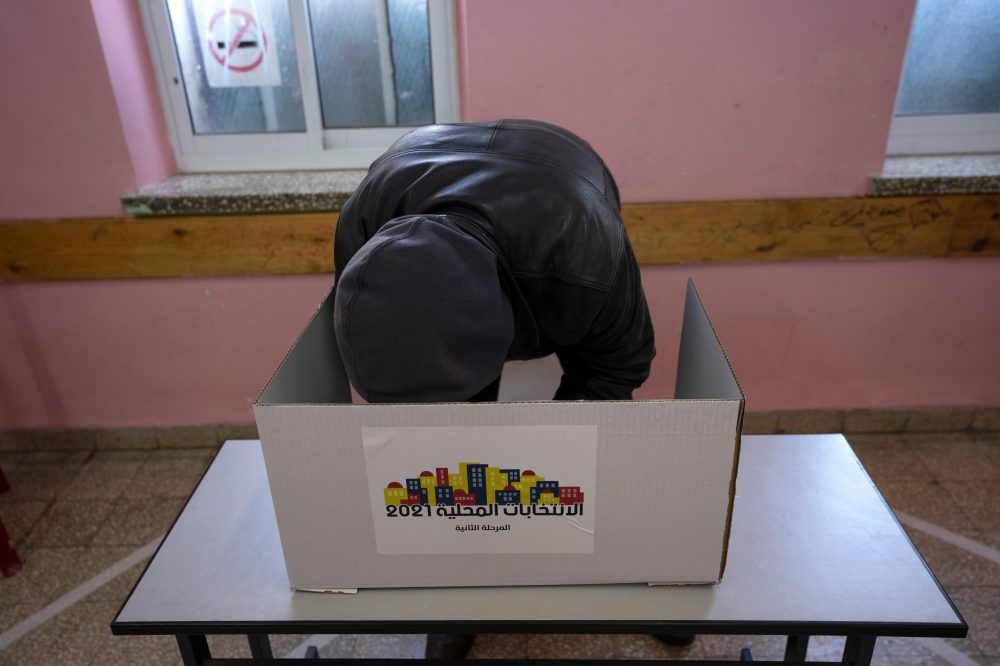

RAMALLAH, West Bank (AP) — Palestinians in war-torn Gaza are participating in their first opportunity to vote in local elections in twenty years, marking a significant political moment on Saturday.
Meanwhile, residents of the Israeli-occupied West Bank are heading to polling stations for their first electoral experience since the Israel-Hamas conflict began. Voter participation could signal the degree of public confidence in the broader political structure overseen by veteran West Bank leadership, as Gaza anticipates a possible shift away from Hamas governance.
West Bank balloting will decide the composition of local councils responsible for managing water systems, roadway maintenance, and electrical services. In contrast, the single Gaza city participating represents more of a symbolic gesture, with authorities describing it as an experimental “pilot” program.
Despite not conducting presidential or parliamentary elections since 2006, the Palestinian Authority has championed these local contests following reform measures implemented last year in response to pressure from international supporters.
Operating under the motto “We Stay,” the Ramallah-headquartered Central Election Commission has worked to boost involvement among approximately 70,000 eligible voters in Gaza’s Deir al-Balah and one million throughout the West Bank.
According to spokesperson Fareed Taamallah, casting ballots “reflects the will if the Palestinian people to stay on their land and develop their country.”
Given that extensive portions of Gaza have been destroyed during more than two years of warfare, the commission selected Deir al-Balah for its inaugural vote because while the area sustained airstrike damage, it remained among the few locations that avoided Israeli ground operations. Officials had to adapt their approach since standard voter registration procedures proved impossible.
“The main idea is to link the West Bank and Gaza politically as one system,” Taamallah explained. Palestinians view combining both territories under unified governance as essential for any future path toward statehood.
The commission avoided direct coordination with either Israel or Hamas before the Deir al-Balah election and could not transport essential supplies including ballot papers, voting boxes, or ink into Gaza, he noted. COGAT, the Israeli military organization managing humanitarian matters in Gaza, did not respond to inquiries about permitting election materials entry.
While Palestinian voter participation has slowly declined, it has remained comparatively strong in previous local elections by regional measures, commission data shows, typically ranging from 50% to 60%. For context, recent local election turnout in Lebanon and Tunisia fell below 40% and 12%, respectively.
Ninety-year-old President Mahmoud Abbas approved legislation last year restructuring the electoral framework to address some Western donor requirements. The changes permit voting for individual candidates instead of party lists, reduced the minimum age for candidacy, and increased quotas for female candidates.
In January, another Abbas order mandated that candidates endorse the Palestine Liberation Organization’s platform, the organization leading the Palestinian Authority. This platform demands recognizing Israel and abandoning armed resistance, effectively excluding Hamas and other militant groups.
Candidate lists in major cities are primarily controlled by Fatah, the Palestinian Authority’s leading faction, and independents, some connected to other political groups. However, this marks the first instance across six local elections where no other faction has formally presented its own candidate list — an omission that experts say demonstrates political disappointment with Abbas and the authority’s elderly leadership.
Throughout the Israeli-occupied West Bank, the authority maintains limited self-governance, with local councils managing services from waste collection to construction permits. Elections will occur in villages within “Area C” under Israeli military administration and in municipalities that have been occupied by Israel’s military since launching a ground offensive in the northern West Bank last year.
Campaign advertisements have been displayed throughout cities, although many locations — including Ramallah and Nablus — will skip elections due to insufficient candidate or slate registration.
The Palestinian Authority’s influence has diminished during years without peace talks with Israel and continued growth of Israeli settlements in the occupied West Bank. However, it views local elections as a low-risk method to showcase reform progress, according to Aref Jaffal, director of the al-Marsad Arab World Democracy and Electoral Monitor.
“The PA wants to show it is on the right track on political, financial and administrative reforms, and is using local elections as a symbol of that,” he stated. “With the weak legitimacy of the national government, it is seeking to bolster legitimacy through local elections.”
With the authority having limited options to address hundreds of new military checkpoints and settler outposts restricting West Bank movement, he explained that many councils have gained greater significance, managing local healthcare facilities, educational institutions, and public services that residents previously accessed elsewhere.
Hamas secured parliamentary victories in 2006 and forcibly took Gaza control from the Fatah-led Palestinian Authority the following year. While not fielding candidates for Saturday’s elections, surveys from the Palestinian Center for Policy and Survey Research indicate it continues as the most favored Palestinian faction in both Gaza and the West Bank.
Ramiz Alakbarov, the U.N. deputy special coordinator for the Middle East peace process, described the elections as “an important opportunity for Palestinians to exercise their democratic rights during an exceptionally challenging period.”
However, other international participants have remained mostly quiet regarding the Gaza vote, with recent memories of previous elections sparking conflict and alternative governance options remaining uncertain.
Hamas maintains control over the Gaza section that Israeli forces evacuated last year, including Deir al-Balah, but the coastal territory is preparing to shift toward new governance arrangements under U.S. President Donald Trump’s 20-point plan.
The plan created a Board of Peace consisting of international representatives and a committee of unelected Palestinian specialists designed to function beneath it. Movement toward additional phases, including Hamas disarmament, reconstruction, and power transfer, remains stalled.
Although elections in Israeli-annexed East Jerusalem regularly create tension between Israel and Palestinian officials, the 1995 Oslo Accords contained no stipulations regarding the authority conducting local elections there.