
France and Germany are sitting down this week for joint defense talks, with both nations hoping to prove they can still work as partners even as tensions over major weapons programs have put their relationship under pressure.
The French presidential office announced that the two countries will take up issues including nuclear deterrence, missile defense systems, long-range strike weapons, and space cooperation during a joint ministerial retreat. The goal is to show that Europe’s two biggest defense players remain capable of working together.
The timing is significant. Just weeks ago, industrial competition between the two nations forced them to abandon the Future Combat Air System, or FCAS — a landmark program intended to produce a next-generation fighter jet. That collapse came at a moment when the United States is actively pushing European nations to invest more in their own defense.
The problems don’t stop there. A joint Franco-German project to develop a next-generation tank has also experienced delays, a multinational drone program aimed at producing a European rival to the American Reaper drone has hit setbacks, and competition in the space sector has further strained the relationship.
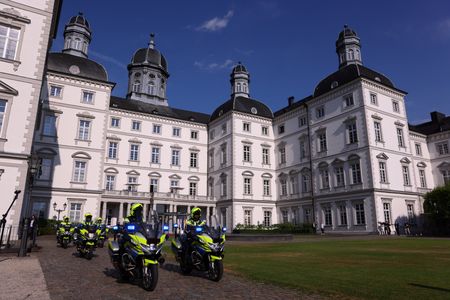
The Franco-German Defense and Security Council, along with a broader joint ministerial session, is scheduled for Thursday and Friday near Cologne. Two joint declarations are expected to follow the meetings.
A French official was candid about the challenges, saying the discussions were “not a path where everything is necessarily aligned,” but emphasized that Franco-German defense industry cooperation extends well beyond the failed FCAS program.
A German official indicated that both sides are expected to reach an agreement on how parts of the FCAS project will continue moving forward. Both countries have committed to developing data-sharing links between warplanes and related software, commonly referred to as a “combat cloud.”
Also on the agenda is a proposal put forward by France’s leader in March for what he called “forward deterrence” — a plan that would allow European allies to participate in French nuclear deterrence exercises and temporarily station French nuclear assets on their soil. A German official said Berlin now expects to agree that German troops will take part in a French nuclear exercise this coming autumn.
At the heart of the Franco-German defense relationship lies a deeper disagreement: how much Europe should rely on American weapons technology, particularly at a time when the continent is questioning whether President Donald Trump can be counted on as a reliable security partner.
France has consistently pushed for Europe to rely more heavily on its own technologies, especially when it comes to missile defense. “On ballistic missile defense, we have always argued to Germany the importance of what is sovereign,” a French presidential office official said.
Space cooperation is also expected to come up, an area that has recently added friction to the bilateral relationship. Both countries are set to reaffirm their support for IRIS², the European Union’s planned secure satellite communications network, even as Germany simultaneously pursues its own separate military satellite project. France views IRIS² as a central pillar of Europe’s push to secure its own communications infrastructure and reduce reliance on foreign providers.