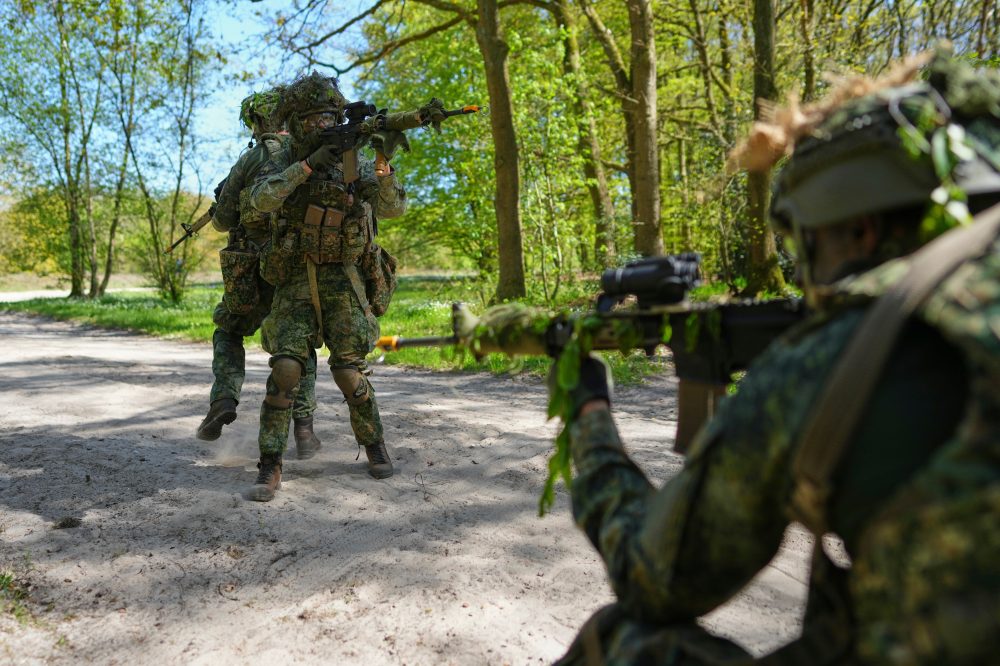

HAVELTE, Netherlands — With faces painted in camouflage patterns, soldiers move quietly through woodland terrain carrying Colt C7 rifles while carefully watching for potential dangers around them.
These military personnel belong to the 10th Infantry Battalion Guard Security Corps National Reserve, participating in weekend training exercises as the Netherlands strengthens its armed forces through an influx of new volunteers and recruits. Dutch leadership has pledged to expand military personnel numbers from the current 80,000 to 120,000 by 2035 — an initiative enjoying widespread political backing.
The recent decision by the nation’s queen and her eldest daughter to join as volunteer reservists appears to be making a significant impact, with officials now working rapidly to equip and prepare the growing number of new enlistees.
This recruitment push in the Netherlands mirrors similar efforts throughout Europe to strengthen and modernize military forces as leaders watch nervously as Russia’s ongoing war against Ukraine continues, while also considering U.S. President Donald Trump’s criticism of the NATO alliance that has served as Europe’s primary defense foundation since World War II devastated much of the continent.
A reserve battalion corporal, speaking anonymously due to service requirements, described witnessing changing priorities as global security has become increasingly unstable and unpredictable.
“When I first joined, there was almost no risk or almost no threat … and now it’s changing so we are more aware of it,” she explained. This has resulted in a focus shift toward “more what we call ‘green things,’ infantry things.”
She continued: “We are here to defend our country and to make sure to keep the threat down.”
European Union and NATO leadership consider this threat genuine, believing Russian President Vladimir Putin may be prepared to launch attacks elsewhere in Europe within three to five years, particularly if he achieves victory in Ukraine.
Recent NATO strategies designed to address this threat require member nations to prepare their military forces for large-scale conflicts, emphasizing more agile units capable of rapid deployment.
Dutch military recruitment received a major boost when Queen Maxima and her eldest daughter, heir apparent Amalia, Princess of Orange, joined as volunteer reservists. Images of Maxima during training exercises and practicing marksmanship at shooting ranges circulated globally.
This royal endorsement, combined with recruitment efforts spanning newspapers, billboards, and social media platforms, has proven remarkably effective, leaving the military working intensively to arm, train, and house all the new applicants.
Defense Ministry officials refer to this phenomenon as “the Amalia effect.”
“It’s really a thing, yes,” State Secretary for Defense Derk Boswijk explained to The Associated Press. “It’s very inspiring to see how members of our royal family inspired people to join our armed forces.”
Boswijk reported approximately 9,000 current reservists in the Netherlands, with recruitment goals targeting at least 20,000 by 2030.
“We have more applications than we can handle,” Boswijk noted. The military now faces challenges including “a lack of training capacity, a lack of housing. You have to give them all uniforms, you have to give them weapons.”
However, he emphasized: “It’s a luxury problem.”
German legislators are reviewing government proposals to provide improved compensation and conditions for short-term enlistees, along with enhanced training and greater flexibility regarding service duration.
The goal involves attracting adequate recruits without reinstating male conscription that ended in 2011. The proposal allows for limited mandatory recruitment if volunteer numbers prove insufficient.
Similar to the Netherlands, France is emphasizing voluntary service to strengthen its military. A September program aims to recruit 3,000 volunteers between ages 18-25. These individuals will serve in uniform for 10 months within France’s mainland and overseas territories exclusively. The initiative seeks to attract up to 50,000 annual volunteers by 2035.
In northern and eastern European regions, where Russian threats feel most immediate, some countries maintain conscription systems.
Finland operates a draft system for all males with voluntary participation for women. Sweden restored gender-neutral partial military service in 2017. When volunteer numbers fall short, lottery systems select individuals for remaining positions. Denmark employs a comparable system, as does Latvia since reviving its draft in 2023 following Russia’s Ukrainian invasion.
While the Netherlands never completely eliminated its draft system, call-ups have remained suspended since 1997 with no immediate plans for restoration. Instead, the Defense Ministry seeks to make military service appealing to diverse societal segments.
Modern threats have expanded beyond conventional battlefields into cyber and digital domains, Boswijk noted, “so we need all kind of skills, to keep our society, our country, our allies safe. So, yes, we need also people wearing hoodies, having blue hair, who can game perfectly.”
For some among the new generation responding to their nation’s military call, a painful lesson from Dutch history provides motivation.
“When I was in primary school, we were taught that in the Second World War it took (German forces) five days to take over Holland,” Lisette den Heijer shared during a recent military information session for volunteer reservists, expressing her desire to prevent historical repetition.
During exercises in eastern Netherlands, a reserve battalion private first class, also speaking anonymously due to employment with a defense-related company, described observing similar changes in recent years.
“So where we were just focused on peaceful operations in 2018, we’re now more focusing on protecting vital infrastructure,” he explained. This included participating in extensive security operations protecting last year’s NATO leaders’ summit in The Hague.
Dutch reservists commit to 300 annual service hours, including regular weekend training exercises. Traditionally deployed for domestic security and guard duties, they do not participate in overseas combat missions. They also respond during national emergencies, such as flood protection efforts involving sandbag placement.
Back in eastern Netherlands forests, the reservists suddenly halt and aim their weapons toward an innocuous-looking earth mound covered with dried leaves and wood.
A soldier — a unit member — emerges from the concealed foxhole where he was hiding and surrenders. The volunteers celebrate with high-fives before preparing to dismantle their camp and return to civilian employment.