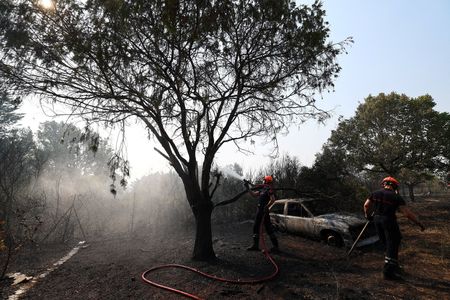

Firefighters across Spain and France spent Wednesday battling enormous wildfires as dangerous heat continued to grip much of southern Europe. While a major blaze in Spain’s central Guadalajara province began to ease, allowing some evacuated residents to return to their homes, officials warned the threat was far from over.
In France, grief followed tragedy after two firefighters were killed Tuesday when their truck was overtaken by flames in the southwestern Gironde region. Authorities there urged the public to stop using backyard barbecues in heat-stricken areas, noting that nine out of every ten wildfires — whether intentional or accidental — can be traced back to human activity.
Across the Western Balkans, the weather threat shifted from scorching heat to violent hailstorms, leaving several people injured in North Macedonia and eastern Kosovo.
Scientists point out that Europe is warming faster than any other continent on Earth, and that human-caused climate change is intensifying heatwaves, droughts, and wildfires — while also setting the stage for sudden, damaging storms. The continent has already endured three back-to-back heatwaves this year, and extreme heat has been linked to thousands of excess deaths between May and June.
Data from the Reuters Climate Monitor showed the average high temperature across Western Europe was forecast at 26.6 degrees Celsius — three degrees above the historical norm for this date based on records from 1961 to 1990.
SPAIN’S WILDFIRE CRISIS
The largest wildfire Spain has seen this year tore through the Guadalajara region, burning an estimated 32,000 hectares. The blaze forced evacuations across 34 municipalities and confinement orders in 14 others before it began to stabilize Tuesday. The Castilla-La Mancha INFOCAM fire service confirmed that residents of five villages had been cleared to return home, though other restrictions remained active. Prime Minister Pedro Sanchez was scheduled to tour the damaged area later Wednesday.
Spain’s national weather agency, AEMET, warned that wildfire danger remained “very high or extreme” across most of the mainland and the Balearic Islands, with conditions expected to worsen in the days ahead. The agency called on the public to “exercise extreme caution” as the heatwave combined with dry thunderstorms and Saharan dust blowing in from Africa.
AEMET spokesperson Ruben del Campo said the heatwave was expected to reach its peak Wednesday, with temperatures climbing to between 39 and 42 degrees Celsius across large parts of the country.
While some areas may see a slight temperature drop Thursday, a dry westerly wind is expected to push a new surge of heat into Mediterranean regions. Highs of 42 to 44 degrees Celsius could be recorded in parts of the Ebro and Guadalquivir valleys, inland Valencia, Murcia, and eastern Andalusia.
A more significant cooldown is anticipated starting Friday, with temperatures falling sharply Saturday to near or even below seasonal averages in parts of central and western Spain. However, that relief may not last long — forecasts suggest temperatures will climb again from Sunday, with intense heat potentially returning across much of the country early the following week.
FRANCE FIGHTS FLAMES
In France, slightly cooler temperatures and calmer winds helped firefighters make progress against a wildfire that has burned 2,500 hectares in the southeastern Var region, damaged dozens of homes, and forced 400 people to evacuate. Helicopters resumed water-dropping operations at 7 a.m. local time as crews continued their efforts.
“The situation has been very difficult. Some 1,100 firefighters fought all night,” said Commander William Vogl, a spokesperson for the Var firefighting teams, speaking on RMC radio. He added that while the fire had not yet been contained, wind conditions were expected to be “more favourable” throughout Wednesday.
Prefect Simon Babre announced a ban on barbecues and asked local municipalities to call off any planned summer fireworks celebrations. A separate fire was also burning in the Hautes-Alpes region in the southeast, officials confirmed.
HEAT, STORMS, AND DANGER ACROSS THE REGION
In Greece, Athens and surrounding eastern and mainland areas were enduring a third straight day of intense heat, with temperatures expected to exceed 41 degrees Celsius. Authorities have prohibited outdoor work during peak midday hours and encouraged employers to offer remote work options for employees who are more vulnerable to heat-related illness.
In Skopje, the capital of North Macedonia, 11 people were taken to the hospital — three with serious injuries — after a violent storm Tuesday night knocked down trees, damaged rooftops, and knocked out power across the country, according to local media reports. Roads were blocked and some communities were left without electricity or running water.
Kosovo’s Hydrometeorological Institute warned of additional storms expected Wednesday, cautioning residents about the risk of lightning strikes, damage to power lines, flooding, and property destruction. Local media footage showed roofs being torn away by wind, heavy rainfall, and residents draping blankets over their vehicles in an attempt to shield them from hail.