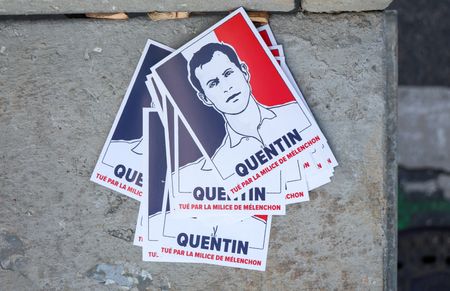

The death of a young French extremist has sparked an unprecedented wave of coordinated demonstrations across Europe, revealing the growing international connections between far-right organizations and raising alarm among security officials.
Twenty-three-year-old Quentin Deranque died following a violent confrontation with left-wing activists in Lyon, France on February 14. His death has been compared by some to a “Charlie Kirk moment,” referencing last year’s shooting of the American conservative figure.
In response to Deranque’s death, extremist groups from multiple countries organized memorial events in more than two dozen European cities, including Rome, Dresden, and Zagreb. The most significant gathering occurred in Lyon one week after the incident, drawing approximately 3,000 participants who displayed Nazi salutes and chanted racist and anti-LGBTQ slurs.
Austrian far-right figure Martin Sellner, who organized a memorial in Vienna, declared in a social media video: “His death must awaken a European-wide movement.”
The Lyon demonstration attracted participants from several countries, including members of Germany’s Identitarian movement, which German intelligence agencies classify as an extremist organization with connections to the Alternative for Germany (AfD) political party. Italian neo-fascist groups CasaPound and Lealta Azione also participated, according to their social media communications.
French government officials confirmed the attendance of extremist groups from Italy, Switzerland, and Germany, though they declined to identify specific organizations.
Monitoring far-right membership remains challenging across Europe, with few governments releasing comprehensive data. Germany, which maintains strict surveillance of such groups due to its historical experience with Nazism, reported 50,520 right-wing extremists in 2024—a 50% increase from 2020 figures.
MAINSTREAM POLITICAL INFLUENCE
A 2023 French parliamentary investigation concluded that international cooperation among far-right groups primarily involved sharing ideological content rather than establishing “operational links” between organizations.
However, report author and former parliamentarian Eric Poulliat now acknowledges a significant change, stating: “It is an evolution.”
Berlin-based researcher Lorenz Blumenthaler from the Amadeu Antonio Foundation confirmed this assessment, noting: “The far right is actually quite successful in forming international bonds.” He added that Deranque’s death provided these groups with additional opportunities “to mobilise even further” through social media platforms.
Despite government warnings about far-right threats, extremist ideologies have gained acceptance in mainstream political discourse. Concepts like “remigration”—forcibly removing non-white immigrants and their descendants—have transitioned from fringe discussions into the platforms of parties such as Germany’s AfD and policies promoted by the Trump administration.
Britain’s Reform UK party has proposed mass deportations and eliminating primary pathways for immigrant citizenship. France’s National Rally advocates for “national preference” policies, seeking to revoke residency rights for unemployed immigrants and limit family reunification programs.
SECURITY RESPONSE
Lyon municipal authorities expressed concern about activists traveling from across France and Europe for the demonstration, positioning police at city entry points according to a source familiar with the mayor’s office operations.
French intelligence agencies are actively monitoring far-right mobilization following Deranque’s death, with security sources noting his transformation into a European-level symbol and expressing worry about potential revenge attacks.
During a recent interview addressing foreign influence concerns ahead of France’s upcoming presidential election, Foreign Minister Jean-Noel Barrot highlighted far-right attempts to undermine democratic institutions following the killing.
“Our responsibility is to prevent it from doing so and to do so to regain control of our public space,” Barrot stated during a franceinfo television appearance, amid French criticism of warnings from the U.S. State Department and Italian Prime Minister Giorgia Meloni about left-wing threats.
Several European nations have implemented entry restrictions against prominent far-right figures in recent years. Switzerland and Germany have barred Austria’s Sellner, while Britain denied visa-free access to Dutch influencer Eva Vlaardingerbroek.
Sellner dismissed these restrictions, telling Reuters: “These measures just create more attention and more interest in what I have to say.” Vlaardingerbroek did not respond to requests for comment.
Greek officials confirmed they are monitoring far-right reactions to Deranque’s death. Switzerland’s intelligence service stated it tracks violent right-wing extremists with known international connections. German, Italian, and British authorities declined to comment on security concerns regarding far-right groups and their cross-border activities.
COORDINATED MESSAGING
The Lyon demonstration united various far-right factions, including groups connected to major extremist political parties such as France’s National Rally and Germany’s AfD.
German media collective Filmkunstkollektiv wrote on its Telegram channel regarding the Lyon march: “As alternative filmmakers, it is our foremost duty to spread the news of the murder of the young patriot as widely as possible.”
Simon Kaupert, who founded the collective, confirmed to Reuters that his organization has collaborated with the AfD and Identitarian movement chapters across Austria, Germany, and France.
More than 30 members of Italian group Lealta Azione attended the Lyon demonstration. The organization’s activists have previously campaigned alongside and sought election with Prime Minister Meloni’s party and Deputy Prime Minister Matteo Salvini’s far-right League party.
The official march organizer and government liaison was Aliette Espieux, an anti-abortion activist who campaigned in Lyon’s 2020 municipal elections on a combined National Rally-Christian Democratic Party ticket called “For the love of Lyon.”
The AfD, Lealta Azione, National Rally, and Espieux did not respond to requests for comment.
A German far-right activist and influencer using the online name “Arminius,” who participated in the march but refused to provide his real identity, explained the strategic importance of international cooperation: “The right only has potential if it works together.”
“Networking with other European activists is extremely important to learn from each other and work together on greater projects,” he added.