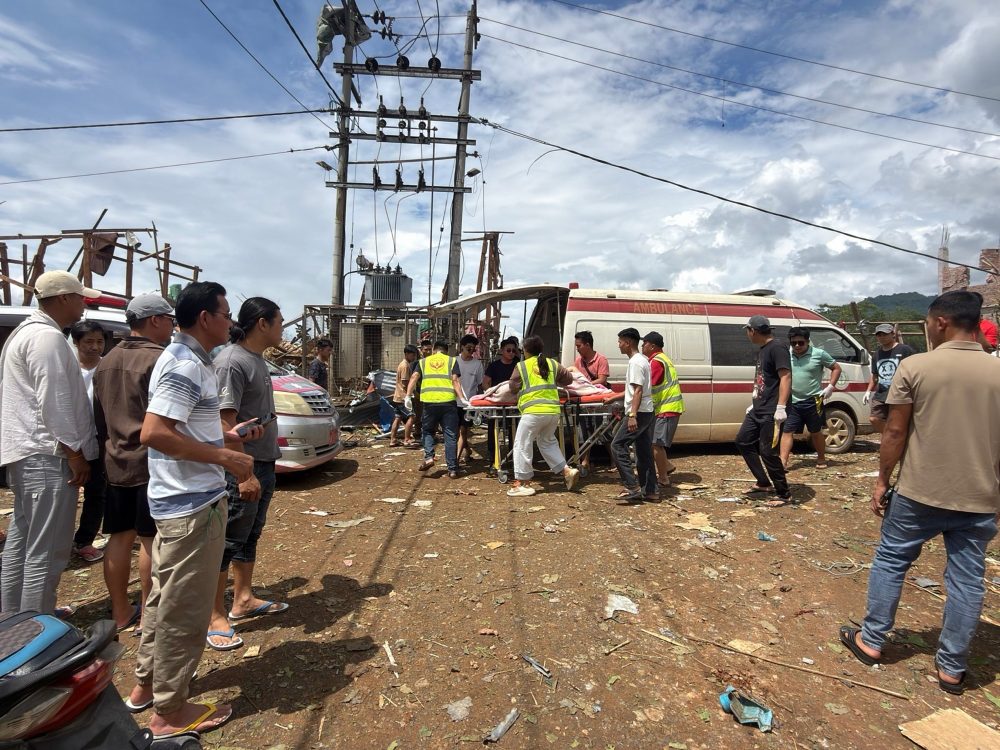

Emergency crews and charitable organizations worked with heavy machinery Monday to retrieve victims following a devastating explosion of stored mining explosives in northeastern Myanmar that claimed dozens of lives.
The deadly blast happened at noon on Sunday in Kaungtup village, located in Namhkam township within Shan state close to the Chinese border.
According to a Monday evening statement from the Ta’ang National Liberation Army, the ethnic rebel organization governing the region, fatalities from the explosion have climbed to 43, with seven of those victims being children. Earlier casualty reports from emergency responders had varied between 38 and 45 deaths. Confirming precise numbers has proven challenging due to the explosive force that dismembered victims’ remains.
The organization reported that 112 individuals sustained injuries, including 25 children, with 37 people in critical condition, sparking fears the death count may rise further.
“Rescue operations and the compilation of casualty figures were still underway,” said the statement.
Numerous resource-abundant regions of Myanmar, where mining activities operate with minimal oversight, fall under the authority of various armed groups engaged in periodic conflicts with the central government while pursuing increased independence. Fatal incidents, including catastrophic landslides, occur with notable frequency.
The TNLA reported that Sunday’s explosion involved gelignite utilized for local mining and stone quarrying operations. While gelignite sees widespread use, it becomes extremely dangerous when stored incorrectly over extended periods.
Village inhabitants from the community of 200 households stated they received no notification that explosive materials were being housed in their area.
The TNLA announced that an investigation into the explosion’s specific cause is currently in progress.
This tragedy has drawn attention to Myanmar’s profitable yet minimally regulated mineral sector and Chinese financial involvement in the nation’s resource extraction operations.
Two area residents informed The Associated Press on Monday that mining facilities producing silicon metal raw materials — an essential industrial component for semiconductors, solar panels, and aluminum alloys — operate in mountainous terrain approximately 15 kilometers southwest of Namhkam town.
The residents, speaking anonymously for personal security reasons, stated these mining operations are jointly managed by the TNLA and Chinese business interests and remain off-limits to most local people. The AP could not independently confirm these claims.
Myanmar’s mining sector serves as a significant global source of rare earth materials, copper, tin, and valuable gemstones, particularly jade and rubies, functioning as China’s primary supplier for materials that undergo processing and refinement there.
China maintains a complicated relationship as Myanmar’s military-backed government’s leading ally while simultaneously building connections with ethnic minority organizations.
Chinese Foreign Ministry spokesperson Lin Jian in Beijing offered profound sympathies and confirmed that a Chinese citizen hurt in the explosion is receiving medical care. Beijing has offered support for managing the incident’s consequences.
The TNLA, which belongs to the Three Brotherhood Alliance, gained control of the Namhkam region in late 2023 during a significant campaign against the military government. This fighting represents part of the wider chaos following the February 2021 military takeover, which removed Aung San Suu Kyi’s elected administration and sparked extensive armed opposition.
Although the TNLA agreed to a China-brokered ceasefire with the military in late 2023, regional stability remains fragile, and mineral and gemstone extraction provides essential revenue for both the central government and the rebel organizations opposing it.