
EDITOR’S NOTE: The following is a recount of events from June 6, 1989, when millions of Iranians gathered to mourn Ayatollah Ruhollah Khomeini, the driving force behind the 1979 Islamic Revolution. The situation spiraled out of control almost immediately. As Iran now prepares to lay Supreme Leader Ayatollah Ali Khamenei to rest, The Associated Press has released its original reporting and historic photographs from Khomeini’s funeral.
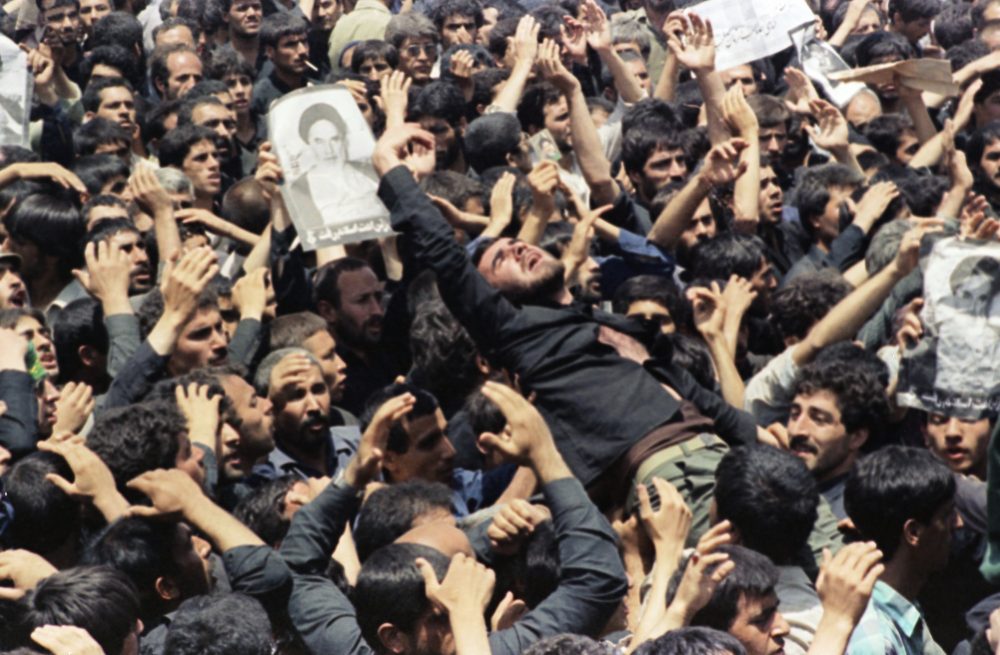
Mourners packed the sweltering streets of Tehran, rhythmically striking their heads and chests in grief, while the cries of women pierced through the deafening noise of the crowd. The scene turned dangerous when the massive throng surged toward the casket, causing the 86-year-old cleric’s white-shrouded body to spill out into the sea of people.
Early reports indicated the mayhem left at least eight people dead and approximately 11,000 others injured. Guinness World Records would later recognize the event as the largest share of any nation’s population ever to attend a funeral — an estimated 10.2 million people, representing roughly one-sixth of Iran’s entire population at the time.
By ALEX EFTY — TEHRAN, Iran (AP)
Countless mourners beating on their own heads and chests brought Ayatollah Ruhollah Khomeini’s funeral procession to a complete standstill, with scores of people — including Khomeini’s own son — being crushed in the overwhelming chaos.
The relentless crowd left authorities with no choice but to postpone the burial entirely.
The full toll of casualties — whether killed, injured, or simply overcome by the 91-degree heat — was not immediately known. At least eight people had already died and hundreds more were hurt the previous day, Monday, during a similarly massive outpouring of grief.
Security forces discharged weapons into the air in an attempt to push the crowds back, but the grieving masses refused to disperse, according to the official Islamic Republic News Agency.
Members of the Revolutionary Guards physically struck mourners on their hands to force them to release their grip on Khomeini’s coffin.
Khomeini’s only son, Ahmad, 43, was knocked to the ground in the dusty north Tehran square outside the Mosalla Mosque, where Khomeini’s body had been lying in state since Monday inside an air-conditioned, glass-enclosed bier. Ahmad Khomeini’s white turban fell from his head as he was lifted above the crowd and passed from person to person until he reached an ambulance waiting at the edge of the square. He appeared pale and sluggish, but remained conscious.
The hearse transporting the body became stranded in a vast ocean of black-clad mourners, completely unable to advance, IRNA reported.
Tehran television declared it was “impossible” to push through the grieving masses and complete the burial before sundown. Islamic tradition prohibits burying the dead after nightfall.
Khomeini had died the previous Saturday at the age of 86.
He was to have been laid to rest at the Baheshte Zahra cemetery, located 22 miles south of Tehran, alongside those who died during the Islamic revolution that brought him to power a decade earlier, as well as thousands who perished in the Iran-Iraq war.
Television broadcasters said alternative plans for the burial would be announced at a later time.
Cries of “Allah Akbar!” — God is Great — rang out across the city. Two hours into the procession, the hearse had barely traveled half a mile.
Many of Tehran’s 6 million residents came out to say their final farewell to Khomeini, while millions more traveled into the city from surrounding regions, according to official state media.
The procession got underway at 7 a.m., when Khomeini’s devoted Revolutionary Guards lifted his body down from the bier.
Five helicopters circled overhead as a military band performed solemn music below.
Khomeini’s body, draped in the Islamic republic’s flag, was placed on the ground in the open air while the white-bearded Ayatollah Mohammad-Reza Golpaygani led prayers. Golpaygani, one of only four senior ayatollahs remaining in Iran, frequently paused to compose himself, lifting his glasses to dry his eyes with a handkerchief.
Following the 30-minute ceremony, Khomeini’s body was placed inside a wooden coffin covered with a white cloth, then carried by the Revolutionary Guards from hand to hand into a white van.
The crowds wept uncontrollably. Recitations from the Koran blared from the mosque’s minaret as the masses cried out, “Farewell beloved imam!” and “Oh Khomeini, why have you left us?”
They struck their heads and chests with closed fists in the traditional Shiite Muslim expression of mourning.
Amid the disorder, women dressed head to toe in black chadors found themselves pressed against men — a breach of the Islamic prohibition on physical contact between women and men outside of marriage.
Firefighters turned their hoses on the crowd in an effort to cool people down.
Roughly 2 million frenzied mourners had maintained an all-night candlelit vigil around the bier.
Some in the crowd scratched their own faces until they bled and threw ashes over their clothing.
Khomeini had died of a heart attack 11 days after undergoing intestinal surgery, leaving the question of his successor unresolved. He left behind a 29-page political testament, excerpts of which were read on Tehran radio the previous Monday.
The portions made public contained no guidance on how Iran should be governed following his death, though such instructions may have been contained in sections not yet released.
President Ali Khamenei, 49, had been named caretaker leader on Sunday. A presidential election and a referendum on constitutional changes — which were expected to expand the president’s executive authority — were scheduled for August 18.
Khamenei’s rapid appointment was seen primarily as a move to fill the power vacuum created by political instability that had been building since February, when Khomeini called for the death of British novelist Salman Rushdie.
With no single figure capable of matching Khomeini’s combined religious and political stature, analysts believed Iran would likely be governed by a collective leadership going forward.
Khamenei had thrown his support behind Parliament Speaker Hashemi Rafsanjani, 55, a political ally and the only announced presidential candidate at the time.
Former Iranian President Abolhassen Bani-Sadr, speaking from exile in France, said Khamenei’s appointment represented a “total failure” by the government.
“Imagine a church that cannot find a pope. It is exactly the same, like a dynasty that cannot find a king. … It will not last,” he said.