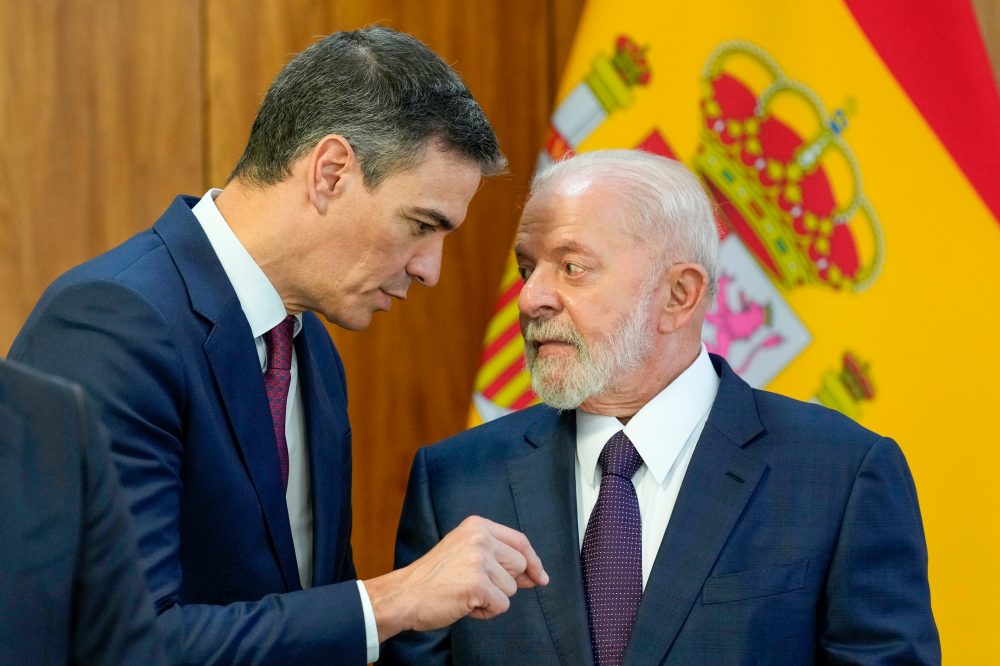

BARCELONA, Spain — Brazilian President Luiz Inácio Lula da Silva began a two-day diplomatic visit to Spain on Friday, where he and Spanish Prime Minister Pedro Sánchez will convene with fellow world leaders from predominantly smaller nations who share concerns about threats to democratic governance and the growing influence of far-right populist movements.
Both Lula and Sánchez have been vocal critics of U.S. President Donald Trump, who has issued threats of punitive tariffs against their nations. The two leaders are viewed as champions of progressive political movements in their regions, where conservative populist parties have gained momentum in recent years.
The Brazilian and Spanish leaders, accompanied by cabinet officials, gathered at a historic former royal palace in Barcelona on Friday to formalize agreements covering economic cooperation, technological partnerships, and social policy initiatives.
Friday’s bilateral discussions will set the stage for Saturday’s dual conferences at a major convention facility in Spain’s second-largest city, where Lula and Sánchez will host additional world leaders.
Saturday’s opening event marks the fourth Meeting in Defense of Democracy, an initiative established by Brazil and Spain in 2024 to create a platform for sharing strategies to counter what organizers describe as “extremism, polarization and misinformation” that weakens democratic participation. The forum’s initial sessions took place at United Nations headquarters, with last year’s gathering held in Santiago, Chile.
Despite both leaders’ public opposition to various Trump administration positions and policies, including military actions against Iran alongside Israel, Lula emphasized that the multilateral summit should not be viewed as anti-American.
“This is not going to going to be an anti-Trump meeting,” Lula stated in an interview with Spanish publication El País on Thursday. “We are going to discuss the state of democracy, to see what went wrong and what we have to do to repair it.”
This year’s democracy summit will feature European Council President Antonio Costa, Mexican President Claudia Sheinbaum, South African President Cyril Ramaphosa, Colombian President Gustavo Petro, and additional heads of state from nations including Uruguay, Lithuania, Ghana, and Albania.
Sheinbaum’s attendance follows the resolution of a diplomatic tension between Spain and Mexico after King Felipe VI recently recognized that Spain’s colonial conquest of the Americas resulted in “abuse” of indigenous populations.
As Latin America experiences a conservative political shift and increased pressure from the Trump administration, Sheinbaum has emerged as a prominent leftist leader in the region. She maintains high approval ratings in Mexico while successfully balancing diplomatic relations with Trump and defending Latin American independence on critical issues.
Many participants from the democracy meeting will remain for the first-ever Global Progressive Mobilization, taking place at the same location later Saturday. This gathering of left-leaning politicians and policy experts originated from discussions between Sánchez and former Swedish Prime Minister Stefan Löfven, now head of the Party of European Socialists, during a European Socialist meeting last year.
Both Sánchez and Lula will deliver keynote addresses at the progressive mobilization, which anticipates 3,000 participants, including U.S. Democratic Senator Chris Murphy. The program will include panel discussions on topics ranging from income inequality to strategies for improving electoral outcomes for progressive candidates.
The Barcelona meetings occur during an eventful period for Sánchez, who recently returned from his fourth visit to Beijing in three years for discussions with Chinese President Xi Jinping.
Sánchez’s administration has prohibited U.S. aircraft involved in the Iran conflict from using Spanish airspace and blocked American access to jointly operated military installations in southern Spain for Iran-related operations.
Earlier this week, Lula issued a video statement expressing “deep solidarity” with Pope Leo XIV after Trump publicly criticized the pontiff for condemning the Iran war.
Pol Morillas, who directs the Barcelona-based international affairs research institute CIDOB, explained that these gatherings represent an effort by established democratic leaders to demonstrate strength in response to the far-right populist movement’s successful promotion of anti-immigration and economic nationalist messages through international forums.
Morillas also connects the meetings to Canadian Prime Minister Mark Carney’s influential January speech at the Davos economic forum, which emphasized the need for “middle powers” to develop new approaches for navigating a world dominated by aggressive superpowers.
Lula, Sánchez, and other attending leaders “share the understanding that the world is not just for the great powers,” Morillas explained to The Associated Press.